The Funeral Home Said Embalming Is "Required." Your Mother's Power of Attorney Just Became Worthless. The Co-op Board Won't Release the Apartment. And You Have No Idea Who Legally Controls the Body.
Someone just died in New York, and you are the person making decisions. You called a funeral home and they quoted you a "complete service package" for $9,500. You asked what that included. The answer was a wall of line items — basic services fee, transfer of remains, preparation, use of facilities for viewing, automotive equipment — bundled together with no indication of what is required by law and what is pure profit margin. You asked if embalming is mandatory. "It's standard for a viewing," they said. You asked about cremation, and they told you someone needs to sign an authorization form — but your sister wants cremation and your brother insists on burial, and neither is backing down.
Meanwhile, you just discovered something nobody warned you about: the Power of Attorney that your mother signed three years ago — the one your sister used to manage all the bank accounts — died the moment your mother did. Every account is frozen. The funeral home wants a deposit. You cannot get to a dollar of her money until the Surrogate's Court issues Letters Testamentary, and that takes weeks. And if there is a co-op apartment involved, the transfer cannot happen until the Tax Department releases Form ET-117 — which takes another 4 to 6 weeks while monthly maintenance charges keep accruing.
The New York Funeral Laws & Consumer Rights Guide is a Statutory Defense System for every decision, deadline, and financial trap in a New York death — from the moment the body needs to be moved through disposition, estate administration, and the tax filings that most families discover too late. Not a sympathy resource. Not a blog post written by a funeral home to funnel you into their packages. A plain-English, statute-by-statute guide to the most regulated, most expensive, and most legally punishing state in the country for funeral and estate matters.
What's Inside the Statutory Defense System
A 12-chapter guide with 2 appendices, a consumer rights checklist, and the New York-specific statutes you need — covering every legal, financial, and procedural question families face when someone dies in the State of New York:
Chapter 1: Who Controls the Body — Your Single Most Important Right
Before you call a funeral home, before you argue with your siblings, before anyone signs anything — you need to know who the law says is in charge. New York Public Health Law § 4201 establishes a strict hierarchy: a designated agent named on Form DOH-5211 supersedes everyone, including a surviving spouse, adult children, the will, and any power of attorney. The guide covers the full statutory ladder, the Appointment of Agent form that overrides the entire hierarchy, the dispute trap that freezes the funeral home when co-equal relatives disagree, and the real-world consequences of not having this form on file.
Chapter 2: The First 72 Hours — Immediate Actions
The step-by-step sequence when a death has just occurred. Search for a DOH-5211. Determine whether the Medical Examiner has jurisdiction. Demand the General Price List from the funeral home before discussing any services. Confirm who legally controls disposition under PHL § 4201. Know your deadline: in New York City, remains must be buried, cremated, or moved within 4 days. For an unembalmed, unrefrigerated home funeral, 3 days. The guide gives you the exact order of operations so nothing falls through the cracks while you are making decisions under pressure.
Chapter 3: Death Registration, Permits, and Transporting Remains
New York requires a licensed funeral director to file the death certificate — this is non-negotiable and is the reason you cannot have a fully independent home funeral in this state. The guide covers the electronic death registration system, how the medical certification and administrative filing work, the NYC-specific delays (6 to 8 weeks for certified copies from DOHMH/VitalChek), how many copies to order (5 to 10), the cost structure ($15 each in NYC plus the $9.30 online fee vs. approximately $10 through local registrars upstate), and the transit permit requirements for moving remains within and out of state.
Chapter 4: Cremation in New York
Cremation authorization in New York requires the person with the legal right of sepulcher to sign — the decedent cannot pre-authorize their own cremation in a way that binds the funeral home. The guide covers who must sign, the pacemaker/implant disclosure requirement, the combustible container rule (a simple fiberboard box is legally sufficient — no casket required), the funeral director's mandatory presence at the crematory, and the chain-of-custody documentation the crematory must maintain. It also covers what to do when one family member objects to cremation.
Chapter 5: Disposition Options — Burial, Home Funerals, Green Burial, and the Alternatives
New York offers more disposition options than most families realize — and restricts more than most families expect. The guide covers traditional burial (cemetery rules vs. state law on vaults), home funerals (legal but a licensed funeral director must still file the death certificate and supervise transport), green and natural burial (no embalming, no vault — but finding a compliant cemetery requires homework), scattering ashes (private land requires owner's permission, NYC parks allow it with conditions, ocean scattering requires EPA notification), natural organic reduction (human composting — legalized in December 2022, but no in-state facility yet), and alkaline hydrolysis (not legal in New York as of 2026 — a red flag if any provider offers it).
Chapter 6: The FTC Funeral Rule and Your Money Rights
The Federal Trade Commission Funeral Rule is the strongest consumer protection most families have never heard of. Every funeral home must provide an itemized General Price List on request. Every funeral home must give accurate prices over the phone without requiring your name. Every funeral home must accept a casket purchased from a third party — online, from a warehouse store, from an independent dealer — without charging a handling fee. Embalming requires explicit authorization. Bundled packages that force you to buy services you do not want are prohibited. The guide covers every provision, gives you a compliance checklist for the meeting, and tells you exactly what to say when the funeral director presents embalming as "standard" or a casket as "required for cremation."
Chapter 7: Preneed Funeral Contracts (GBL § 453)
If someone prepaid for a funeral, the family often assumes everything is covered. It usually is not — and the legal structure of the contract determines whether those funds are protected from Medicaid or exposed to recovery. New York General Business Law § 453 requires 100% of preneed funds to be deposited in an interest-bearing trust. The guide covers the critical difference between revocable contracts (fully refundable but counted as a Medicaid resource) and irrevocable contracts (not refundable but sheltered from Medicaid look-back), the portability rules, the penalties for early termination, and the red flags that indicate a funeral home is not complying with the trust requirements.
Chapter 8: Estate Administration — Getting Access to Accounts and Property
The moment someone dies in New York, their Power of Attorney becomes void. Bank accounts freeze. Bills keep arriving. The funeral needs to be paid for. The guide covers New York's three estate paths: Voluntary Administration (for sole-name personal property of $50,000 or less — costs $1.00 at Surrogate's Court), Letters of Administration (intestate estates), and full probate with Letters Testamentary. It covers the EPTL § 5-3.1 exempt property set that a surviving spouse or minor children can claim immediately — up to $25,000 in cash, one vehicle worth up to $25,000, and $20,000+ in household goods — all of which bypass probate and are shielded from creditors.
Chapter 9: Co-op Apartments and the Estate Tax Lien (ET-117)
If the decedent owned a New York City co-op, you face a problem that exists almost nowhere else in the country. Co-ops are not real property — they are shares in a corporation plus a proprietary lease. The co-op board will not process any transfer without ancillary letters from Surrogate's Court, even if the primary estate is being probated in another state. And no real estate or co-op can be sold or transferred until the Tax Department releases Form ET-117 — which takes 4 to 6 weeks while monthly maintenance charges keep accruing. The guide covers the filing sequence, the documents the board will demand, and how to minimize the financial damage during the waiting period.
Chapter 10: The New York Estate Tax Cliff
New York has the most punishing estate tax structure in the country for families who cross the wrong line. The exclusion in 2026 is $7.35 million — but if the estate exceeds 105% of that amount ($7,717,500), the exclusion disappears entirely and the estate is taxed from the first dollar at rates up to 16%. A family that owns a Brooklyn brownstone, a retirement account, and a life insurance policy can cross this threshold without realizing it. The guide covers Form ET-706, the 9-month filing deadline, and the "Santa Clause" — the nickname estate attorneys give the cliff because of how it arrives without warning and takes everything.
Chapter 11: Medicaid Estate Recovery (MERP)
If the decedent received Medicaid-funded long-term care, New York may seek to recover those costs from the estate. The critical fact most families miss: New York recovers only from the probate estate. Non-probate assets — POD accounts, joint tenancy with survivorship, life-estate deeds, irrevocable trusts, and life insurance — bypass recovery entirely. Recovery is also fully barred if a surviving spouse, a disabled child, or a child under 21 survives. The guide covers the look-back rules, the irrevocable preneed trust strategy, the hardship waiver, and the evolving 30-month Community Medicaid look-back.
Chapter 12: When to Call a Professional (and Who)
Not everything in this guide is DIY territory. The guide tells you exactly which situations require an elder law attorney (contested disposition, irrevocable trust structuring, Medicaid crisis planning), which require a CPA (estates approaching the tax cliff, ET-706 filing), and which you can handle yourself with the information in these pages. The goal is to make you an informed, efficient client who walks into the professional's office knowing exactly what to ask — saving hundreds of dollars in billable hours.
Who This Guide Is For
- The family member who just got a funeral home quote that feels wrong — who needs to know which charges are legally required, which are optional, and which may violate federal consumer protection law. The guide gives you a line-by-line framework for evaluating any General Price List in New York.
- The person trying to arrange a cremation when siblings disagree — who needs to know the PHL § 4201 hierarchy, the DOH-5211 form, and what happens legally when co-equal relatives cannot agree on disposition. The guide maps every scenario.
- The out-of-state relative who just discovered the co-op problem — who has been told the apartment cannot be transferred without ancillary Surrogate's Court letters and a Tax Department lien release, and needs a procedural roadmap to navigate the delays.
- The person who just learned that the Power of Attorney is worthless — who cannot access the decedent's bank accounts and needs to understand Voluntary Administration, Letters Testamentary, and the exempt property claim that may release cash immediately.
- The family that wants a green burial, human composting, or a home funeral — who needs to know exactly what is legal in New York (green burial: yes; human composting: legal but no in-state facility; home funeral: legal but a funeral director must still be involved; alkaline hydrolysis: not legal).
- The caregiver planning ahead for an aging parent — who needs to understand the DOH-5211 form, the irrevocable preneed trust strategy for Medicaid protection, and the estate tax cliff that catches families who think they are below the threshold.
Why Free Resources Will Not Protect You in New York
Funeral consumer information exists. It is scattered across the NYS Department of Health in regulatory language, the Surrogate's Court in procedural jargon, the City Bar Justice Center in lengthy legal PDFs, the Funeral Consumers Alliance in regional chapter sub-sites, and funeral home blogs written to generate leads. Here is what you actually encounter when you try to protect yourself using free sources:
- The Department of Health pages tell you the rules. They do not tell you how to use them. You can find that embalming is not required and that PHL § 4201 governs disposition. But the DOH website does not tell you what to say to a funeral director who insists embalming is "standard for a viewing," how to read a General Price List, what the non-declinable basic services fee actually covers, or what to do when your brother claims authority you do not believe he has.
- The City Bar Justice Center publishes excellent free guides — for a different audience. Their "Guide to Funeral and Burial Options in New York" is thorough and well-written. It is also 40+ pages of academic legal prose focused heavily on New York City low-income planning. It does not cover co-op transfers, the estate tax cliff, Medicaid preneed trusts, or upstate county variations in death certificate processing.
- Funeral home blogs are accurate, detailed, and written by the people selling you services. Every funeral home in Manhattan, Brooklyn, and Long Island publishes educational content. All of it steers you toward their packages, memberships, and preneed contracts — never toward direct cremation providers who charge half the price, third-party casket vendors, or the FTC rules that limit what the home can charge.
- An attorney solves the problem but costs more than the funeral. A New York elder law attorney or estate attorney can resolve a disposition dispute, challenge a co-op board, or file ET-706. The consultation starts at $300 to $500 per hour. For questions like "Do I have to pay for embalming?" or "Can my sister override my decision?" or "What is the $1 Voluntary Administration path?" — an attorney retainer is the most expensive possible way to get a yes-or-no answer.
Free resources give you fragments written by different agencies for different purposes, with no sequencing, no statute references you can cite, and no advocacy for the consumer. The Statutory Defense System puts every New York funeral law, every FTC protection, every estate administration path, and every tax deadline into one document — organized by the decisions you actually face, in the order you face them.
— Less Than One Hour of Surrogate's Court Attorney Fees
The average New York funeral costs $8,500 to $13,000. Families who choose direct cremation from a low-overhead provider pay $1,000 to $2,500 — a difference of $6,000 to $10,000 driven almost entirely by charges that are optional, not required. An embalming you did not authorize: $500 to $1,000. A casket for a cremation that legally requires only a fiberboard container: $2,000 to $7,000. A burial vault the state does not mandate: $1,000 to $3,500. And that does not count the $3,000 to $5,000 in maintenance charges that pile up while the co-op transfer stalls in Surrogate's Court. This guide costs less than any single one of those line items and tells you which ones you can refuse.
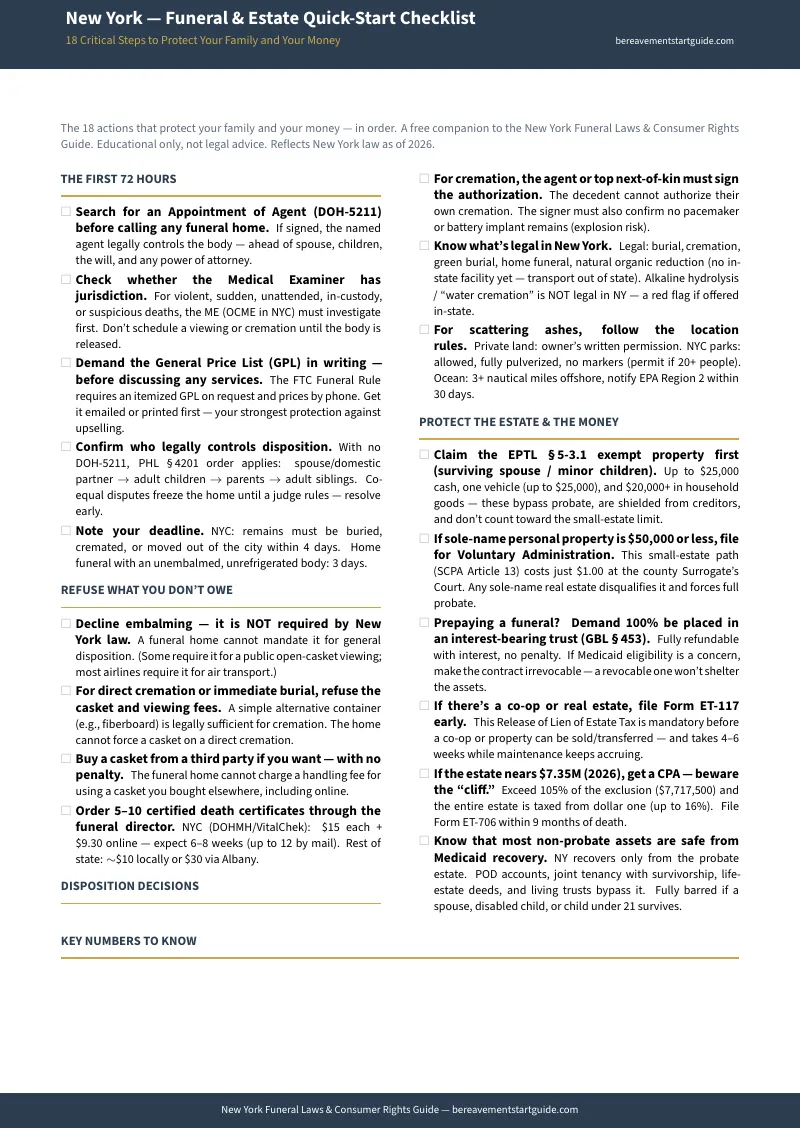
Your download includes the complete 12-chapter guide with 2 appendices, the New York Funeral & Estate Quick-Start Checklist (an 18-item printable reference), and 5 standalone printable tools you can bring to meetings and pin to the fridge:
- Funeral Home Meeting Prep Sheet — FTC Funeral Rule compliance framework, GPL checklist, and scripts for declining unauthorized charges
- Disposition Authority Reference — the full PHL § 4201 hierarchy, DOH-5211 requirements, and the dispute trap explained on one page
- Disposition Options Comparison — side-by-side chart of every legal disposition method in New York with key constraints
- Estate Administration Roadmap — the three paths to accessing accounts and property (including the $1 Voluntary Administration), EPTL exempt property claims, and the co-op transfer sequence
- Forms & Contacts Quick Reference — every official form and agency contact you need, with phone numbers and filing checklists
Print the checklist and bring it to the funeral home meeting.
30-day money-back guarantee. If the guide does not give you clarity on your rights, your options, and the specific New York laws that protect you — email us for a full refund. No questions asked.
Not ready for the full guide? Download the free New York Funeral Consumer Rights Checklist — a summary of the key rights, deadlines, and cost-saving steps that most families do not learn about until it is too late. Enough to walk into a funeral home meeting knowing what you can refuse.
You did not choose this situation. But you can choose to walk into it with the actual laws, the actual numbers, and the actual leverage — so the funeral home meeting is a negotiation, not a surrender, and the estate settlement does not cost your family more than it has to.