The hospital report is in Spanish. The bank accounts are frozen. The state funeral home is the only option. And you have 72 hours before Cuba buries the body without your consent.
When someone dies in Cuba, the system does not slow down because you do not speak Spanish. The death must be registered at the Civil Registry. The police report and forensic autopsy happen whether you are ready or not. The bank freezes every individual account the moment it learns of the death. And Cuban public health policy enforces something that blindsides English-speaking families: if an unembalmed body is not buried within 72 hours, the state takes over — transferring remains to cold storage or burying them at public expense, potentially eliminating your repatriation options before you even land in Havana.
Meanwhile, every funeral home is state-run. Every notary is a government employee. Every document legalization goes through a single agency — Consultoría Jurídica Internacional — with backlogs of three to eight months. And the free embassy resources that exist online? They tell you what needs to happen. They cannot tell you how to actually make it happen inside a system designed entirely in Spanish, with no private alternatives.
The Cuba Death Administration Roadmap — every deadline, every agency, every Spanish term explained, in the order things actually happen
The Someone Died in Cuba: English Speaker's Emergency Guide is a chronological roadmap built for the specific situation of navigating Cuban death bureaucracy without fluent Spanish. It follows the actual sequence — not alphabetical topics, not a glossary, but the order in which Cuban hospitals, police, state funeral services, banks, and notaries expect you to act.
Every Spanish legal term appears with its English translation the first time it is used. Every deadline is flagged with its legal basis. Every state agency is identified by its official name and function. And every step tells you whether you can handle it yourself or whether this is the precise moment you need CJI, a state notary, or a consular officer.
What's inside
- First 24 hours protocol — who to call in what order, how to navigate the hospital and police notification process, what documents to have ready, and the critical difference between the medical certificate and the civil death certificate that determines everything downstream
- 72-hour burial deadline management — how the unembalmed burial window works, how to extend it through state embalming services, what happens if the deadline passes, and the progressive mortuary storage fees at the Institute of Legal Medicine (free for 3 days, then 1,200 CUP/day through day 15, 600 CUP/day through day 53)
- Death certificate and document chain — how to request records from the Civil Registry, the tomo/folio/office details that CJI requires, the nine-document chain for repatriation, and the legalization and apostille sequence through CJI and MINREX
- Bank account freeze mechanics — how Cuban state banks handle individual accounts after death, the three probate thresholds (up to 1,000 CUP via joint-heir affidavit, up to 5,000 CUP via beneficiary payout, above 5,000 CUP via formal Declaration of Heirs), and the step-by-step paperwork for each tier
- Repatriation logistics — embalming through state funeral services, hermetically sealed casket requirements, ASISTUR coordination for insured travelers, embassy clearances, charter flight options, and the complete cost breakdown for returning remains to the US, Canada, or the UK
- Local burial and cremation — cemetery regulations, the documentation difference between burial and cremation, and the full cost comparison to help families make an informed decision under time pressure
- Embassy and consular coordination — what your embassy can and cannot do (they confirm identity and issue Consular Reports of Death Abroad — they do not pay costs, provide legal representation, or manage estate distribution), and the exact support available from the US, Canadian, and UK missions in Havana
- Property and inheritance — real estate transfer taxes (4% of municipal value), the power of attorney process for heirs abroad, non-resident income tax (flat 15%), and the ONAT obligations that catch foreign heirs who inherit rental properties
- CJI document legalization guide — the fee schedule, realistic processing timelines, tracking strategies, and the difference between retrieval (405 CUP from within Cuba) and abroad requests (125 CUP in stamps) that determines your cost and timeline
- Travel insurance and ASISTUR — how to file claims, what mandatory Cuban travel insurance covers, common exclusions (pre-existing conditions, travelers over 70), and how to coordinate with ASISTUR for emergency repatriation
Plus 8 standalone printable worksheets — document-tracker.pdf, timeline-planner.pdf, cost-comparison.pdf, agency-contacts.pdf, asset-inventory.pdf, bilingual-scripts.pdf, bank-notification.pdf, and communication-log.pdf — each designed to be printed and used at the Civil Registry, at the bank, or at the state notary.
Who this is for
- Family members abroad who just received a call from a Cuban hospital, police station, or embassy — and need to know what to do tonight, not after a week of research
- Expats and long-term residents in Cuba whose spouse, parent, or family member has just died — and who need the administrative sequence in English
- Non-resident heirs managing a Cuban estate from abroad — dealing with frozen bank accounts, property transfers, and state notaries in a language they do not speak
- Travel insurance adjusters and corporate travel managers coordinating emergency repatriation — who need structured checklists and verified fee schedules
- Anticipatory planners with an elderly parent or ill family member in Cuba — preparing now so they are not blindsided by the 72-hour rule later
Why not just use the free resources?
The US Embassy in Havana publishes a consular fact sheet. The UK FCDO has a guidance page last updated in 2023. Global Affairs Canada covers the basics. All three are reliable — and all three are legally restricted from providing the practical help families actually need: navigating bank freezes, managing property transfers, working with CJI on document legalization, or dealing with state notaries who operate exclusively in Spanish.
Expat forums have peer advice and personal stories — most of it undated, unverified, and reflecting policies that may have changed. And the one professional agency that handles Cuban document legalization from abroad — CJI — charges hundreds of dollars per document and operates with backlogs measured in months.
No single free source covers the full sequence from death to estate settlement in English, with current fees and timelines, in the order things happen. This guide does.
The cost of getting it wrong
- Missing the 72-hour embalming window and losing the option to repatriate remains entirely
- Paying progressive mortuary storage fees — a 30-day delay costs 23,400 CUP — because a single missing document held up the legalization
- Having CJI reject your document request because the tomo and folio details were missing — adding months to an already slow process
- Discovering that bank accounts above 5,000 CUP require a formal Declaration of Heirs — a process that takes months through state notaries — after you have already spent weeks trying to access funds
- Assuming your embassy will manage everything — then learning that consular services do not extend to paying funeral costs, filing estate paperwork, or representing you in Cuban courts
- Inheriting a Cuban rental property and triggering a 15% non-resident income tax obligation you did not know existed
Satisfaction guarantee
If the guide does not give you a clear path through Cuban death administration, email us for a full refund. No questions, no forms. You are dealing with enough bureaucracy already.
Get the free checklist or the full guide
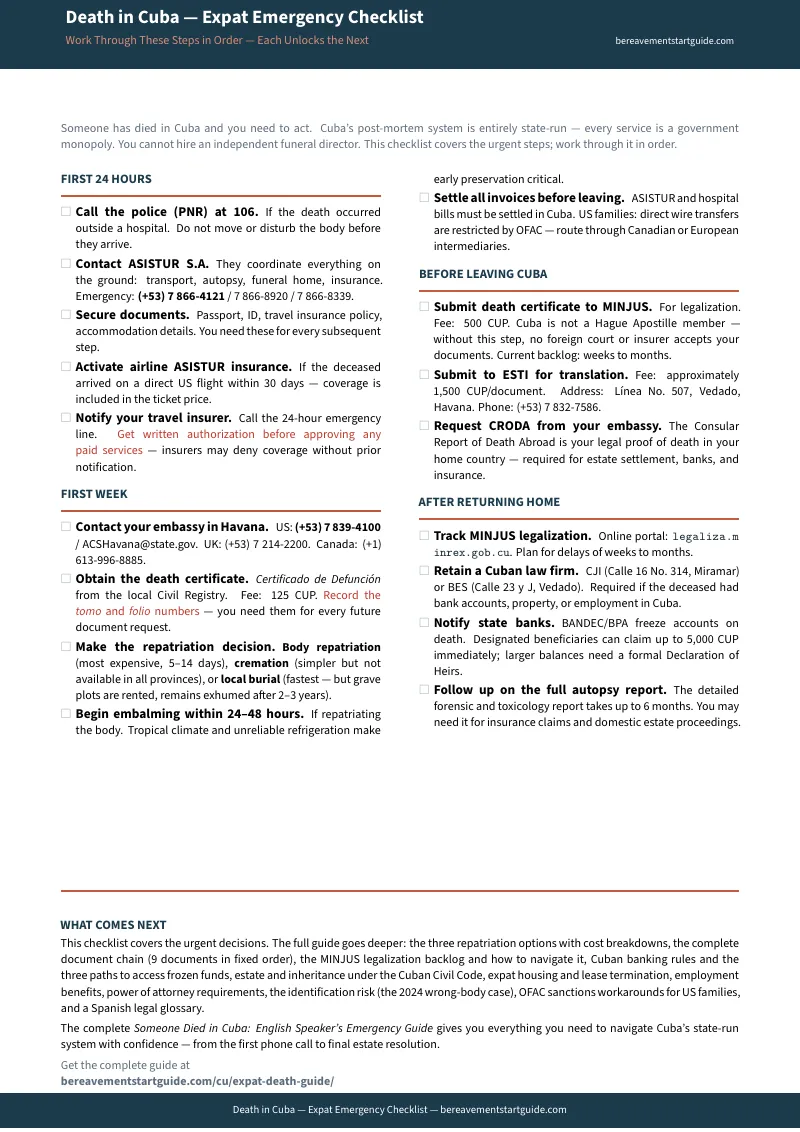
The free Emergency Checklist gives you the critical first steps — who to call, what documents to gather, and the key deadlines including the 72-hour burial rule. It is the right starting point if you need to act tonight.
The full guide covers the complete process from death to estate settlement — the 72-hour deadline, bank freezes, CJI legalization, repatriation logistics, property inheritance, and tax obligations — plus 8 standalone printable worksheets you can use at every stage. For , it replaces hours of fragmented research and potentially thousands of dollars in avoidable delays and professional fees.
Frequently Asked Questions
What if the rules change after I buy?
We update the guide when the rules change. Email us any time, even years later, and we'll send you the current edition free.