The Call That Changes Everything
Your wife collapsed in a Bali hotel room. Your father died in a traffic accident on a Jakarta highway. Your brother drowned off Lombok. Within hours, you are coordinating with Indonesian police who speak no English, a hospital mortuary demanding payment before they release any paperwork, and a funeral director quoting you SGD 10,000 for repatriation before you have even confirmed how the death happened.
You call the Singapore Embassy expecting them to take charge. They give you a list of funeral directors and tell you they cannot investigate the death, cannot translate documents, cannot pay for anything, and cannot act as your legal representative. You are on your own — managing a crisis that spans two sovereign governments from a hotel room in Indonesia, or worse, from your flat in Singapore with no way to physically verify what is happening on the ground.
The information you need exists. It is scattered across MFA advisory pages, Disdukcapil civil registry rules, Kemenkumham Apostille portal instructions, NEA coffin import regulations, CPF Board withdrawal forms, and Family Justice Court probate requirements. Piecing it together while grieving takes 40+ hours of research across two jurisdictions. One missing Apostille — one skipped step in the Kemenkumham authentication — means hiring an agent in Jakarta to process documents retroactively while you wait months for frozen bank accounts to unfreeze.
The Two-Country Crisis Roadmap
This guide sequences every step of the Singapore-Indonesia death corridor into one chronological manual — from the first phone call to the Indonesian hospital through CPF claims, probate filings, and insurance settlements months later. It is built around the specific regulatory realities that most families discover too late: Indonesia's decentralised civil registry means the death certificate process varies by regency, the Hague Apostille shift in 2022 made most online advice dangerously outdated, and Indonesian probate grants cannot be resealed in Singapore because Indonesia is not a Commonwealth jurisdiction.
Those three facts — decentralised registration, the Apostille shift, and the non-Commonwealth probate trap — drive most of the cost, delay, and heartbreak in this corridor. The guide maps each trap before you walk into it, along with dozens of others that no funeral director or government website will volunteer.
The Disdukcapil Two-Step
When a foreigner dies in an Indonesian hospital, the attending doctor issues a preliminary medical statement — the Surat Keterangan Kematian. Families routinely mistake this for the legal death certificate and leave the country. It is not. The legal death certificate — the Akta Kematian — must be separately obtained from the local regency-level civil registry office (Disdukcapil), using the hospital note plus the deceased's passport, visa documents, and witness identification. Leaving Indonesia without the Akta Kematian is the single most expensive mistake in this corridor. The guide walks you through both steps, including what happens when the death occurs in a remote area far from the nearest Disdukcapil office.
The Kemenkumham Apostille (Not the Embassy)
Before June 2022, families had to get Indonesian documents authenticated through a multi-step embassy legalisation chain. Indonesia's accession to the Hague Apostille Convention changed everything. Today, the Indonesian Ministry of Law and Human Rights (Kemenkumham) issues Apostilles directly through an online portal at apostille.ahu.go.id. The Singapore Academy of Law accepts these Apostilled documents immediately — no embassy involvement needed. But the internet is still saturated with pre-2022 advice directing families to embassies for traditional legalisation. Following outdated instructions wastes days and thousands of dollars. The guide provides the exact, current Kemenkumham workflow.
The Non-Commonwealth Probate Trap
When a person dies with assets in Singapore and has obtained a Grant of Probate in an overseas court, Singapore law allows the Family Justice Courts to "reseal" the foreign grant — but only for grants from gazetted Commonwealth jurisdictions. Indonesia is not a Commonwealth country. Resealing an Indonesian grant is legally impossible. To unlock the deceased's Singapore bank accounts, CPF, and insurance policies, the executor must apply for an entirely fresh Grant of Probate through the Singapore Family Justice Courts. This requires an Affidavit of Foreign Law sworn by a lawyer admitted to practice in Indonesia, plus the original Apostilled and translated Akta Kematian. Legal fees typically run S$3,000 to S$8,000, and the process takes months. The guide explains exactly when this applies and the documents needed to start.
What You Get
- The Complete Emergency Guide — 15 chapters covering crisis stabilisation, the Disdukcapil two-step registration, the Kemenkumham Apostille workflow, repatriation logistics (air from Jakarta/Bali and ferry from Batam/Bintan), local cremation and burial options, document translation requirements, ICA overseas death reporting, insurance claims, bank account unfreezing, CPF claims, the non-Commonwealth probate process, and the common mistakes that cost families thousands
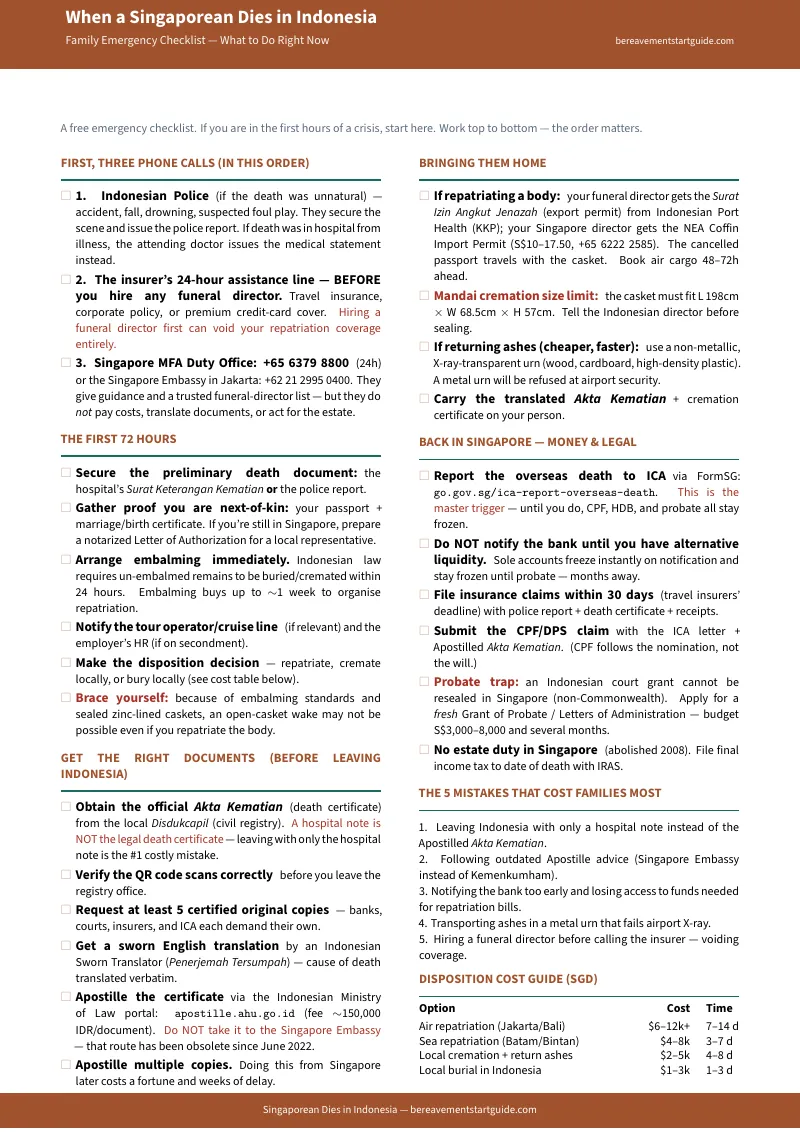
- Emergency Checklist — 18 action items across four time phases (first 72 hours, first week, first month, first 6 months) so nothing falls through the cracks
- Apostille Workflow Flowchart — the exact path from hospital medical statement to Singapore-accepted Apostilled document, step by step through Disdukcapil and Kemenkumham
- Repatriation Cost Comparison — air cargo from Jakarta/Bali vs. ferry from Batam/Bintan vs. local cremation, with regulatory requirements, document checklists, and realistic cost ranges for each route
- Funeral Director Evaluation Sheet — a vendor comparison checklist covering embalming standards, sealing certificates, casket dimensions, airway bills, and pricing transparency to prevent upselling
- Coffin Dimensions Quick Reference — NEA cremation and burial size limits for Mandai Crematorium (198cm x 68.5cm x 57cm), plus a casket compliance check to run before approving any purchase in Indonesia
- ICA FormSG Reporting Walkthrough — how to register the overseas death to unlock CPF, banking, and probate proceedings
- CPF Claims Decision Tree — the exact process based on citizenship, residency status, and nomination status, including the Intestate Succession Act override for unnominated funds
- Insurance Claims Checklist — the documents MSIG, Chubb, and NTUC Income require, common exclusions, and the strict 30-day filing deadline
- Situation-by-Situation Triggers — separate workflows for tourist accidents, expatriate deaths, worker fatalities, medical tourism deaths, and remote-island scenarios where domestic transport precedes international repatriation
Who This Is For
- Families in Singapore right now dealing with a death in Indonesia — whether it happened in Bali, Jakarta, Batam, or a remote island — who need a clear sequence of steps before making any expensive decisions
- Next-of-kin coordinating remotely from Singapore, trying to manage Indonesian funeral directors, police, and hospital bureaucracies without being physically present
- Families facing repatriation decisions who need to compare air cargo from Jakarta/Bali (SGD 6,000–12,000+), ferry from Batam/Bintan (SGD 4,000–8,000), and local cremation (SGD 2,000–5,000) with the regulatory requirements for each
- Executors and administrators who need to navigate the non-Commonwealth probate trap, frozen bank accounts, and CPF withdrawal procedures after the funeral
- Employers and HR departments managing the death of a Singaporean employee on secondment in Indonesia, or handling Work Permit holder repatriation obligations under MOM regulations
- Pre-planners with family members living, working, or retiring in Indonesia who want to understand the process before a crisis hits
Why Free Information Falls Short
The MFA website tells you it will notify next-of-kin and provide a list of undertakers. It does not explain the Disdukcapil two-step, the Kemenkumham Apostille portal, or the non-Commonwealth probate trap. Funeral director websites explain their repatriation packages but not the six months of estate unwinding that follows. Expat forums share anecdotes about carrying ashes through customs — many of which describe pre-2022 embassy procedures that are now completely obsolete.
The problem is not that the information does not exist. The problem is that it is split across MFA, Disdukcapil, Kemenkumham, NEA, CPF Board, ICA, and the Family Justice Courts — in two languages, across two legal systems, with no single source connecting the dots in the order you actually need them. A single outdated forum post about embassy legalisation can cost you weeks and thousands of dollars.
— Less Than One Night's Mortuary Storage
A single administrative mistake in this corridor — leaving Indonesia without the Apostilled Akta Kematian, following outdated embassy advice, buying an oversized casket that does not fit Mandai's cremation chamber — costs hundreds to thousands of dollars to fix. If the guide prevents one rejected document, one unnecessary return trip to Jakarta, or one wasted week waiting for retroactive Apostille processing, it has paid for itself before you finish the first chapter.
Every purchase includes a money-back guarantee, no time limit. If the guide does not give you the clarity and structure you need to navigate this crisis, email us for a full refund.
The free Emergency Checklist covers the 18 most critical actions across four time phases — the ones with hard deadlines and immediate financial consequences. The full guide covers every chapter in depth: the Disdukcapil registration process, the Kemenkumham Apostille workflow, repatriation logistics by route, situation-specific triggers, the non-Commonwealth probate process, CPF and insurance claim walkthroughs, and the detailed timeline that keeps two bureaucracies moving in sync.