
You Held Everything Together for Months. Now the Caregiving Is Over — and Everyone Expects You to Run an Estate on an Empty Tank.
You were the caregiver. The one managing the medication schedule, the hospice calls, the 3 a.m. repositioning. Your body ran on adrenaline for months, and now — days after the funeral — the funeral home wants decisions, the bank wants a death certificate, the insurance company wants forms, and your employer wants to know when you're coming back.
And underneath the paperwork, something nobody warned you about: you feel relief that the vigil is over, and the relief is immediately followed by guilt so sharp it takes your breath away. You close your eyes and see the bedside, not the person. You can't read a two-page insurance letter without losing your place. You are not broken — this is what post-caregiving collapse looks like, and it has a clinical name and a neurological explanation.
Here's the problem with every resource you've been handed: the hospice leaflet covers the first two hours and stops. The government checklist assumes a rested mind and uses bureaucratic language. The law firm's "free guide" is a funnel for a $3,000 retainer. None of them were written for someone who is simultaneously grieving, decompressing from months of caregiving, and legally responsible for an estate.
After a Long Terminal Illness is a Compassionate Triage and Executor Toolkit — an external brain for the weeks when yours isn't working. Not a grief memoir. Not a legal textbook. A chronological system that holds the sequence, the deadlines, and the exact words to say, so you can copy, paste, and check things off in fifteen-minute sessions — because that may be all the executive function you have right now.
What's Inside the Toolkit
Eleven chapters plus a complete template toolkit, ordered by when you'll actually need each one:
The First Hours — Who to Call, and Who Not to Call
The single most expensive mistake after a hospice death is calling 911 instead of the hospice nurse line — triggering a police and coroner response during what should be a peaceful expected death at home. The toolkit gives you the exact call sequence with word-for-word phone scripts, so you don't improvise in the most disoriented hour of your life.
The Death Certificate Deep-Dive — the Document Everything Depends On
One misspelled middle name or wrong Social Security digit can freeze probate and stall insurance claims for months. The toolkit shows you how to verify every field before you accept the certificate, how to count your real institutional exposure (each bank account, policy, and property title needs its own certified copy), and how to fix errors after the fact — the amendment process most families discover only after a court rejects their filing.
Funeral Decisions Under Pressure — Your FTC Funeral Rule Rights
A traditional burial now averages $11,000–$13,000, and consumer advocates report that most funeral home price lists contain at least one violation or deceptive practice. You'll learn your federal right to an itemized General Price List, the embalming you can legally decline ($750–$1,200 and rarely required), the hidden 5–15% cash-advance markups buried in third-party items, and when a $2,000–$3,000 direct cremation is the smarter choice. The included comparison worksheet routinely saves families more than the cost of this toolkit.
Life Insurance and the Claims Minefield
Why claims get held when the cause of death says "pending" — and how to get it finalized. The two-year contestability window, and how insurers use post-claim underwriting to audit years of medical records for anything they can call a misrepresentation. The premium trap that voids coverage if you stop paying before the claim is approved. Step-by-step filing instructions with a claim log so no follow-up call falls through the cracks.
Medical Bills — What the Estate Owes vs. What Collectors Say You Owe
Debt collectors call grieving families within weeks and pressure them to pay from personal funds — money they are usually not legally required to pay. The toolkit explains which debts die with the estate, the community-property and co-signer exceptions, and gives you the exact phone script for collector calls so you never commit to a payment you don't owe.
Estate, Probate, and Digital Legacy in Plain Language
When you actually need probate and when you don't, what the executor's first filings look like, and the one rule that protects you personally: never pay the deceased's debts out of your own pocket before the estate is opened. Plus how to close, memorialize, or secure email, social media, and cloud accounts — and how to protect the deceased's identity from theft, which spikes in the weeks after a death notice is published.
The Recovery Chapters — Because Your Body and Mind Went Through This Too
Why relief after a long illness is normal and not a measure of your love. What to do when closing your eyes replays clinical images from the bedside — grounding techniques that interrupt the loop. The crash that arrives weeks after the funeral, when the casseroles stop and the structure of caregiving disappears. How children grieve an expected death differently, which euphemisms to avoid, and how to keep sibling conflict over the estate from becoming permanent.
The Template Toolkit — Ten Standalone Printables, Ready to Fill In
The first-hours call card with word-for-word phone scripts. The death certificate tracker (verify every field, count your copies, track where each one goes). The funeral cost comparison worksheet. The insurance claim log, one per policy. The benefits and account tracker for every notification. The medication disposal and equipment custody logs. The incident log. The questions-to-ask card for every official. Copy-paste notification scripts for employers, banks, insurers, collectors, and family. And the first-30-days task calendar that tells you what is urgent, what has a deadline, and what can safely wait. Every administrative artifact you'd otherwise have to invent while cognitively impaired — already built.
Quick-Start Checklist (free download)
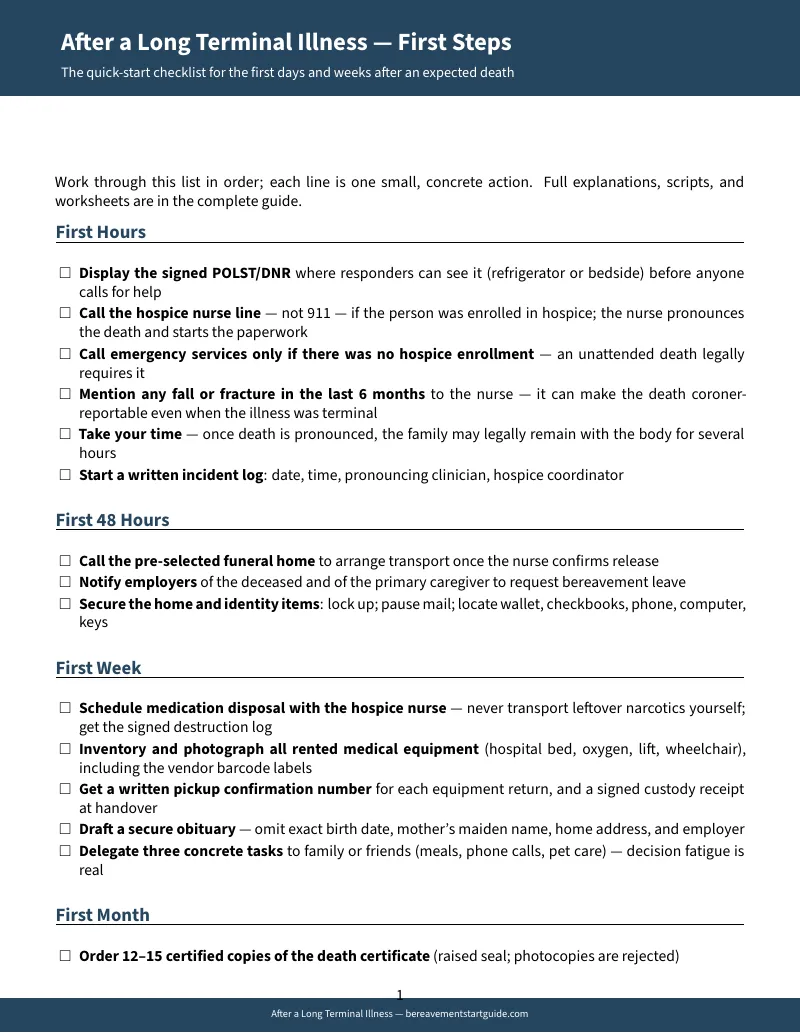
The first-steps checklist covering the critical actions from the first hours through the first week — who to call, what to secure, what to order. Enough to get through tonight with confidence.
Who This Toolkit Is For
- Adult children who were also the caregiver — you lost a parent to cancer, dementia, heart failure, COPD, or another long illness, and now you're the de facto executor while still decompressing from the caregiving itself
- Surviving spouses and partners — grieving your person while untangling joint accounts, property titles, and benefits claims
- The family member everyone calls "the organized one" — suddenly responsible for an estate on two weeks of broken sleep
- Siblings and close relatives stepping in to carry part of the administrative load for the primary caregiver
- Anyone who feels relief that it's over — and guilt about the relief — and needs both the emotional normalization and the practical sequence in one place
Why Not the Free Resources?
Free information exists — scattered across a dozen websites, written for a rested mind. Here's what each actually delivers:
- Government and vital records pages are authoritative and sterile. They tell you to "obtain certified copies of the death certificate" without telling you how many your specific situation needs, or that a one-letter name mismatch will freeze every filing that follows. You get regulations, not a sequence.
- Hospice and hospital handouts are genuinely helpful — for the first two hours. Then they stop. They don't cover insurance contestability windows, funeral-home markup practices, medical debt collectors, or what happens to your own nervous system in week three.
- Law firm estate blogs explain probate in careful detail because their business model is convincing you it's too complex to handle alone — then charging a $3,000–$5,000 retainer. They will never publish the plain-language triage that makes half of that engagement unnecessary.
- Grief memoirs and nonprofit forums offer real emotional validation but zero administrative tools — no scripts, no trackers, no timelines. And the app-based estate platforms want a subscription, an account, and your family's most sensitive documents on their cloud servers.
This toolkit fills the gap between "I know I need to do things" and "I know exactly what to do next." One download, no accounts, no cloud — your family's legal and financial details stay on your device. It's the only resource that treats the administrative sequence and the post-caregiving crash as the same problem, because for you, right now, they are.
— A Fraction of What One Funeral-Home Markup Costs You
The hidden cash-advance markups in a single funeral arrangement run $300 to $800. An unnecessary embalming charge is $750 to $1,200. An estate attorney's first consultation is $300 or more. The funeral cost comparison worksheet inside this toolkit routinely saves families many times its price — before you've even opened the insurance chapter.
Money-back guarantee, no time limit. If the toolkit doesn't make the next month measurably easier to navigate, you pay nothing.
Download the free First Steps checklist to get through the next 48 hours. When you're ready for the full sequence — the scripts, the trackers, the insurance and funeral playbooks, and the recovery chapters — the complete toolkit is here.
You carried them through the illness. Let this carry you through what comes after.