Your family's spiritual obligations don't pause while you figure out the logistics
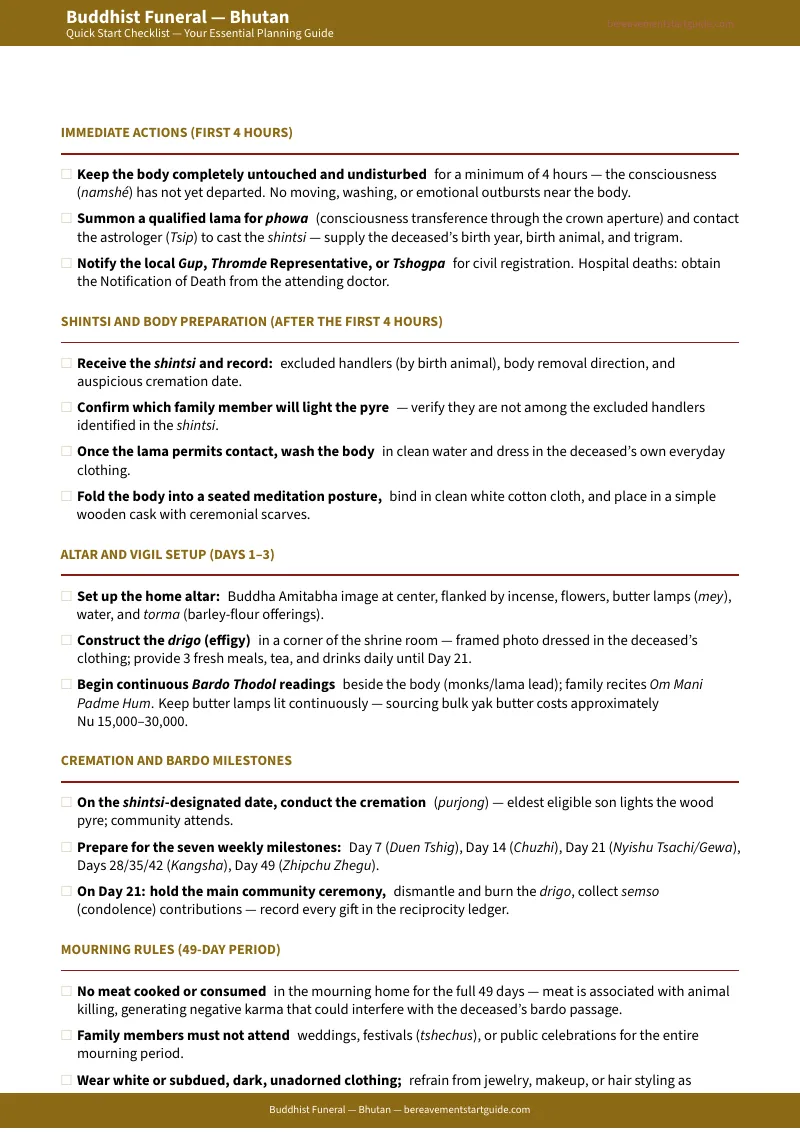
When someone dies in a Bhutanese Vajrayana Buddhist family, the first three to eight hours are spiritually decisive — and most Western hospitals have no idea. The consciousness is still transitioning. A lama needs to perform Phowa before anyone moves the body. An astrologer must calculate the Shintsi death horoscope, which dictates who can touch the corpse, which direction it leaves the building, and when cremation can happen. And within days, you need to set up a drigo shrine, begin daily three-meal offerings, and start coordinating a 49-day mourning cycle that involves monastery engagements, community feasting, tsa-tsa creation, and a 108-flag prayer array.
The Buddhist Funeral — Bhutan guide is a Vajrayana Coordination Toolkit — the only resource that connects the spiritual sequence of the bardo transition to the practical logistics of executing it, whether you're in Thimphu, Perth, or New York.
What the guide covers
- The Phowa negotiation window — pre-written scripts for requesting a 3-to-8-hour post-mortem quiet period from hospital administrators and coroners, with the clinical and legal terminology that gets the request taken seriously
- Shintsi interpretation framework — a plain-English guide to reading the death horoscope's directives on body-removal direction, handler zodiac-year exclusions, cremation timing, and astrological compatibility rules, plus the questions to ask the Tsip when directives are ambiguous
- The complete 49-day bardo calendar — every weekly milestone from the Droda Zhi (day 4) through the Zhipchu Zhegu (day 49), with the ritual requirements, guest-hosting logistics, monastery coordination, and merit-making expectations for each
- Drigo shrine setup and daily offering schedule — how to prepare the effigy or photograph shrine, maintain butter lamps and the three daily meals, and transition the shrine after the final ceremony
- Tsa-tsa creation instructions — collecting bone fragments, mixing ratios for clean clay, pressing into molds, and identifying respectful deposition sites in both rural Bhutan and metropolitan areas
- The 108 darchor prayer flag array — sourcing poles and printing mantras, navigating municipal land-use permits, and scaled-down adaptations for suburban gardens and apartment balconies
- Sur offerings and monastery donations — preparing roasted barley burnt offerings, calculating appropriate donation amounts for officiating lamas and monasteries, and coordinating communal feeding of monastics and visiting guests
- Regional variation modules — distinct protocols for Ngalop (Drukpa Kagyu), Sharchop (Nyingma), and Lhop burial traditions, with lineage-identification questions so you follow the right practices for your family
- 9 standalone printable worksheets — including the funeral budget planner, semso reciprocity tracker, bardo timeline tracker, hospital communication script, funeral director negotiation checklist, Shintsi decisions worksheet, tsa-tsa production log, civil registration checklist, and bilingual Dzongkha reference cards
Who this guide is for
- Diaspora families managing a parent's funeral from Australia, North America, or Europe — especially when Western funeral homes have never handled Vajrayana rites and hospital staff need clear documentation to accommodate post-mortem stillness
- Interfaith spouses and executors who have taken on the role of funeral organizer without prior Vajrayana literacy and need to coordinate with visiting lamas, family elders, and traditional community expectations
- Urban Bhutanese professionals in Thimphu or Paro who no longer have a village support network handling logistics automatically and need structured planning tools for a complex multi-week commitment
- Multicultural funeral directors serving Himalayan Buddhist families who need a professional reference for body-handling protocols, cremation timing requirements, and ritual accommodation requests
Why free online information falls short
Most resources that surface when you search during a crisis are either generic "Buddhist funeral" guides that blur Theravada, Zen, and Vajrayana into one checklist, or academic anthropology texts that don't help you negotiate with a hospital at 2 a.m. The generic guides recommend practices that actively conflict with Vajrayana requirements — suggesting immediate refrigeration when the tradition requires hours of undisturbed stillness, or listing Jodo Shinshu posthumous naming rituals when your family needs a Shintsi death horoscope.
Diaspora community associations provide emergency fundraising and moral support, but none offer structured, downloadable planning tools. And while a qualified lama guides the spiritual transition, no lama manages your municipal permits, writes your hospital letters, or tracks your catering budget across a 49-day cycle. This guide fills the operational gap between spiritual authority and administrative reality.
Your purchase is protected
If the guide doesn't give you the clarity and structure you need to coordinate your loved one's funeral with confidence, email us within 30 days for a full refund. No questions, no conditions.
The free checklist gives you the essential task list. The full guide gives you the system — the Shintsi interpretation framework, the complete bardo calendar, the regional variation modules, and 9 standalone printable worksheets including the hospital communication script, budget planner, and bilingual reference cards. For , you get the coordination toolkit that replaces days of anxious searching with a single, trusted reference you can print and carry into every conversation.