You have seventy-two hours. The rules are unwritten. The stakes are personal.
A death in a plain community triggers a sequence that most outsiders have never seen — and that no website fully explains. Within three days, the body must be washed by family members, dressed in handmade white garments, placed in a plain pine casket built after the death, transported by horse-drawn hearse, and buried in a hand-dug grave. The entire church district mobilizes to manage the farm, prepare the home, and feed several hundred visitors. And every step follows the Ordnung — an oral code that shifts by county, conference, and church district.
If you are navigating this from outside the settlement, you are working without a manual. The bishop cannot help with state burial permits. The funeral director does not know the meetinghouse seating rules. The internet offers romanticized tourism articles and forum threads that contradict each other. And the clock is already running.
The Plain Burial Bridge System
The Amish & Mennonite Funeral Guide is a structured intermediary reference — built to sit between the plain community's oral tradition and the modern legal and logistical world. It does not replace the deacon's authority or the funeral director's expertise. It coordinates them, so nothing falls through the gap.
The guide maps the full cycle from the first phone call through estate administration, with parallel tracks for the spiritual process (managed by the church) and the legal process (managed by you). Where those tracks intersect — body release from a hospital, embalming decisions, casket sourcing, burial permits — the guide provides the exact scripts, questions, and reference tables you need to keep both sides aligned.
What's Inside
- 72-Hour Timeline with Hour-by-Hour Benchmarks — because the three-day window leaves no room for guessing. You know exactly what should be happening at each stage, who is responsible, and where the common delays occur (hospital holds, organ procurement review, coroner release).
- Body Preparation Protocols by Subgroup — the washing ritual, the white burial garments, the strict no-cosmetics rule, and why the funeral director's role ends after embalming. Separate entries for Old Order Amish, Swartzentruber, Nebraska Amish, Old Order Mennonite, and Modern Mennonite communities.
- Plain Casket Sourcing Guide — how to contact community carpenters, what specifications to provide (no metal hardware, no interior lining, no decorative elements), and how to legally bring a third-party casket to a commercial funeral home using the FTC Funeral Rule.
- State-by-State Legal Comparison (PA, OH, IN) — the three largest plain-settlement states handle home burials, funeral director requirements, and embalming mandates differently. Pennsylvania allows full family independence. Indiana requires a licensed funeral director. Ohio falls between. The comparison table prevents costly legal mistakes.
- Deacon Communication Scripts — exact phrasing for asking the local deacon about district-specific customs without sounding prideful or intrusive. These scripts work whether you are an ex-member navigating shunning dynamics, an interfaith spouse, or a professional funeral director.
- Funeral Director Directive Card — a printable reference card grounded in the FTC Funeral Rule that protects you from unnecessary upselling: premium casket substitutions, cosmetic applications, and service-bundling practices. Hand it directly to the funeral home.
- Meetinghouse and Home-Service Etiquette — gender-segregated seating, the photography ban, dress codes for non-plain visitors, the language barrier during Pennsylvania Dutch services, and how Old Order Mennonite meetinghouses differ from Amish home services.
- Community Meal Logistics — coordination templates for the post-funeral meal (300–600 attendees), the traditional raisin funeral pie, ingredient sourcing, kitchen labor division, and how to support the meal train if you are outside the immediate church district.
- Six Standalone Worksheets and Reference Cards — printable templates for the 72-hour timeline, home viewing setup, estate administration, deacon questions, attendee etiquette, and the FTC Funeral Rule directive card. Designed for letter-size paper so you can bring them to the funeral home, the deacon's meeting, or the viewing.
Who It's For
Diaspora and ex-plain relatives returning to the settlement after years away. You remember enough to know that mistakes matter — the wrong clothing, the wrong question, a phone visible during the service — but not enough to navigate the full three-day sequence without a reference.
Interfaith spouses and secular executors who must bridge the community's cash-based, insurance-free mutual-aid system with modern banking, probate courts, and state bureaucracy. The guide's estate administration worksheets and deacon communication scripts are built for exactly this crossover.
Funeral directors and death-care professionals serving their first (or fifth) plain family. The non-cosmetic embalming directive, the third-party casket acceptance protocol, and the meetinghouse etiquette section prevent the kind of well-intentioned professional misstep that damages community trust for years.
Why Free Resources Fall Short
The information exists — scattered across Anabaptist publishers, forum threads, county clerk websites, and local funeral homes that share details only after you sign a service agreement. The problem is not scarcity. It is fragmentation.
Church deacons are peerless on the Ordnung, but they cannot advise on burial-transit permits or hospital release paperwork. Mainstream funeral directors understand state law, but they rarely know the theological basis for the no-cosmetics rule or the physical setup of a home viewing. Anabaptist booklets address spiritual grief beautifully, but they assume you are an active church member — not a secular executor trying to reconcile a cash-based mutual-aid system with a modern bank account.
The guide brings all three sources into a single, structured reference — organized by timeline, not by topic — so you can act decisively in a situation that does not forgive hesitation.
Start with the free checklist, or get the full guide
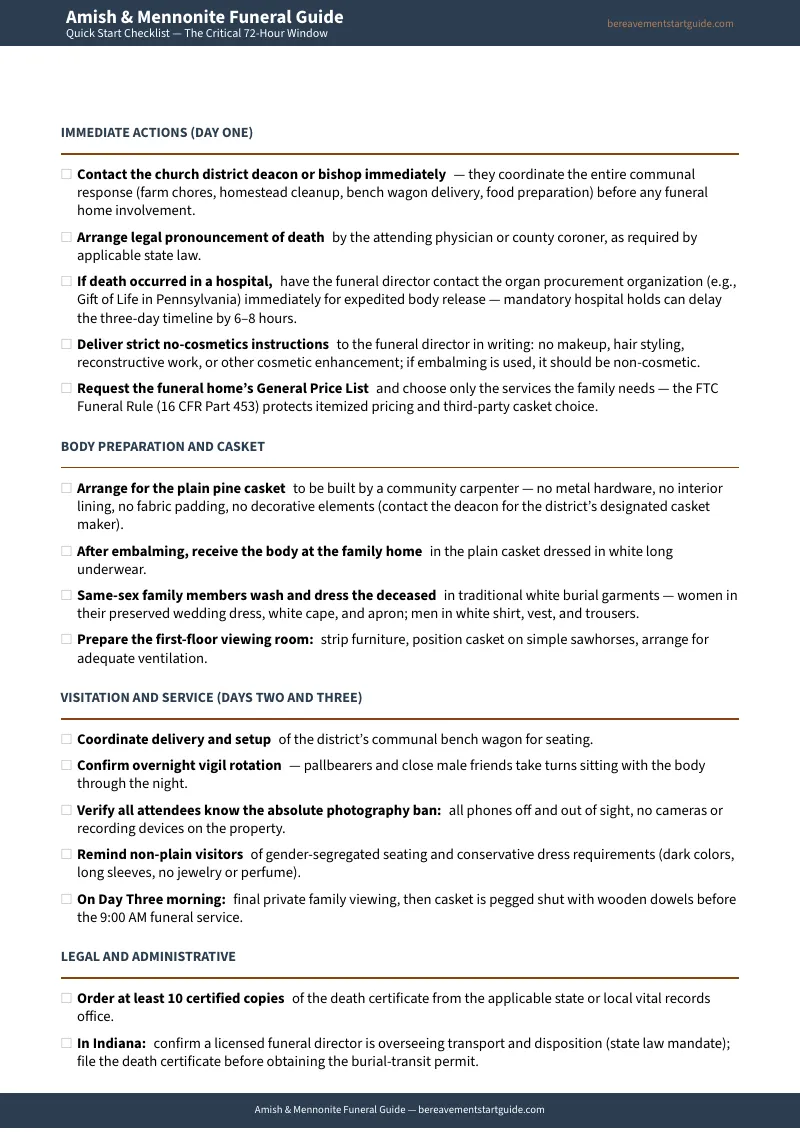
The free checklist covers the essential actions across all five sections of a plain-community funeral — from the deacon's first notification through grave recording and estate administration. It tells you what to do.
The full guide tells you how — with the subgroup-specific customs, the legal comparison tables, the communication scripts, the planning worksheets, and the home viewing setup diagrams that turn a compressed, high-stakes timeline into a sequence you can actually manage. Get the full Amish & Mennonite Funeral Guide →
Both options include a satisfaction guarantee. If the guide does not give you the clarity you need, email us and we will make it right.
Frequently Asked Questions
What if the rules change after I buy?
We update the guide when the rules change. Email us any time, even years later, and we'll send you the current edition free.