Someone on Your Team Just Died. Nobody Trained You for This.
An employee or colleague has died, and the next eight hours will define how your organization handles everything that follows. There is an OSHA reporting clock ticking. Payroll is about to deposit wages into an account the bank may freeze. Your team is staring at you, waiting for guidance — and you have no idea what you are legally allowed to say about the cause of death.
You could spend the next weeks patching together advice from an outdated EAP pamphlet, a payroll blog, a Reddit thread, and a grief book that assumes you lost a family member. Or you could open one resource that combines the operational compliance, the team communication, and the human side of workplace loss in the sequence you actually need them.
The Workplace Bereavement Command System
This is not a grief book. It is not an HR manual. It is a command system — a structured toolkit that tells you exactly what to do, in what order, and what the legal consequences are if you miss a step. Every chapter pairs the compliance requirement with the human reality underneath it, because you cannot separate the OSHA report from the colleague sobbing in the conference room. They are happening at the same time, and you need a resource that treats them that way.
Built for the specific operational complexity that a workplace death creates: OSHA fatality reporting windows, post-mortem payroll tax rules that most payroll managers have never encountered, HIPAA boundaries that persist for 50 years after death, digital asset laws that make logging into a colleague's email a federal offense, and the team grief dynamics that determine whether your remaining employees stay or quietly start looking.
What You Get
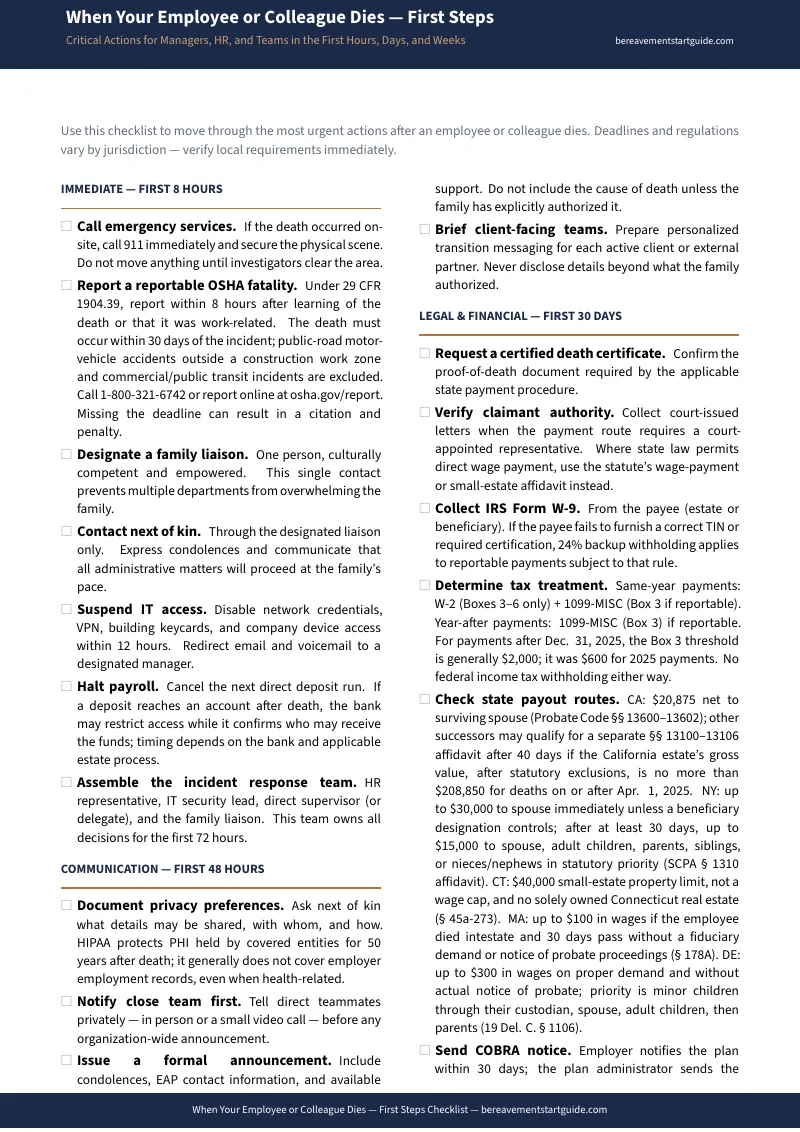
- First-8-Hour Triage Sequence — the mandatory OSHA fatality reporting window (29 CFR 1904.39), immediate payroll halt procedures, IT security lockdowns (credentials, email redirect, building access, devices), and how to assemble a four-person incident response team. Written for crisis brain: one action per sentence, in exact operational order.
- Communication Scripts with Privacy Boundaries — how to establish a family liaison, document privacy preferences before any announcement, tell the close team first (in person, never by mass email), and draft the organization-wide notification. What HIPAA protects for 50 years after death, what the ADA requires about medical records, and what GDPR Recital 27 means for international teams. Includes copy-and-adapt announcement templates for different audiences.
- Final Pay and Tax Compliance Breakdown — the IRS rules most payroll departments do not know: year-of-death wages go on the W-2 (boxes 3–6) and a 1099-MISC (Box 3) to the beneficiary with no federal income tax withholding; next-year wages are exempt from FICA, FUTA, and income tax entirely. State-by-state direct wage payout thresholds — from Connecticut's $40,000 to Delaware's $300 — with the statutory references and required documentation for each.
- Benefits Termination and COBRA Guide — election windows, notice requirements, group life insurance interactions, retirement account beneficiary designations, and what the family needs from you to file their claims. Written from the employer's side: what you owe, what you must provide, and which deadlines bind you.
- Workspace and Belongings Protocol — a chronological desk-clearing workflow with inventory tracking and family coordination scripts. When to clear the space (the research on premature clearing is unambiguous), how to handle colleagues who want to keep something as a memorial, and how to manage shared spaces without erasing the person overnight.
- Workload Redistribution Matrix — how to reassign projects without burning out the surviving team, identify critical deliverables, negotiate deadline extensions with clients, flag single-points-of-failure, and handle the question of when to post the job opening. Includes the accommodation framework for team members whose productivity has dropped.
- Digital Asset Access Under RUFADA — what the Revised Uniform Fiduciary Access to Digital Assets Act says about accessing a deceased person's work email, cloud storage, and software accounts. Why logging in with stored passwords violates the Computer Fraud and Abuse Act. Platform-specific procedures for enterprise accounts that protect business-critical data without breaking the law.
- Workplace Grief Psychology Guide — disenfranchised grief (why teammates grieve intensely for someone they "weren't close to"), survivor guilt, bystander stress, the Dual Process Model of oscillating between loss and restoration, and the measurable cognitive depletion that affects every team member for weeks. Not therapy — the vocabulary your team needs to understand what is happening to them.
- Manager Duty of Care — Three-Level Escalation — peer check-ins, EAP referral, and crisis intervention. How to recognize when someone is struggling beyond normal grief, what an EAP actually provides (and its limits), and specific scripts for saying "I notice you are not doing well" without overstepping professional boundaries.
- Phased Return-to-Work Framework — a structured transition plan for the team, not just individuals. Productivity adjustment protocols, flexible scheduling, grief anniversary and holiday triggers, and how to build a sustainable new normal without pretending the loss did not happen.
- Memorial Planning Guide — continuing bonds activities that research supports: memory boards, scholarship funds, dedicated spaces, and anniversary observances. What works in secular, multi-faith, and culturally diverse workplaces — and what to avoid.
- Printable Checklist — 25 prioritized action items across five phases, from the hour you learn of the death through the first year. Designed for an office wall or an HR binder, not a PDF that gets opened once.
Who This Is For
- Managers and team leaders who just learned someone on their team has died and need a step-by-step roadmap for the next eight hours, the next week, and the next year
- HR professionals handling final pay, benefits termination, COBRA notices, and OSHA reporting — who also need to support a grieving team, not just process an exit
- Small business owners without a dedicated HR department, who are the manager, the payroll admin, and the family liaison all at once
- Colleagues and teammates processing their own grief while watching how the organization treats the loss — because how the company handles this shapes whether the remaining team stays or updates their resumes
- The family of the deceased employee who needs to understand what they are owed and what the employer is required to provide
Why Not Free Resources?
Free resources exist. The EAP pamphlet covers "supporting a grieving employee" in two pages of clinical generalities, and says nothing about OSHA reporting timelines, post-mortem tax withholding, or digital asset law. Payroll blogs explain one tax rule at a time and assume you already understand the W-2/1099-MISC split. Grief books offer insight into loss — and zero guidance on workload redistribution, desk-clearing protocols, or team communication scripts.
The gap is structural. No single free resource combines the legal compliance, the operational workflows, the communication templates, the grief psychology, and the practical tools (checklists, matrices, scripts) in one place. This toolkit fills that gap because you do not have the bandwidth to assemble five different resources while your team is falling apart.
Satisfaction Guarantee
Full refund, no time limit. If this toolkit does not help you, email hello@bereavementstartguide.com and you will get your money back. No questionnaire, no justification required.
Start With the Free Checklist
Download the free checklist to see the format and the most critical first steps. When you are ready for the full command system — the 45-page, 13-chapter guide plus six standalone printable worksheets covering OSHA compliance, final pay, HIPAA boundaries, team communication scripts, workload redistribution, digital asset law, grief psychology, and phased return-to-work — the complete toolkit is here. It costs less than a single hour of HR consulting and you keep it for life.