You just got the worst phone call of your life — and now two countries on opposite sides of the planet want paperwork.
Your family member died in Australia. A funeral director in Sydney or Melbourne needs a signed authorization before they can take custody of the body. If the death was unexpected — a car accident, a drowning, a heart attack on a hiking trail — the state coroner has already ordered an autopsy, and the remains are locked in a forensic science facility you cannot even visit. Your travel insurer is asking for documentation you have never heard of. And behind all of that, a 14-to-18-hour time-zone gap means every phone call you need to make happens in the middle of your night.
The U.S. Embassy will open a case file, hand you a list of funeral directors, and wish you well. They cannot pay for repatriation, cannot override Australian state jurisdiction, and cannot help you navigate probate, Social Security, or your own bank's refusal to accept a foreign death certificate.
You are on your own — managing two legal systems, eight Australian state and territory bureaucracies, airline cargo rules, biosecurity export permits, and cross-border tax obligations — while grieving from 8,000 miles away.
The Cross-Border Repatriation Roadmap
The American Dies in Australia — Family Emergency Guide is a 52-page chronological workflow that takes your family from the first emergency phone call through final estate settlement. Every chapter produces a specific document that feeds the next step, so nothing falls through and nothing stalls waiting for a piece of paper you did not know you needed.
This is not a generic "what to do when someone dies" guide padded with condolence advice. It is a cross-border operations manual — built around the actual document chain, coronial timelines, and regulatory requirements your family will encounter when an American citizen dies on Australian soil.
What You Get
- First 72 Hours Crisis Protocol — the exact sequence of calls, authorizations, and document retrievals that prevents the most expensive bottlenecks, including scene protocols for Australian state police and the three qualifying questions to ask before signing a funeral home contract
- State-by-State Death Certificate Guide — from New South Wales online registration (standard 10-day processing) to Victoria's 2-day priority option to Western Australia's mail-only process for overseas applicants, so you know exactly what to expect for every downstream process
- Australian Coronial System Explained — the median 13-month timeline from mortuary admission through formal cause-of-death registration, what happens during each phase, how the body gets released in 6–10 days while the investigation continues for months, and how to lodge a Senior Next-of-Kin autopsy objection if your family opposes an invasive post-mortem
- DFAT Apostille Procedures — Australia's Department of Foreign Affairs and Trade is the sole apostille authority under the Hague Convention; the guide walks through original BDM certificate apostilles, the two-step notarisation-then-apostille path for certified copies, and the in-person requirement for electronically issued documents
- e-CRODA and the "Raised Seal" Trap — U.S. Mission Australia now issues the Consular Report of Death Abroad as a secure digital PDF, but many American banks still demand paper copies with raised seals; the guide gives you the Form DS-5542 workaround that bypasses months of estate freezes
- Repatriation vs. Local Disposition Cost Comparison — full-body air repatriation ($10,000–$20,000 USD), local cremation with ash shipment ($900–$3,500 USD), and air courier ashes services ($2,100–$2,800 USD), each broken down by component cost so you can make an informed decision instead of accepting the first option a repatriation company offers
- Airline Cargo and Biosecurity Rules — approved carriers for Australia-to-U.S. human remains transport, hermetic zinc container requirements, Australian biosecurity export permits, CDC clearance protocols at U.S. ports of entry, and TSA X-ray-friendly urn requirements for carry-on ashes
- Social Security Fairness Act Survivor Recovery — the GPO and WEP are repealed; what this means for benefits payable from January 2024 onward, how automatic adjustments work, and the Form SSA-561 reconsideration process when retroactive lump sums are short-changed — plus the critical distinction between the repealed federal offsets and still-active state pension plan offsets
- Superannuation Tax Traps and Cross-Border Estate — the taxable component paid to non-dependants can be taxed at 15–30% plus Medicare levy; the guide covers Australian state-by-state probate, frozen bank accounts, IRS foreign asset reporting (Form 3520, FBAR), and Australia-U.S. Tax Treaty provisions
- 5 Printable Planning Tools — a repatriation cost-comparison worksheet, state BDM death certificate tracker, DFAT apostille submission log, insurance claim tracker, and agency communication log, each designed to be printed and filled in as you work through the process
Who This Guide Is For
- U.S. families managing a death in any Australian state or territory — whether the person was traveling, living as a retiree, working on a temporary visa, studying abroad, or visiting family
- Executors and administrators handling cross-border estates with Australian superannuation, property, or dual tax obligations
- Adult children coordinating arrangements remotely across the worst time-zone gap in the English-speaking world
- Corporate HR managers, university study-abroad directors, and travel companions who need a structured response checklist
Why Not Just Google It?
You could. Here is what you will find: a U.S. Embassy page listing funeral directors in Sydney and Melbourne with no guidance on how to evaluate them. Eight separate state and territory Births Deaths and Marriages websites, each with different application processes. A coroner's court FAQ that tells you the investigation takes "some time" but does not mention that "some time" is a median of 13 months. Forum threads from 2021 that still describe the old consular authentication process Australia replaced when it joined the Apostille Convention. And funeral home blogs that quote the $15,000 full-body repatriation price without mentioning that local cremation and ash shipment runs under $3,500.
The information exists — scattered across consular websites, state registries, coronial court publications, airline cargo policies, and tax treaties. The guide brings it into one document, organized in the order your family actually needs it, updated for 2026 law.
The Free Checklist vs. the Full Guide
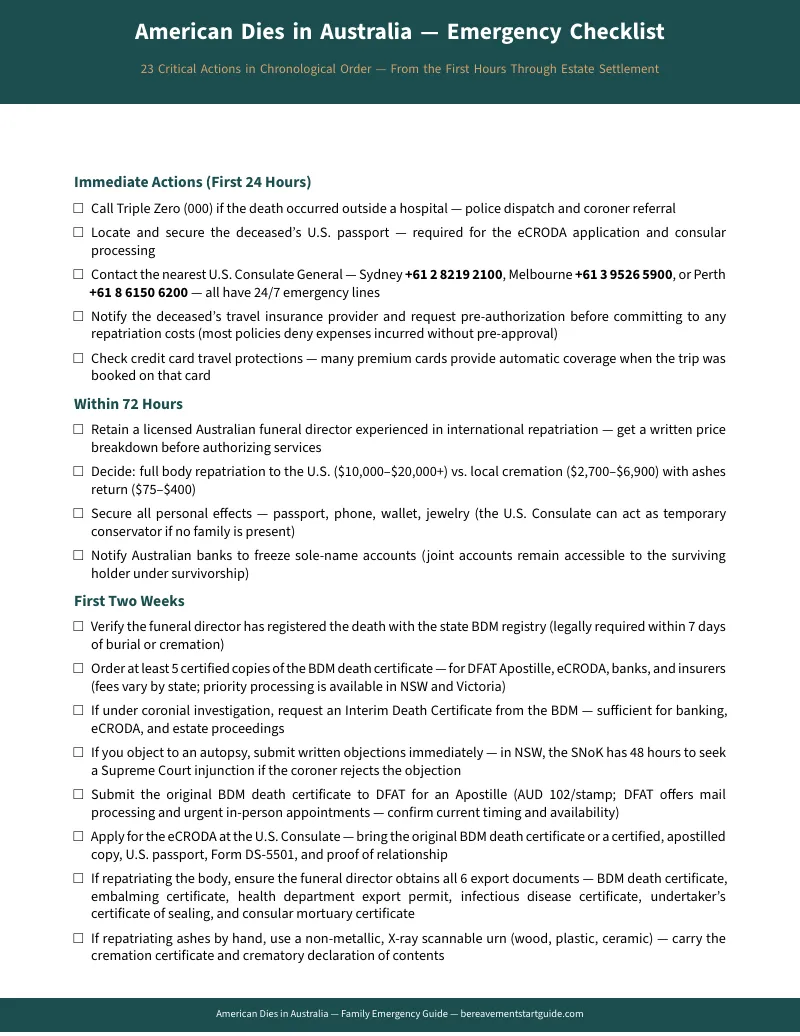
The free emergency checklist gives you the first-48-hours action list — enough to stabilize the situation and avoid the most immediate mistakes. The full guide takes you from there through the entire process: state-by-state death certificates, the coronial investigation timeline, DFAT apostille procedures, repatriation logistics, Social Security recovery, superannuation claims, cross-border tax filing, and estate settlement.
The checklist tells you what to do. The guide tells you how, when, where, and how much.
Full Refund, No Time Limit
If the guide does not help your family, email hello@bereavementstartguide.com for a full refund. No time limit, no questions, no hoops.
Get the American Dies in Australia Guide →
Your family is dealing with enough right now. The paperwork should not be the part that breaks you.