
The bank froze everything. Now what?
You called the bank to report a death and they locked every account your family depends on. The mortgage payment bounced. The debit card was declined at the pharmacy. Online banking shows an error screen. Nobody at the branch will tell you how to get access back — they just hand you a number for the "Estate Services department" and send you home.
Meanwhile, creditors are calling. Siblings are asking questions you cannot answer. You are Googling legal terms at 2 a.m. that you have never seen before — Letters Testamentary, EIN, Payable-on-Death, Small Estate Affidavit — and every article either contradicts the last one or ends with "consult an attorney."
An attorney charges $200–$500 per hour. The average estate spends $12,400 on legal and accounting fees. And the average executor spends 570 hours administering an estate over 16 months. Most of those hours are not spent on legal strategy — they are spent figuring out which form to file, which department to call, and which deadline matters.
That is the problem this toolkit solves.
The Post-Death Financial Claims System
This is not a generic grief resource or a blank legal form. It is a structured operational system designed specifically for the person who just became responsible for someone else's financial life — and who needs to act before deadlines pass, accounts drain, and family conflicts escalate.
The system works because it replaces the 40+ hours of scattered Googling with a single, ordered sequence: what to do first, what to do next, what to bring to each appointment, what to say on each phone call, and what to file at each stage. Every chapter addresses a specific set of decisions you will face, with the exact forms, statutes, and step-by-step procedures that apply.
What's Inside
- Account Freeze Survival Protocol — exactly what happens when a bank learns of a death, why your Power of Attorney is now void, and the four levels of restriction that hit simultaneously (debit cards, online access, autopayments, checks)
- Complete Account Discovery System — the physical audit, tax return trail (1099-INT, Schedule B, Schedule D), credit report strategy, digital footprint search, and three institutional registries that catch what personal records miss
- POD / TOD / Joint Account Claim Procedures — step-by-step claim processes for Payable-on-Death accounts, Transfer-on-Death accounts, and joint survivorship accounts, including the exact escalation script when a bank teller wrongly demands court letters for a non-probate asset
- Estate Banking Setup Walkthrough — from court appointment to EIN application to opening the estate checking account, with a worked example of the IRS online application and a list of exactly what to bring to the bank appointment
- State-by-State Small Estate Affidavit Reference — current thresholds, waiting periods, and key exclusions for every state, including the gross-vs-net value trap that disqualifies estates that should have been eligible
- Creditor Priority Framework — the statutory payment order that protects you from personal liability, the creditor claim period rules that vary by state, and the specific consequences of distributing estate funds too early
- Identity Theft Prevention System — credit bureau notification procedures, DMV license cancellation, marketing suppression, and the post-death fraud monitoring timeline
- Bank Communication Scripts — pre-written letters and phone scripts for notifying banks, claiming accounts, disputing unauthorized charges, and responding to aggressive debt collectors
- Family Conflict Navigation — the convenience-account trap that triggers sibling lawsuits, co-executor deadlock resolution, and transparency protocols that prevent accusations of mismanagement
- Grief-Responsive Pacing — the entire guide is structured for "grief brain," breaking complex procedures into discrete tasks you can complete in short sessions without losing your place
Who This Is For
- Surviving spouses whose household checking account was just frozen and who need to pay the mortgage, utilities, and funeral expenses immediately
- Adult children named as executor who have never dealt with probate, estate banking, or the IRS
- Family members managing from a distance who cannot visit every bank branch in person and need scripts and procedures they can execute by phone and mail
- Co-executors who disagree on how to handle the estate and need a clear framework for fiduciary obligations and decision-making authority
- Anyone using a Small Estate Affidavit to avoid formal probate and who needs to know their state's threshold, waiting period, and excluded assets
Why Free Resources Fall Short
You can find pieces of this information scattered across government portals, bank websites, Reddit threads, and legal blogs. The problem is not that the information does not exist — it is that it exists in fragments designed to protect institutions, not to guide you.
Bank portals tell you what documents they need. They do not tell you how to get those documents, how long each step takes, or what to do when a branch manager gives you incorrect information about POD accounts. Government sites explain creditor priority in statutory language. They do not tell you what happens to you personally if you pay the credit card bill before the funeral home.
And none of them address the reality that you are doing all of this while grieving — while your memory is unreliable, your decision-making capacity is diminished, and your family is looking to you for answers you do not have.
This toolkit consolidates every procedure into one ordered sequence, written in plain language, structured for cognitive overload, and verified against current state and federal requirements.
What You Get
- The Complete Guide — 55 pages, 13 chapters covering every stage from account freeze to final distribution
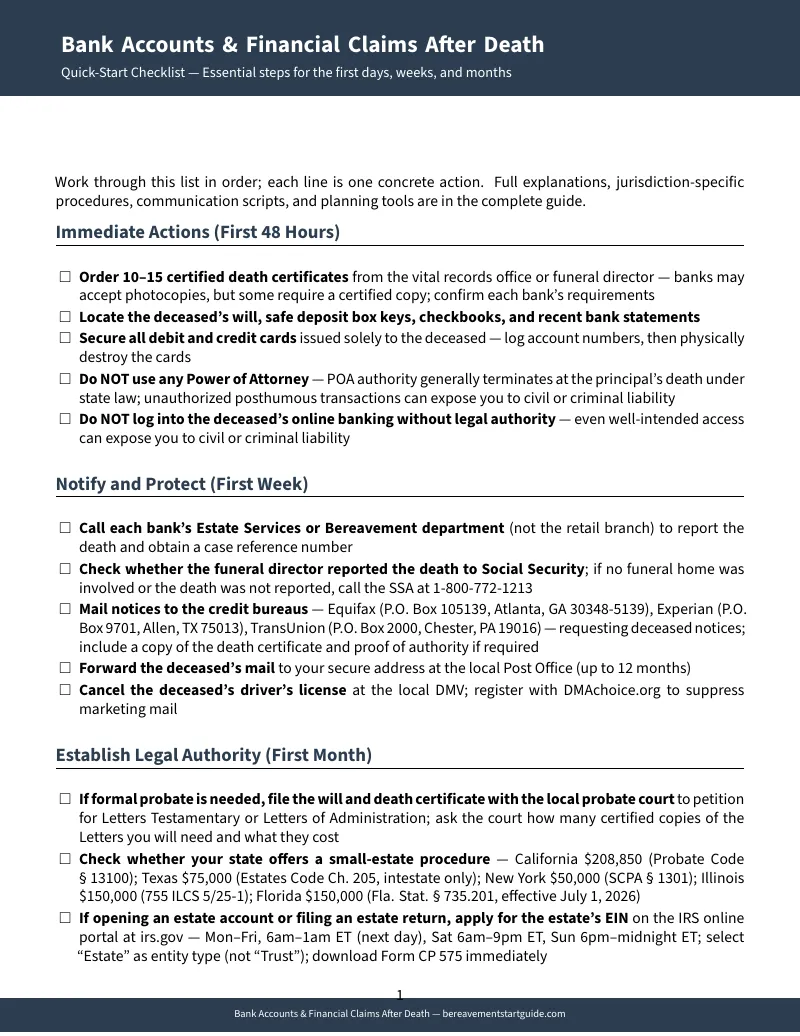
- The Quick-Start Checklist — a printable 25-item action list organized by timeline (first 48 hours, first week, first month, months 1–12)
- Account Registry Worksheet — a fill-in tracker for every bank, investment, loan, and digital account you discover
- Document Organizer Checklist — track which estate documents you have gathered and which are still outstanding
- Creditor Claim Tracker — log every creditor claim with the statutory priority framework built in
- Fiduciary Decision Log — document every estate decision to protect yourself from liability challenges
- Agency Communication Log — record every call, email, and visit to banks, courts, and creditors
- Estate Accounting Ledger — a running ledger for every deposit and payment from the estate bank account
- Bank Communication Scripts — five pre-written scripts you can read verbatim when calling banks, pushing back on incorrect POD demands, notifying family, requesting billing holds, and declining creditor pressure
Satisfaction Guarantee
Full refund, no time limit. If the toolkit does not give you the clarity and structure you need, email hello@bereavementstartguide.com and we will refund you — no questions, no forms, no waiting period.
Get Started Now
Download the free Quick-Start Checklist to see the complete action sequence. When you are ready for the full system — every script, every procedure, every state-specific threshold — upgrade to the complete toolkit for .