Your Client Just Died. Your Firm Has Four Hours.
The surviving spouse is on the line, voice cracking, asking you to liquidate the portfolio before the market drops. Your compliance officer is asking whether anyone has frozen the accounts yet. The estate attorney needs date-of-death valuations on fourteen positions by end of week. And you're not sure whether the joint account gets a 50% or 100% basis step-up because nobody documented which state's property rules govern.
You didn't train for this. Nobody did. Portfolio construction, tax planning, regulatory compliance — your firm invested thousands of hours developing expertise in every dimension of wealth management except the one that carries the highest concentration of regulatory risk, relationship damage, and emotional strain: what happens when a client dies.
The Deceased Client Protocol Toolkit replaces the improvised response with a defensible, structured system that your entire team can execute under pressure — from the moment the call comes through estate settlement, heir retention, and post-transition audit.
What Makes This Different from the Custodian Checklist You Already Have
Schwab's death notification workflow tells you which forms to submit to Schwab. Fidelity's inheritance center tells you how to process a transfer through Fidelity. Neither tells you what to say to the crying widow whose accounts you just froze. Neither explains why sharing the account balance with the deceased's daughter before Letters Testamentary are verified constitutes a Regulation S-P data breach. Neither walks you through the basis step-up difference between Texas and New York that could cost the heirs six figures in unnecessary capital gains tax.
Professional association toolkits from NAPFA and FPA carry institutional credibility. They're also locked behind expensive annual memberships, and they completely ignore the communication scripts, staff wellness protocols, and family conflict management that distinguish a firm that handles death well from a firm that survives it.
The CeFT designation builds deep transition-counseling expertise. It also requires a year-long study program, $5,100 in tuition, and ongoing annual fees. The advisory team that needs help today has a case on their desk right now.
This toolkit sits in the gap between all of those. It translates SEC regulation, FINRA enforcement precedent, federal tax code, and thanatological research into the specific protocols, scripts, calculations, and checklists your team uses during the actual crisis — and treats every procedure as something that needs to work at 8:47 a.m. with a crying caller on the line and a compliance clock already running.
What's Inside the Toolkit
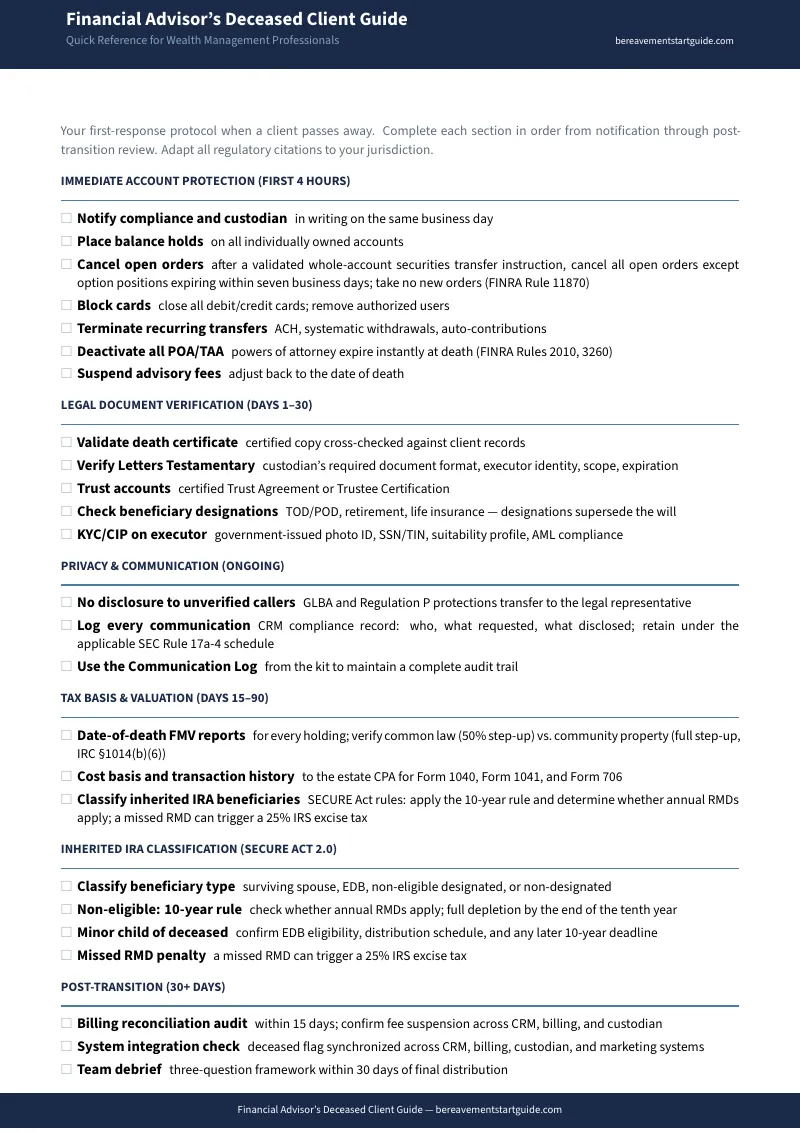
- First-Four-Hours Crisis Protocol — the complete operational sequence from notification through account freeze, open order cancellation, fee suspension, POA deactivation, and same-day compliance notification — with the five data points your CSA must capture during that first call and the specific reason you should never request documents during it
- Post-Death Authority Verification — instant expiration of all trading authorizations and powers of attorney; the orphaned account problem; fee-rebating protocol; and the FINRA Rule 3241 trap for representatives named in client estate documents without prior written approval
- Document of Authority Framework — documentation requirements mapped by account type (individual, JTWROS, tenancy in common, trust); Letters Testamentary validation; beneficiary designation conflicts; and executor KYC/CIP verification
- Regulation S-P Privacy Protocol — post-mortem privacy obligations under GLBA and Regulation S-P; the 2025–2026 amendment deadlines; incident response and 30-day notification requirements; and the specific scenario where premature disclosure to family members becomes a formal data breach
- Multi-Disciplinary Handoff System — structured coordination with estate attorneys, CPAs, custodian estate services, and government agencies — with clear scope-of-practice boundaries so your team knows what to provide, what to defer, and what to never touch
- IRC Section 1014 Basis Step-Up Calculations — worked examples for common law states (50% step-up) and community property states (full 100% step-up under IRC 1014(b)(6)), the alternate valuation date election, and the documentation trail that prevents costly basis-reporting errors
- SECURE Act Inherited IRA Distribution Rules — beneficiary classification, the 10-year depletion rule, the annual RMD requirement within that window, the 25% excise tax on missed distributions, and eligible designated beneficiary treatment for minor children
- Suitability and Elder Abuse Protection — re-establishing risk profiles for the new account holder, FINRA Rule 2165 protective holds, Rule 4512 trusted contact verification, and multi-tier escalation thresholds
- Trauma-Informed Communication Scripts — word-for-word scripts for notification calls, account freeze explanations, family boundary-setting, the Decision-Free Zone that protects clients from irreversible decisions during acute grief, and multi-beneficiary dispute navigation
- Record Retention Architecture — SEC Rule 17a-4 requirements, CRM compliance record templates, billing reconciliation audit, and the retention schedule that keeps your firm defensible years after the case closes
- Advisory Team Wellness Protocols — recognition frameworks for compassion fatigue, secondary traumatic stress, moral injury, and countertransference; the three-question team debrief; and crisis intervention resources
- Post-Transition Quality Audit — a compliance integrity checklist, system integration check, and wellness check that surfaces the risks still hiding 90 days after you think the transition is finished
Plus a 25-item quick-reference checklist covering every critical action from initial notification through post-transition audit — designed to be printed and grabbed the moment the call comes in.
The toolkit also includes six standalone planning tools: a First-Four-Hours Crisis Action Checklist with compliance sign-off, an Executor KYC Verification Worksheet, a Date-of-Death Valuation Worksheet for basis step-up calculations, an Inherited IRA Distribution Planner with a 10-year depletion projection table, a Privacy-Compliant Communication Log, and a Team Debrief and Wellness Assessment form. Each one is designed to be printed and used during the actual case — not filed in a binder.
Who This Is For
- Lead Financial Advisors and Wealth Managers who carry the relationship responsibility when a client dies and need the complete compliance-to-communication framework, not a custodian's account-transfer form packet
- Client Service Associates who take the initial call, execute the freeze, manage document intake, and coordinate the administrative pipeline — and need structured procedures that work under cognitive overload
- Chief Compliance Officers and Operations Managers building or updating the firm's bereavement SOP with Regulation S-P protocols, FINRA Rule 3241 procedures, and a documentation architecture that survives regulatory examination
- Solo Practitioners and Small RIA Teams who handle everything — the condolence call, the account freeze, the basis calculation, the custodian coordination — themselves, and need a plug-and-play system they can deploy this week
Satisfaction Guarantee
Full refund, no time limit. If the toolkit doesn't deliver what you need, email hello@bereavementstartguide.com and we'll process the refund. No forms, no questions, no hoops.
Start Building Your Protocol Today
Download the free Quick Reference Checklist to see the operational framework. When you're ready for the complete 14-chapter guide with scripts, calculations, templates, and team wellness protocols, get the full Deceased Client Protocol Toolkit — for less than the billable hour you'd spend drafting a single internal memo on the same topic.