You Were Never Trained for This — But You're Expected to Get It Right
You've handled hundreds of calls. Stabilized patients, secured scenes, restored order. But the call that stays with you isn't the one where the protocols worked — it's the one where you stood on a porch at 3 AM, facing a mother who hadn't heard yet, and you had no script, no training, and no idea what to say first.
About half of all active first responders have never received structured death notification training. The academy gave you hours on defensive tactics and evidence preservation. For the moment that permanently reshapes a family's life — and leaves a mark on yours — you got "you'll figure it out."
The Notification Command System
The First Responder Death Notification Guide is a field-ready operational manual that covers every phase of the notification pipeline — from confirmed fatality to post-call debriefing — with the kind of step-by-step specificity you'd expect from a tactical operations order.
This isn't a grief counseling pamphlet. It's not a policy template written by legal. It's an execution manual built for the operational reality of shift work: you get the call, you verify the ID, you assemble the team, you drive to the address, and you deliver the worst news someone will ever hear. The guide walks every step with protocols, scripts, and legal safeguards that protect both the family and your career.
Word-for-Word Notification Scripts
Customizable scripts for the five most common notification scenarios — motor vehicle collision, sudden cardiac arrest, homicide, suicide, and pediatric death. Each script includes the "warning shot" opening, direct language guidance (why "died" instead of "passed away" changes outcomes), and adapted versions for phone notifications when in-person delivery is impossible. You're not improvising language during the hardest conversation of someone's life.
Legal Compliance Checklists
HIPAA exemption decision trees that show exactly what you can and cannot disclose at the scene — the law enforcement emergency exemption, coroner/medical examiner exemption, and organ procurement exemption under 45 CFR § 164.512. Next-of-kin verification workflows with the statutory priority hierarchy and state-specific variations. Body-worn camera policies covering when to record and when to deactivate, with jurisdiction-specific guidance. One documentation error during a notification can generate a privacy complaint that follows you for years.
Scene Documentation Templates
Patient Care Report narrative blocks, incident report frameworks, and evidence preservation checklists you can complete on scene. The templates cover presumptive signs documentation, personal effects chain of custody, medical device preservation protocols, and notification details — everything a shift supervisor reviews before your report hits the records system.
Pre-Departure Planning Checklist
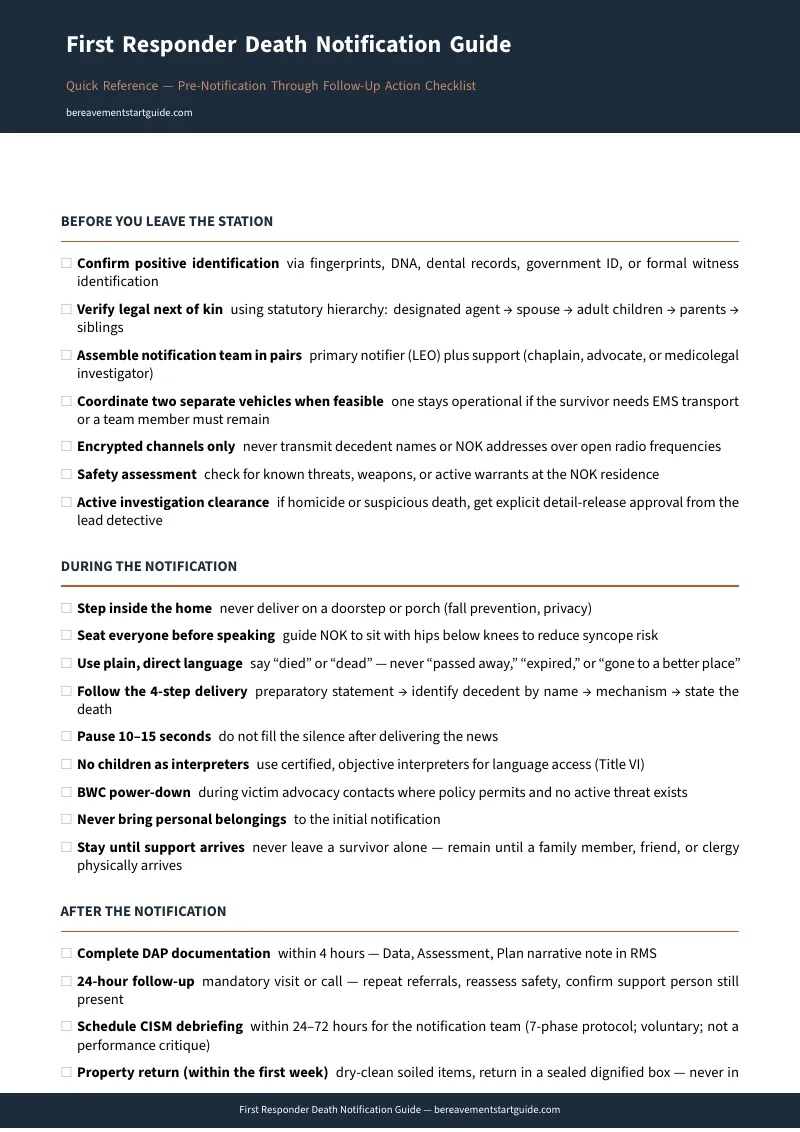
A systematic pre-notification protocol covering positive identification verification, next-of-kin priority confirmation, team composition, residence safety assessment, case investigation parameters, and vehicle coordination. A missed item at this stage cascades into the field — the checklist prevents that cascade before you leave the station.
Family Crisis Response Protocols
Structured approaches for managing acute shock, hostile reactions, medical emergencies triggered by notification, and minor children on scene. Non-verbal communication guidance — seating position, eye contact, physical grounding techniques — and verbal de-escalation scripts for when grief turns to rage. The notification environment is unstable by definition; these protocols keep it from becoming uncontrolled.
Cultural and Religious Considerations
Notification protocols adapted for diverse communities — including religious prohibitions on body handling, culturally specific mourning practices that affect scene management, and language considerations when notifying through an interpreter. One culturally uninformed action during a notification can damage community trust for an entire agency.
Responder Wellness and Debriefing Tools
Post-notification debriefing frameworks built on Mitchell's 7-phase CISD model alongside voluntary peer-led defusing protocols. Screening tools for secondary traumatic stress, moral injury, and burnout — the three psychological hazards of repeated death notification that most agencies never differentiate. Knowing the difference between "I'm burned out" and "I feel guilty about how I handled that call" changes what kind of support actually helps.
Who This Guide Is For
- Law enforcement officers — patrol, detectives, and command staff who deliver or supervise next-of-kin notifications
- EMS clinicians and fire service personnel — paramedics, EMTs, and fire captains managing on-scene pronouncements and immediate family contact
- Medicolegal death investigators — coroner and medical examiner staff coordinating jurisdiction and body release
- Victim services advocates — crisis intervention specialists deployed alongside notification teams
- Chaplains and peer support coordinators — managing spiritual care and team wellness after high-impact calls
- Agency trainers — building notification training programs from a structured, evidence-based framework
Why Not Free Resources?
Free death notification resources fall into two categories, and both leave you exposed.
Professional association toolkits (IACP, FBI, MADD) carry institutional credibility but are typically archived behind member logins, lack customizable templates, and haven't been updated to address body-worn camera policies, HIPAA's post-mortem exemptions, or digital-era media leaks. Institutional SOPs are legally vetted for a single jurisdiction but read like compliance manuals — they tell you the regulation without giving you the communication scripts, de-escalation tactics, or wellness tools that make the difference between a notification that stabilizes a family and one that damages them.
Generic grief handouts approach death from the survivor's perspective — empathetic but entirely useless for the tactical, legal, and scene-safety considerations of field operations. And law firm compliance articles cover liability without once acknowledging that the person you're protecting yourself from is also the person you're supposed to help.
This guide bridges the gap: legally defensible protocols that also protect the family's dignity and your psychological health. Shield and compass in the same manual.
Satisfaction Guarantee
If this guide doesn't give you a clearer, more confident approach to death notification, email hello@bereavementstartguide.com for a full refund — no time limit, no questions asked.
Get Started
Download the free Quick Reference checklist to see the notification sequence at a glance. When you're ready for the complete protocols, scripts, legal compliance frameworks, and debriefing tools, get the full kit — for 9 printable PDFs you can pull up on your phone at the scene.