The estate won't settle itself — and your family won't survive the process without structure
When a parent who remarried dies, the legal system treats their stepchildren as strangers. The surviving spouse can rewrite their will the day after the funeral. Verbal promises about the house, the retirement account, the family jewelry — none of them carry legal weight. And the executor is left trying to hold together a family that is one misunderstood text message away from permanent estrangement.
Sixty percent of second marriages end in divorce. In the ones that last, a death triggers something worse: an inheritance dispute where every participant is grieving, suspicious, and operating from incomplete information about what the law actually says.
The Step-Relations Settlement System
The Blended Family Inheritance toolkit replaces confusion with process. Instead of hoping that everyone stays reasonable while frozen bank accounts, creditor letters, and probate deadlines pile up, you give every party — biological children, stepchildren, the surviving spouse, the executor — the same framework, the same timeline, and the same language for conversations that feel deeply personal but are actually administrative.
This is not a general estate planning guide. It is a settlement system built specifically for the fault lines that exist only in blended families: the surviving spouse who controls assets the biological children were promised, the stepchild with no legal standing, the executor accused of favoritism, and the family heirloom that three people believe was promised to them.
What's Inside
- Legal Doctrine Decoder — plain-language explanations of the three doctrines that actually protect blended families (contractual mutual wills, proprietary estoppel, quantum meruit for caregivers), with the exact evidence requirements courts demand. Most families learn about these too late or from a $400-per-hour attorney explaining why their case is weak.
- Communication Script Book — word-for-word email and message templates for the conversations that derail blended estate settlements: requesting financial transparency from a defensive step-parent, notifying stepchildren of their legal standing, establishing executor boundaries with hostile beneficiaries, and proposing mediation before litigation.
- Heirloom Division Protocol — the snake-draft system used by professional estate mediators to divide sentimental personal property fairly. Classify items by provenance (bloodline heirloom vs. marital acquisition), photograph and inventory everything, then run a structured selection process that eliminates first-mover advantage and shouting matches.
- Probate Timeline Tracker — every critical deadline across five phases: will filing windows, creditor notice periods, tax return due dates, and distribution milestones. Missing a single deadline can expose the executor to personal liability or give a disgruntled beneficiary grounds for a removal petition.
- Property Classification Worksheets — structured tools for separating marital property from separate property, tracing commingled assets back to their source, and documenting the ownership history that determines who actually has a legal claim to what.
- Executor Liability Shield — fiduciary duty checklists, accounting templates, and documentation protocols that protect the executor from the removal petitions and breach-of-duty claims that are endemic to blended family estates.
- Trust Structure Guide — when and how to use QTIP trusts (income for the surviving spouse, principal preserved for biological children), ILITs (life insurance proceeds outside the taxable estate), and revocable living trusts (probate avoidance). Each structure is explained with a worked dollar example showing exactly how the money flows.
- Conflict Resolution Framework — a decision tree that moves through self-managed negotiation, family settlement agreements, formal mediation, and litigation, with clear indicators for when to escalate. Includes a caregiver compensation calculator for the family member who spent years providing care and needs documentation to support a quantum meruit claim.
Who This Toolkit Is For
- Executors navigating step-relations — you've been named in the will and need to administer the estate while managing the expectations of biological children, stepchildren, and a surviving spouse who may have competing interests.
- Adult biological children concerned about disinheritance — your parent remarried, and you need to understand your actual legal options if the surviving step-parent controls the estate or changes their will.
- Surviving step-parents establishing their rights — you need to understand homestead protections, elective share claims, and jointly titled asset rules so you can secure your financial position without triggering a family war.
- Stepchildren who were promised an inheritance — verbal promises don't hold up in court without specific evidence. The toolkit explains exactly what documentation you need and which legal doctrines may apply to your situation.
- Families heading toward mediation — the toolkit's frameworks often resolve disputes before they reach a mediator's office, and when mediation is necessary, they ensure you arrive organized and prepared.
Why Scattered Free Resources Won't Get You Through This
Free articles explain what probate is. They don't tell you what to say when your stepmother refuses to produce the will, or how to respond when your stepsiblings hire a lawyer and start threatening the estate, or what to do when you discover that the beneficiary designation on your father's retirement account still names his first wife.
Estate planning blogs are written for people planning ahead. This toolkit is built for people dealing with a death that already happened, with deadlines already running, in a family structure that generic advice was never designed to address.
The difference between a blended family that survives estate settlement and one that fractures permanently is almost never about the money. It is about whether someone brought a structured process to the chaos before suspicion hardened into estrangement.
Full Refund, No Time Limit
If the toolkit doesn't help you navigate your family's situation, email hello@bereavementstartguide.com for a full refund. No time limit, no questions asked. You're dealing with enough right now — a purchase decision shouldn't add to it.
Get the Blended Family Inheritance Toolkit — bring structure, legal clarity, and communication tools to the most complex estate settlement a family can face.
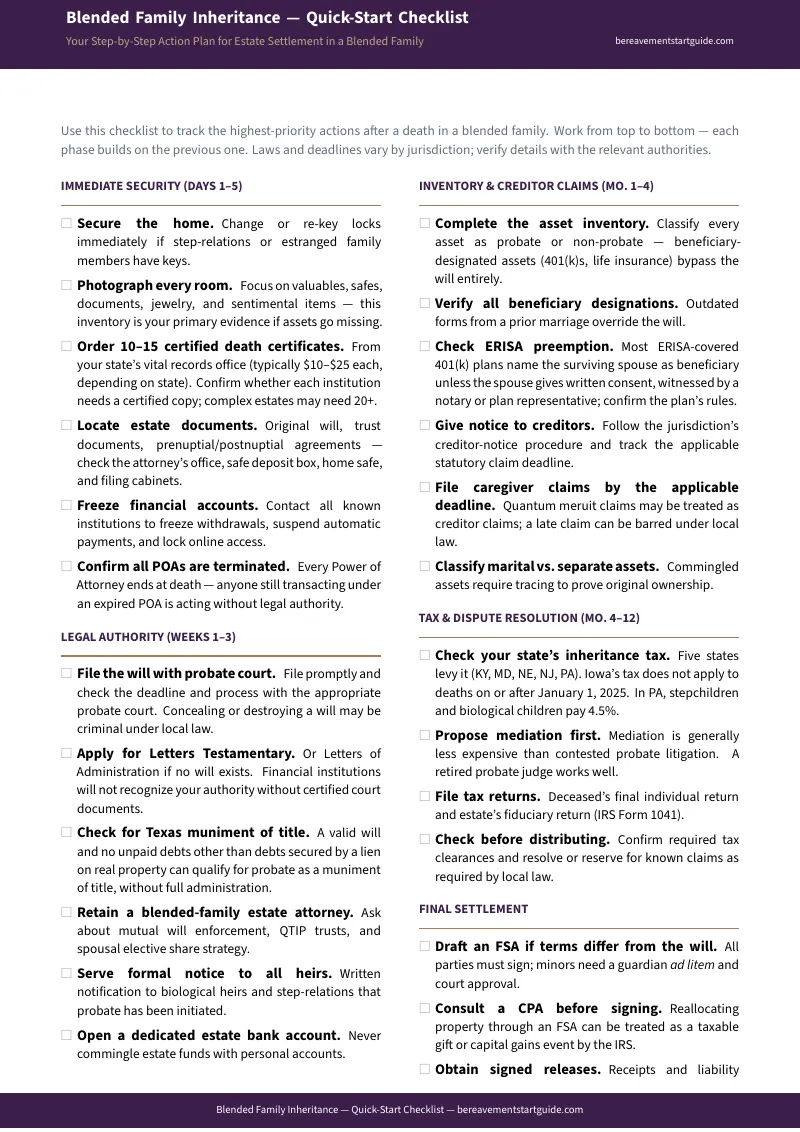
Or start with the free Quick-Start Checklist to see whether the approach fits your situation before committing to the full toolkit.