
Your child is grieving. You are drowning in paperwork. Nobody built a resource that handles both.
The death split your world into two urgent crises running on the same clock. On one side, a child — maybe a three-year-old asking when Daddy is coming back, maybe a ten-year-old who stopped eating, maybe a teenager who punched a hole in the drywall — needs you to say and do exactly the right things during the most psychologically fragile period of their young life. On the other side, the probate court wants a full asset inventory, Social Security requires an in-person appointment for survivor benefits, the bank froze the joint account, the school is calling about absences, and the life insurance company needs a notarized claim form you cannot find. You are the same person on both sides. And your brain is operating at roughly half its normal capacity because acute bereavement has shifted your nervous system into survival mode — a clinically documented phenomenon researchers call "grief brain."
You searched for help. You found grief books that speak compassionately about children's emotional development but offer nothing for the probate deadline next Tuesday. You found legal guides that explain estate administration with the emotional depth of a tax filing. You found Etsy printables with beautiful grief journal pages designed by graphic designers who have never navigated a court inventory. Nobody built the resource you actually need: a single toolkit that treats a child's grief and the estate's administrative demands as one interconnected system — because that is what they are in your household right now.
The Grief-and-Administration Bridge
This workbook is organized around a structural reality that every other product ignores: every legal and financial task you face has a direct emotional consequence for the child in your care, and every behavioral shift in that child has practical implications for your administrative timeline. When the bank freezes the estate account, it does not just delay probate — it creates a cash-flow crisis that destabilizes the child's daily routine. When a child refuses to go back to school, it does not just affect grades — it triggers accommodation requirements that need formal documentation before the district will act.
The Grief-and-Administration Bridge pairs every administrative step with its emotional counterpart across a developmental span from age two through eighteen. You never handle a financial task without understanding how it affects the children. You never address a behavioral concern without knowing which logistical actions to take alongside it.
What's Inside
- Developmental Grief Framework (Ages 2–18) — four clinically grounded age brackets, each with the cognitive science of how that age group processes death, the behavioral markers to watch for, and the specific mistakes adults make when they interpret normal developmental grief as pathological behavior. A three-year-old asking "When is Mommy coming home?" twenty times is not failing to understand — they are processing death the only way a preschool brain can. This chapter stops you from making it worse.
- Age-Specific Conversation Scripts — word-for-word language for telling a child someone has died, calibrated for toddlers, school-age children, preteens, and adolescents. Separate scripts cover sudden death, anticipated death, suicide, overdose, and homicide — because "just be honest" is not a strategy when you are shaking and the child is looking at you waiting for the world to make sense again.
- Six Therapeutic Activities with Clinical Backing — hands-on grief processing activities matched to developmental stage: Somatic Worry Dolls for ages 4–10, the Indoor Memory Garden for ages 5–12, the Rainbow Emotion Wheel for ages 3–8, the Straw Rocket Emotional Release for ages 4–12, the Grief Jar Model for ages 6–12, and a Five-Minute Somatic Check-In for ages 8 and up. Each one includes a materials list, step-by-step instructions, the therapeutic objective it serves, and guidance on what responses to expect from the child.
- Estate Administration Roadmap — the complete sequence of legal and financial obligations following a death: registering the death, ordering death certificates (how many copies and why), establishing legal authority through Letters Testamentary or Letters of Administration, opening an estate bank account with an EIN, filing Social Security survivor benefits, notifying credit bureaus, and navigating the probate inventory timeline. All of it written for someone whose working memory is fragmented, not a paralegal.
- Family Conflict Resolution System — personal property disputes ignite more family conflict than liquid assets. This section includes a Personal Property Memorandum (PPM) template, verbal scripts for de-escalating sibling rivalries over heirlooms, and structured approaches to rotating item selection, point allocation, and professional mediation — because "divide everything equally" is not a plan when three siblings want the same ring.
- School Coordination Templates — notification letter templates for the child's school, guidance on requesting academic accommodations (including Section 504 plans in the U.S.), a structured school re-entry meeting agenda, and long-term academic planning frameworks. Schools accommodate grieving students, but only when someone advocates in writing with the right language.
- Sibling Loss Chapter — a dedicated section for families where the death was a child's brother or sister, covering survivor guilt, identity reconstruction, and the specific interventions that help surviving siblings process a category of grief that adults routinely underestimate.
- Behavioral Tracking and Crisis Screening — a structured tool for monitoring regression, somatic complaints, and behavioral changes over time, paired with a clinical diagnostic framework for distinguishing normal grief from complicated grief that requires professional intervention. Includes the specific questions to ask a grief-trained therapist before the first appointment.
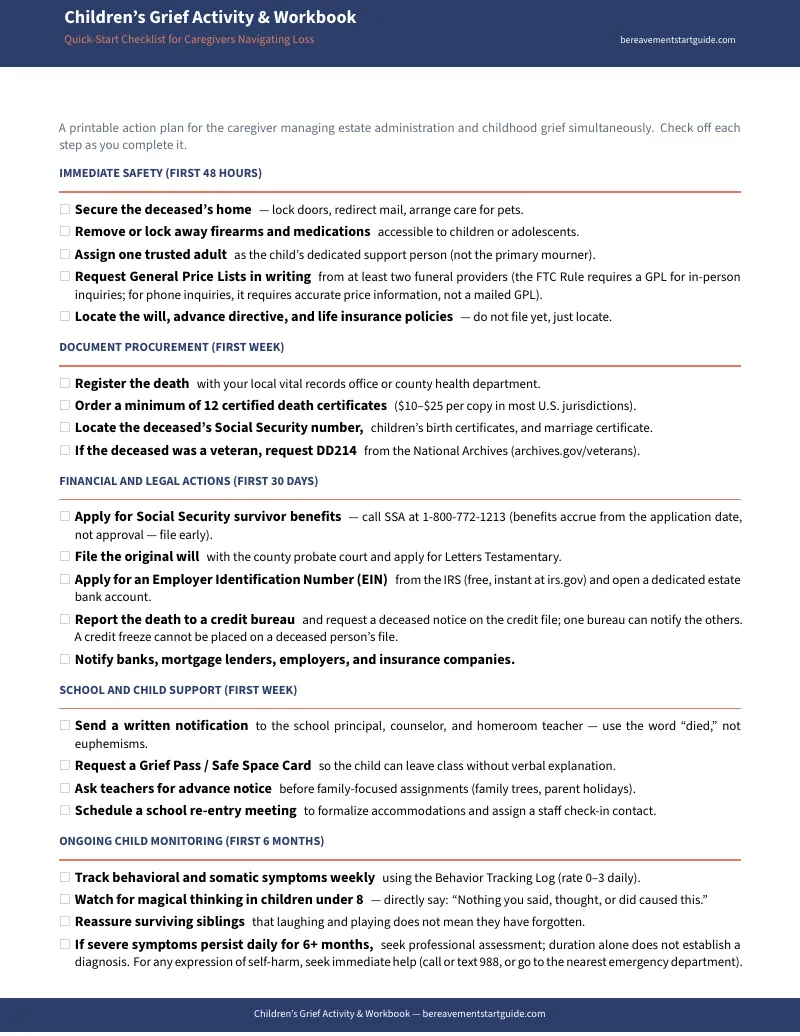
- 23-Item Quick-Start Checklist — every critical action item organized by urgency across five phases, from the first 48 hours through the six-month mark. Designed for someone who needs the next right step without reading a full chapter.
Who This Is For
You are a surviving parent, grandparent, stepparent, aunt, uncle, godparent, foster carer, or family friend who just became the person responsible for a grieving child and a pile of legal obligations. The children in your care range from toddlers to teenagers. You are operating under decision fatigue, sleep deprivation, and the kind of cognitive overload that makes a trip to the post office feel like a military operation. You need a system, not sympathy.
This workbook is also used by school counselors, teachers, therapists, hospice social workers, and clergy who support grieving families — the developmental frameworks and therapeutic activities work for any adult in a child's orbit.
Why Free Resources Leave You Stranded
The free resources available online are each missing a critical piece. Bereavement nonprofits like the Dougy Center and the National Alliance for Children's Grief offer world-class clinical guidance on childhood grief — but their organizational charters prohibit them from covering estate administration, tax obligations, or benefit filings. Government portals explain how to file for survivor benefits in bureaucratic prose that assumes you are not simultaneously managing a seven-year-old's nightmares. Estate planning sites are written for people making plans before a death, not people in crisis after one. Funeral home resource pages are compassionate but shallow — built to drive local business, not to help you through month four when the probate is still open and the child's grades are still dropping.
Assembling this information yourself from these scattered sources requires dozens of hours of research during a period when your cognitive energy is at its absolute lowest. This workbook consolidates everything a caregiver needs — the legal mechanics, the child psychology, the school coordination, the family mediation — into a single structured system designed to be scanned rapidly under conditions of profound exhaustion.
Satisfaction Guarantee
Full refund, no time limit. If this workbook does not help your family, email hello@bereavementstartguide.com and we will process your refund. No forms, no justification required.
Get Started Now
Download the free Quick-Start Checklist to see 23 prioritized action items immediately. When you are ready for the full workbook — the developmental scripts, the therapeutic activities, the estate administration roadmap, the school templates, and the behavioral tracking tools — get the complete toolkit for .