The Compliance Gap That Keeps You Up at Night
You run a tight operation. Your staff treats families with genuine compassion. Your facility is clean, your equipment is maintained, and your reputation in the community is everything.
But when was the last time you verified that your receptionist knows the exact FTC disclosure requirements for a phone pricing inquiry? Can every member of your transport team complete a chain-of-custody log that would survive a state board audit? Does your arrangement conference protocol include a disposition authority verification step — the one that prevents a contested cremation from becoming a six-figure lawsuit?
The gap between knowing the rules and executing them under pressure is where funeral homes get into trouble. Not from incompetence. From the absence of printed, repeatable systems that work at 2 a.m. with a skeleton crew.
The Audit-Ready Operations System
The Funeral Director's Compliance & Best Practice Toolkit is a complete operational compliance system — not a reference manual you read once and shelve. It is built around ten standalone tools designed to be printed, posted in your facility, and used with a pen during active shifts.
Every protocol traces directly to a specific federal regulation, state statute, or professional standard. Every template includes clearly marked state-law adaptation fields so you can customize it to your jurisdiction. Every script is written for the person who will actually use it — your night-shift receptionist, your transport driver, your apprentice embalmer — not for a compliance officer reviewing it in a conference room.
What the Toolkit Covers
- FTC Funeral Rule Compliance — GPL distribution protocols, telephone pricing templates, itemization checklists, and the Price Disclosure Log that creates an auditable record of every consumer inquiry. Violations carry penalties up to $53,088 per violation and are enforced through undercover inspections.
- 14-Point Chain-of-Custody System — intake logging, numbered ID disc assignment, personal effects dual-signature inventory, and third-party crematory due diligence. Every set of remains is tracked from removal through final disposition without a single undocumented handoff.
- Right of Disposition Verification — the worksheet that identifies who holds legal authority before you accept any instructions. State-by-state statutory priority tiers, contested-disposition protocols, and the documentation that protects your firm when family members disagree.
- Embalming Authorization Protocols — state-specific consent procedures, verbal consent documentation for time-critical cases, and the forms that keep you compliant whether your state uses a promulgated authorization form or allows in-house versions.
- OSHA Preparation Room Safety — formaldehyde air monitoring protocols, PPE standards, emergency eyewash requirements, and the 30-year exposure monitoring records required under 29 CFR § 1910.1048.
- Mandated Reporting Protocols — post-mortem elder abuse indicators, suspicious death recognition, and the reporting procedures that protect your license.
- Staff Mental Health Framework — Critical Incident Stress Debrief protocols, secondary traumatic stress screening, countertransference management, and structured debriefing for traumatic cases.
- Arrangement Conference Communication — verbal scripts for pricing conversations, de-escalation techniques for family conflict, and boundary-setting language for high-emotion situations.
- State Record Retention Matrix — federal minimums mapped against state-specific requirements, formatted for posting in your records room.
- Family Aftercare Tools — bereavement referral handouts and community resource directories customizable for your local area.
Who This Is Built For
- Independent funeral home owners and managers who need audit-ready systems without a corporate compliance department
- Licensed funeral directors handling removals, arrangements, and inspections without standardized protocols
- Embalmers and preparation room staff responsible for OSHA compliance and chain-of-custody integrity
- Apprentices and newly licensed professionals who need the operational playbook mortuary school didn't provide
Why Association Memberships and CE Courses Are Not Enough
The NFDA and ICCFA provide credible general guidance — but their custom compliance program templates cost $600 to $1,700 and still require extensive reformatting before your staff can use them during a shift. Continuing education courses build knowledge over weeks of structured learning hours, but they hand you nothing printable for tomorrow's midnight removal. Law-firm blogs explain your liability exposure without giving your receptionist a script for handling a price inquiry.
This toolkit fills the execution gap. It gives your team the printed logs, verbal scripts, and decision frameworks they need at the point of action — not the point of study.
What You Get
Your purchase includes 12 PDF downloads:
- The Complete Guide — a 14-chapter operational manual covering every regulatory domain with protocols, scripts, and decision frameworks your team can implement immediately
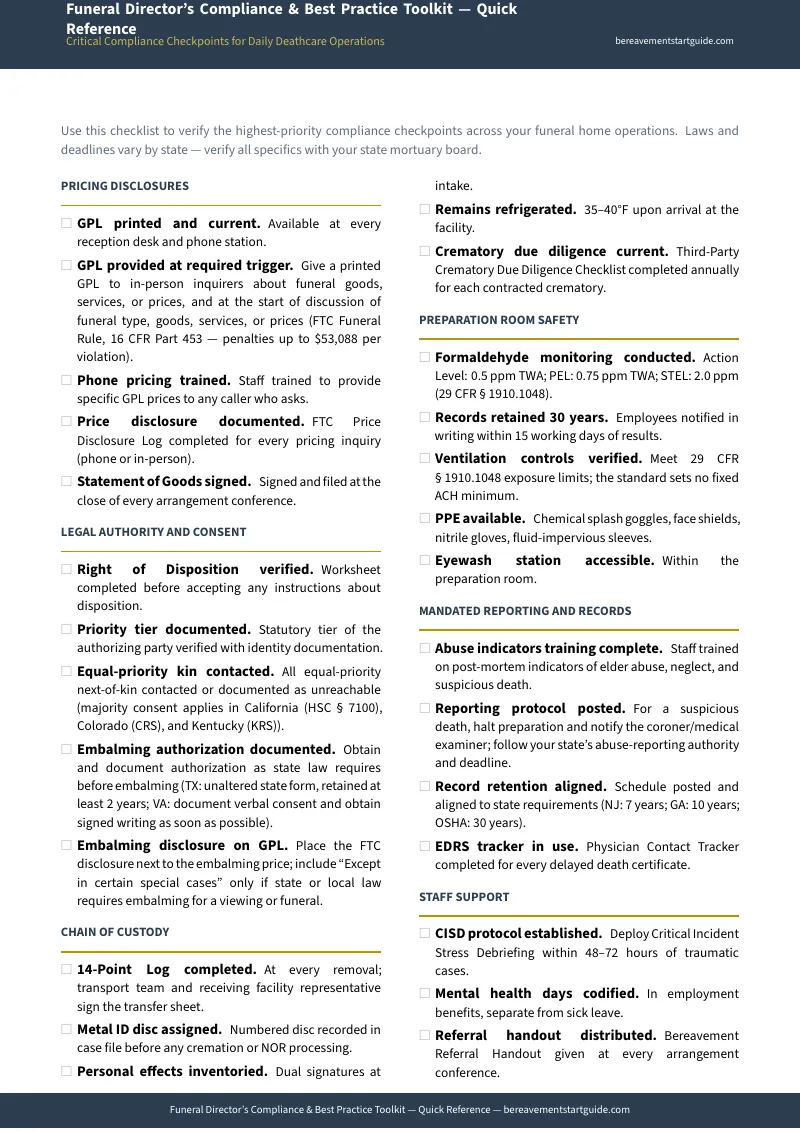
- The Quick-Reference Checklist — a printable compliance checkpoint list designed to live in your SOP binder, covering pricing disclosures, chain-of-custody, preparation room safety, and mandated reporting
- 10 Standalone Tools — the 14-Point Chain-of-Custody Log, FTC Price Disclosure Log, Right of Disposition Worksheet, Verbal Embalming Consent Form, OSHA Monitoring Log, EDRS Physician Contact Tracker, Crematory Due Diligence Checklist, State Record Retention Matrix, Critical Incident Stress Debrief Log, and Family Bereavement Referral Handout — each designed to be printed in quantity and used by every staff member who performs the relevant function
Full Refund, No Time Limit
If the toolkit doesn't improve your operation's compliance posture, email hello@bereavementstartguide.com for a full refund. No time limit. No questions.
Your team already knows the rules. This toolkit gives them the systems to execute those rules — during the shifts when execution actually matters.
Download the Toolkit and put audit-ready protocols in your facility's hands this week. Or start with the free quick-reference checklist to see the format and approach before you decide.