You just got the worst phone call of your life — and now two countries need you to make perfect decisions
Your family member has died in Colombia. The hospital, the police, or a travel companion delivered the news. And within hours, you are expected to navigate a system you have never seen — in a language you may not speak — while grieving.
The Colombian authorities may already have custody of the body. If the death was anything other than a physician-witnessed natural passing in a hospital, the Fiscalía General de la Nación and Medicina Legal take over. Visual identification by family is legally prohibited — they use fingerprints, dental records, or DNA. The remains become state evidence, and you have no authority to move them until a prosecutor signs a release order.
Meanwhile, a 48-hour countdown is running on death registration at the local Notaría. Miss it, and you trigger a formal late-registration process that requires sworn witnesses under oath, a police inspector's judicial authorization, and weeks of administrative delay. Every document that depends on the death registry — the apostille, the translation, the embassy report, the probate filing — stalls behind that one missed window.
The U.S. Embassy can open a consular case, but they cannot select a funeral home, pay for services, negotiate costs, or make any decision about what happens to the remains. They point you to the next agency. Nobody gives you the full picture.
The Cross-Border Death Navigator — a step-by-step system built for the U.S.–Colombia corridor
This is not a generic death-abroad overview. The American Dies in Colombia — Family Emergency Guide was built specifically for the legal, logistical, and administrative corridor between Colombia and the United States. It maps every agency you will encounter, every document you need, and every decision you face — in the exact order you will face them.
The guide covers two distinct tracks from the moment of death: the medical-certificate track (when a licensed physician certifies a natural death in a hospital or clinic) and the forensic track (when the Fiscalía and Medicina Legal take jurisdiction over unattended, accidental, violent, or suspicious deaths). You follow the track that applies to your situation, and every subsequent chapter builds on that foundation.
What's inside the guide
- The emergency notification sequence — the exact priority order for police, embassy, funeral home, insurance, and employer, with specific warnings about what authorizations to obtain before signing any contracts
- The two-track classification system — how Colombian law routes deaths and what each track means for your timeline, your options, and your costs, including the holiday calendar that delays government processing by 72 to 96 hours during puentes
- Forensic track navigation — the three-tier identification process at Medicina Legal (fingerprints, dental records, DNA), the prosecutor's absolute authority over the remains, and what it means when a case is classified as reservado with autopsy findings sealed for up to a year
- The document legalization pipeline — the exact sequence from Registro Civil de Defunción to electronic apostille through the Cancillería portal to certified English translation, timed so nothing gets rejected and nothing has to be redone
- Repatriation logistics — hermetically sealed casket specifications for Avianca Cargo and Copa Airlines, the Consular Mortuary Certificate from the U.S. Embassy, and a coordination timeline for managing two funeral homes across two countries simultaneously
- Cremation and ashes transport — the Fiscalía cremation block that catches most families off guard, TSA-compliant urn materials for carry-on, and the documents you need at El Dorado International Airport
- Local burial decision framework — the four-year municipal cemetery lease limit, the exhumation and common-grave risk upon expiration, and the questions to work through before making an irreversible choice under time pressure
- Insurance claim coordination — how to notify your travel insurer immediately, the prior-authorization rule that can void your entire repatriation benefit, and a printable claim-filing checklist with fill-in fields for claim numbers and authorization codes
- U.S.-side estate settlement — how the e-CRODA replaces a domestic death certificate for probate, bank account claims, life insurance filings, and the post-repeal Social Security survivor benefit paths (the WEP and GPO were eliminated in January 2025 — the guide explains what that means for your claim)
- Bilingual glossary and contact directory — every Spanish legal term used in the guide, translated and explained, plus direct phone numbers for Medicina Legal, the Fiscalía, the Registraduría, the Cancillería, and the U.S. Embassy ACS unit in Bogota
- 7 printable worksheets — fill-in tools for the 72-hour emergency period, document legalization tracking, funeral home cost comparison, insurance claim filing, agency communication logging, estate asset inventory, and Social Security benefit verification
Who this guide is built for
- The spouse or partner in Colombia who needs to act today — you are dealing with local authorities, a funeral home, and a ticking clock on remains preservation, often while isolated from your family network back in the United States
- The adult child coordinating from the United States — you are managing logistics across time zones, making decisions about repatriation vs. local disposition, and trying to get documents that will actually work in American probate court
- The executor or probate attorney — you need the certified document sequence spelled out so you can file correctly the first time, without costly rejections from banks or courts
- The travel companion at the scene — you are in a foreign country, possibly at a hospital or police station, and you need the emergency contact numbers and first-response instructions right now
Why free information falls short in this corridor
The U.S. Embassy's website tells you to contact a local funeral home. The funeral home tells you to wait for Medicina Legal. Medicina Legal tells you the case is with the Fiscalía. The Fiscalía tells you the case is reservado. Expat forums give you advice from someone who handled a different type of death, in a different city, years ago under different regulations.
The problem is not a lack of information — it is that the information is fragmented across agencies, websites, and languages, and none of it is sequenced. You cannot figure out step four until you know that steps one through three happened in the right order. A single document error — a missing apostille, a name misspelled by the Notaría, a translation done before the apostille was issued — sends you back to the beginning of a process that already takes weeks.
This guide connects the entire chain. Every chapter tells you what you need from the previous step before you can proceed, what can go wrong, and how to fix it if it does.
Your purchase is protected
Full refund, no time limit. If the guide does not help your situation, email hello@bereavementstartguide.com and we will refund you — no questions, no deadline.
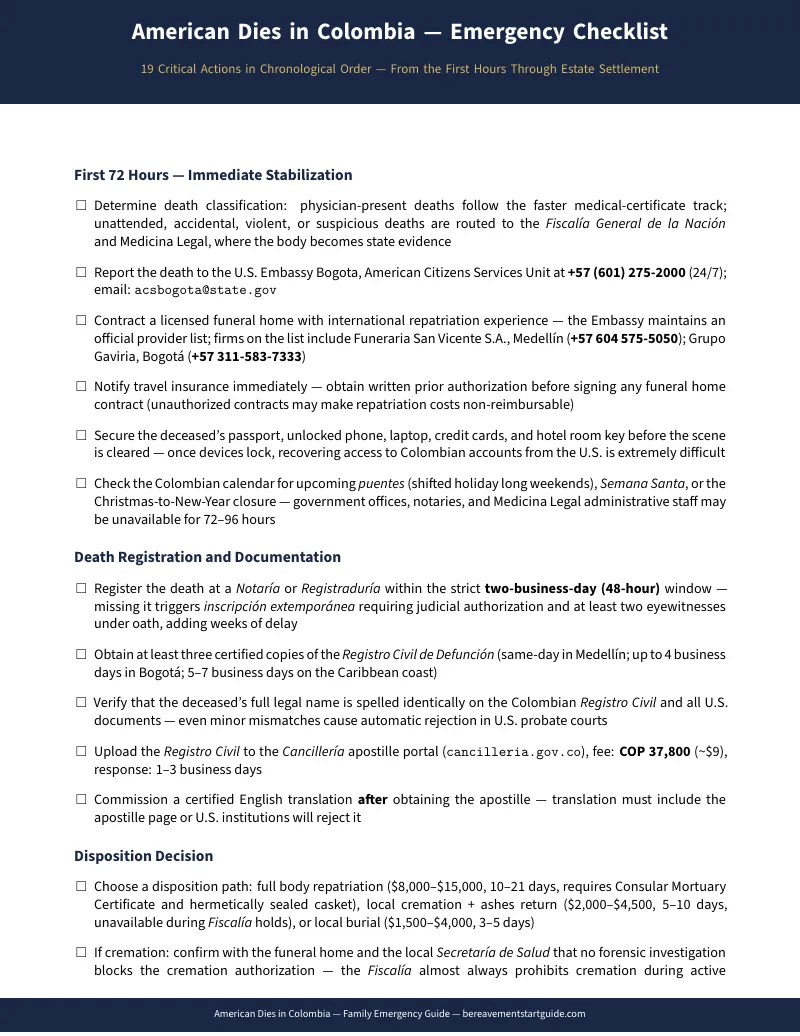
The free checklist gives you the emergency sequence. The full guide gives you everything else — the detailed how behind every step, the documents, the decision frameworks, and the bilingual reference materials that keep the process moving forward instead of stalling at every agency handoff.