The Post-Mortem Clinical Playbook — Every Script, Template, and Decision Tree You Need When a Patient Dies on Your Watch
The pager goes off at 2 a.m. A patient on your unit just died. The charge nurse is waiting for you to come manage the family. The spouse is sobbing in the hallway. Two adult children are already arguing about cremation. One of them is demanding to see the chart. The organ procurement organization is calling. Risk management wants your documentation before shift change. And the bed manager needs a timeline.
Your hospital's policy manual tells you to "notify next of kin and document the encounter." It does not tell you what to say when the spouse asks how their partner died and you are not sure what HIPAA lets you disclose. It does not tell you who signs for cremation when Texas law requires a majority of adult children and the family is split two to two. It does not tell you how to chart a volatile de-escalation in language that protects your license if a family member files a complaint six months later.
The Hospital Social Worker's Death Resource Kit is the Post-Mortem Clinical Playbook — the operational bridge between your hospital's compliance manual and the clinical reality of managing a death at 2 a.m. with no supervisor, no legal counsel, and no margin for procedural error.
What Makes This Different from What You Already Have
Your hospital's post-mortem procedures protect the institution. This playbook protects you — your clinical practice, your documentation, your emotional boundaries, and your license. It translates the legal statutes, HIPAA regulations, and NASW ethical standards into the specific words you say, the specific forms you fill out, and the specific decisions you make during the actual crisis.
Professional association toolkits give you ethical frameworks written for a professional development seminar. This playbook gives you verbatim scripts you can read from while standing at a bedside. Palliative care CEUs build deep knowledge over weeks of classroom time. This playbook gives you the clinical decision tree you need tonight. Law-firm HIPAA briefings explain the regulation in precise legal language and then suggest you call them at $400 an hour. This playbook gives you the worked examples that show exactly what you can and cannot disclose, in the actual scenarios you face.
What's Inside the Kit
- Death Notification Script Library — verbatim scripts using the Ask-Tell-Ask model for expected deaths, sudden deaths, traumatic deaths, and pediatric deaths, with the specific language substitutions that prevent the confusion euphemisms create during acute grief
- HIPAA Post-Mortem Decision Trees — the 50-year PHI protection framework mapped to the five disclosure scenarios you actually face, with worked examples showing exactly what you can tell a distraught family member demanding chart access versus a court-appointed personal representative versus a funeral director
- Next-of-Kin Verification and Right of Sepulcher Framework — the state-aware hierarchy for determining who has legal authority over final disposition, including cremation majority rules, written-declaration overrides, forced-timeline waiver provisions, and the specific protocols for when parental rights have been terminated
- SBAR Documentation and Defensive Charting Templates — copy-paste-ready progress note frameworks in SOAP, BIRP, and DAP formats, designed for post-mortem bereavement encounters with the clinical language that passes audit, establishes your scope of practice, and holds up in discovery
- OPO Coordination Protocol — the federally mandated notification sequence, the clinical boundary between your role and the OPO's family approach, and the Medicare Conditions of Participation compliance requirements that protect your hospital's certification
- Unclaimed and Unrepresented Patient Workflows — the diligent search protocol for patients who die without identifiable next of kin, including personal effects review, database search procedures, veterans affairs coordination, and the documentation standards that demonstrate due diligence when a relative surfaces months later
- Crisis De-escalation and Boundary Scripts — evidence-based techniques for managing volatile relatives who blame the hospital, with physical safety protocols, verbal boundary-setting language, and the de-escalation sequence that maintains clinical empathy without absorbing projected rage
- Cultural Competence Adaptations — practical adjustments for religious and cultural practices that affect body handling, viewing, autopsy consent, and disposition timing, with the specific language for navigating conflicts between family practices and hospital policy
- Interpreter Coordination Protocol — the clinical and legal requirements for professional medical interpreters during death notifications, with pre-session alignment scripts and the boundary violations created by using family members as interpreters
- Mandated Reporting at the Post-Mortem Interface — the clinical indicators that trigger reporting obligations at the moment of death, jurisdictional variations in reportable death categories, and the coordination protocols with coroners and medical examiners
- Staff Resilience and Secondary Trauma Prevention — the operational distinction between STS, compassion fatigue, and moral injury, with structured tools including Jonathan Bartels' "The Pause" bedside ritual, Schwartz Rounds guidance, self-assessment instruments, and team debrief protocols
- Family Resource Worksheets — white-label, print-ready "first steps" materials you hand to families before discharge, covering funeral home selection, death certificate copies, and immediate financial notifications — because families in acute shock retain almost nothing you say, and the worksheet bridges your intervention to their next action
Plus 8 standalone printable tools — death notification script cards, an SBAR progress note template, a next-of-kin verification worksheet, a post-incident debriefing form, a family resource handout, a telephone call log, a diligent search log, and an agency communication log — each designed to be printed and used at the bedside, in the consultation room, or during a team debrief.
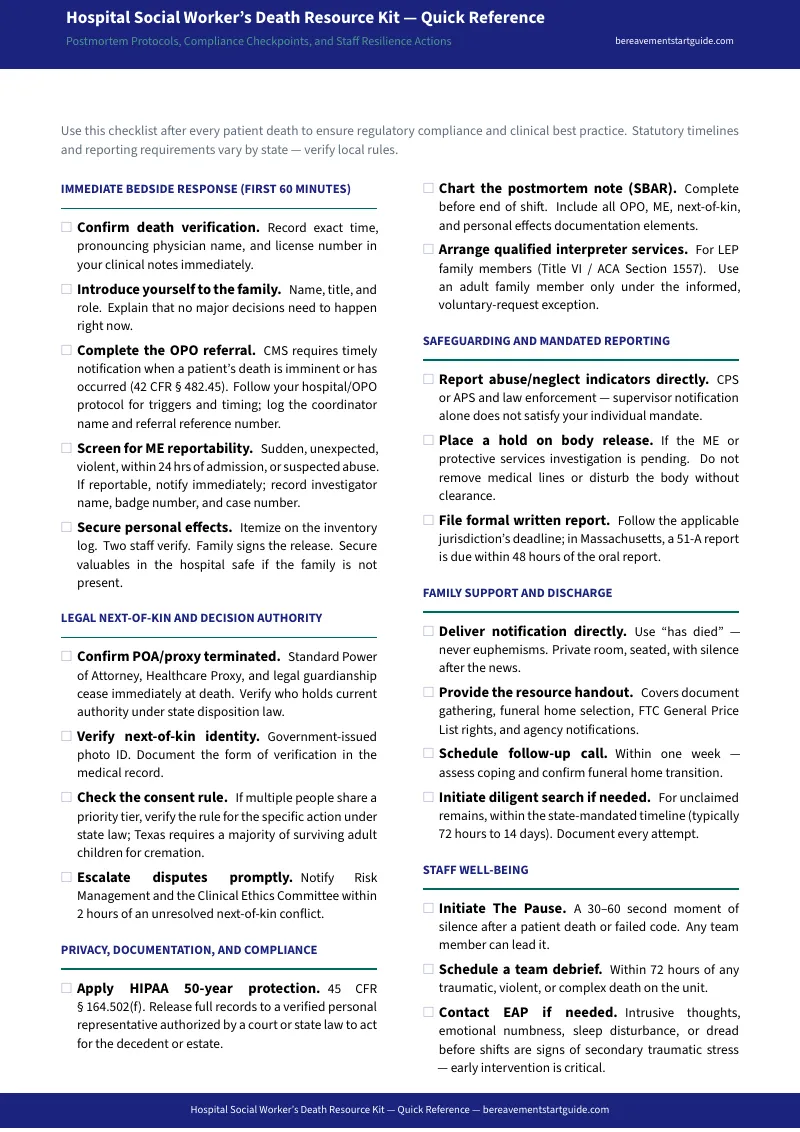
And a 22-item quick-reference checklist covering every critical action from initial page response through post-incident documentation — designed for your badge holder, not your bookshelf.
Who This Kit Is For
- Frontline hospital social workers in acute care, emergency departments, ICUs, and palliative care units who manage the clinical, legal, and emotional aftermath of patient deaths — and who need operational tools, not grief theory
- Case management supervisors and social work directors building standardized death response protocols for their departments
- Discharge coordinators and patient navigators handling the handoff chain from clinical units to decedent affairs, OPO, funeral directors, and county authorities
- New MSW graduates entering their first hospital role who completed excellent clinical training and zero preparation for managing a death at 2 a.m. with no supervisor available
Why Free Resources Fall Short
Free law-firm compliance blogs explain HIPAA post-mortem rules but offer no clinical context — no scripts for the family conversation, no guidance on charting the encounter, no framework for managing the emotional dynamics. Generic social work templates on Etsy and Teachers Pay Teachers are designed for outpatient therapy documentation, not the specific medicolegal requirements of post-mortem acute care. Your hospital's internal policy manual is written by risk management to protect institutional liability — it does not address your clinical communication needs, your emotional boundaries, or the specific charting vulnerabilities that arise when a family dispute escalates months after the death.
The Hospital Social Worker's Death Resource Kit integrates all three dimensions — legal compliance, clinical practice, and emotional resilience — into a single, immediately usable system designed for the professional who is standing at the bedside right now.
Satisfaction Guarantee
Full refund, no time limit. If the kit does not serve your practice, email hello@bereavementstartguide.com and you'll receive a complete refund — no questions, no deadline.
Get Started Now
Download the free quick-reference checklist to see the clinical action sequence. When you're ready for the complete scripts, decision trees, charting templates, and resilience tools, get the full Hospital Social Worker's Death Resource Kit — for .