Your family deserves a funeral that honors the tradition — not one cobbled together from contradictory Reddit threads at 2 a.m.
When a Buddhist elder dies, you don't get a grace period. Within hours, you're making decisions about body handling, monastic arrangements, and ritual sequencing that carry permanent spiritual and social consequences. The hospital wants to move the body. Your aunt insists on a specific chanting order. Your cousin's wife doesn't know whether to bow or kneel. And you — the person everyone is looking to — cannot find a single resource that covers your family's tradition from start to finish.
Temple pamphlets assume you read classical Chinese or Japanese. Funeral home guides are designed to upsell expensive packages, not explain which rituals are spiritually essential and which are commercial add-ons. Online forums are full of heartfelt advice from strangers whose family customs may differ completely from yours. And generic funeral planning sites skip Buddhist cosmology entirely — no 49-day mourning guidance, no altar setup instructions, no chanting protocols.
You need a resource that bridges the gap between ancient Mahayana tradition and the practical reality of planning a funeral in a Western institutional setting — one that respects the differences between Chinese, Vietnamese, Korean, and Japanese practices instead of treating East Asian Buddhism as a monolith.
The Mahayana Funeral Coordination System — Four Traditions, One Clear Framework
This guide is a cultural translator and cognitive buffer, built for the moment when grief and logistics collide. It separates universal Mahayana principles (the post-death quiet period, Pure Land aspirations, the 49-day intermediate state) from tradition-specific protocols (Korean Yeom bathing, Japanese Kotsuage bone-picking, Vietnamese Khâm Liệm wrapping, Chinese Shouyi dressing), so you always know which rules apply to your family and which don't.
Every section is organized by cultural context with side-by-side comparisons, so interfaith relatives and non-Buddhist funeral directors can follow along without confusion — and so you never accidentally apply a Japanese Koden-gaeshi return-gift obligation to a Vietnamese memorial meal.
What's Inside
- First-48-Hours Protocol — exactly what to do after clinical death across all four traditions. How to negotiate the 4-to-8-hour touch taboo with hospital staff, when to call the temple, and which documents to secure before the body is moved — because a misstep during the consciousness-transition window is the one thing families regret most.
- Body Preparation by Tradition — step-by-step instructions for the Chinese Shouyi longevity garments, Vietnamese Khâm Liệm and Nhập Quan, Korean Yeom bathing with incense water, and Japanese pre-cremation cleansing, with the spiritual reasoning behind each action so you understand why, not just what.
- Chanting and Liturgical Guide — what the Amitabha Sutra, Heart Sutra, and Ksitigarbha Sutra say and why each is recited, with the invocation names in all four languages, clear guidance on when each text is appropriate, and why Jodo Shinshu families follow different practices entirely.
- 49-Day Mourning Roadmap — weekly prayer schedules, dietary guidelines (including the five-pungent-roots prohibition for monastic catering), behavioral restrictions, and the spiritual logic of the Ten Kings' judgment cycle, through the 100th-day memorial and into annual ancestral rites.
- Condolence Money System — how Koden, Bai Jin, and Ipjang-dong envelopes work, why the bills must be circulated and amounts odd-numbered, and the complete Japanese Koden-gaeshi return-gift obligation with timing and value calculations — because a financial misstep at a funeral can damage relationships for a generation.
- Altar Setup Blueprints — visual placement guides for the Buddha image, portrait, incense burner, and food offerings across each tradition, including home altar maintenance during the mourning period.
- Funeral Director Coordination Packet — pre-written scripts and question lists for working with non-Buddhist Western funeral homes, covering incense permissions, extended visitation requests, crematorium witness accommodations, and the Kotsuage bone-picking ceremony.
- Guest Etiquette Sheet — a shareable one-page guide covering dress code, color rules (and the longevity exception for elders aged 80+), bowing protocol, what to say at the altar, and how to prepare the condolence envelope correctly.
- 9 Printable Planning Tools — timeline planner, 49-day mourning log, condolence money registry and gift ledger, hospital and mortuary directives form, funeral director negotiation sheet, guest etiquette sheet, elder consultation template, and condolence money quick reference.
Who This Guide Is For
- Diaspora adult children — you grew up attending temple with your parents but never learned the funeral liturgy. Now you're the chief mourner, coordinating between a Korean funeral hall, an English-speaking crematorium, and relatives who expect you to know the Seongbok sequence by heart.
- Interfaith spouses and in-laws — your partner's parent just died, and you've been asked to help coordinate the service. You want to participate respectfully without accidentally breaking a taboo you didn't know existed.
- Executors and close friends — you're managing logistics while the family grieves, and you need a framework for tracking condolence money, coordinating vegetarian catering, and communicating with the temple — all in the next 72 hours.
- Funeral directors and celebrants — you serve a diverse metropolitan community and need an authoritative, non-sectarian reference for Chinese, Vietnamese, Korean, and Japanese Buddhist services.
- Pre-planners — you want to document your wishes clearly across traditions so your children aren't left guessing under pressure.
Why Free Resources Fall Short
Temple literature assumes linguistic and cultural fluency that younger diaspora descendants don't have. It doesn't address Western hospital procedures, secular crematorium rules, or how to explain a four-hour touch taboo to an ICU nurse at 3 a.m.
Funeral home brochures are sales tools — they explain the services they want to sell you, not the home-based rituals (altar maintenance, daily merit-making, 49-day mourning practices) that happen outside their facility. They rarely explain why a ritual matters, which means families can't distinguish essential spiritual obligations from optional commercial upgrades.
Generic funeral planning sites handle probate, death certificates, and event logistics well. But they skip Buddhist cosmology completely — no guidance on consciousness transition, Pure Land aspirations, intermediate-state navigation, or the spiritual consequences of disrupting the post-death quiet period.
Online forums offer empathetic personal experiences, but the advice is often contradictory, colored by family-specific superstitions, and impossible to verify under time pressure. When you're planning a funeral in 48 hours, you can't afford to cross-reference three Reddit threads against a temple pamphlet written in a language you don't read fluently.
This guide consolidates all of it — the theological depth of temple resources, the logistical clarity of professional planners, and the real-world nuances of diaspora experience — into one structured framework organized by cultural context.
Satisfaction Guarantee
If the guide doesn't help you plan a more dignified, less stressful service, email us within 60 days for a full refund. No questions, no conditions.
Get Started Now
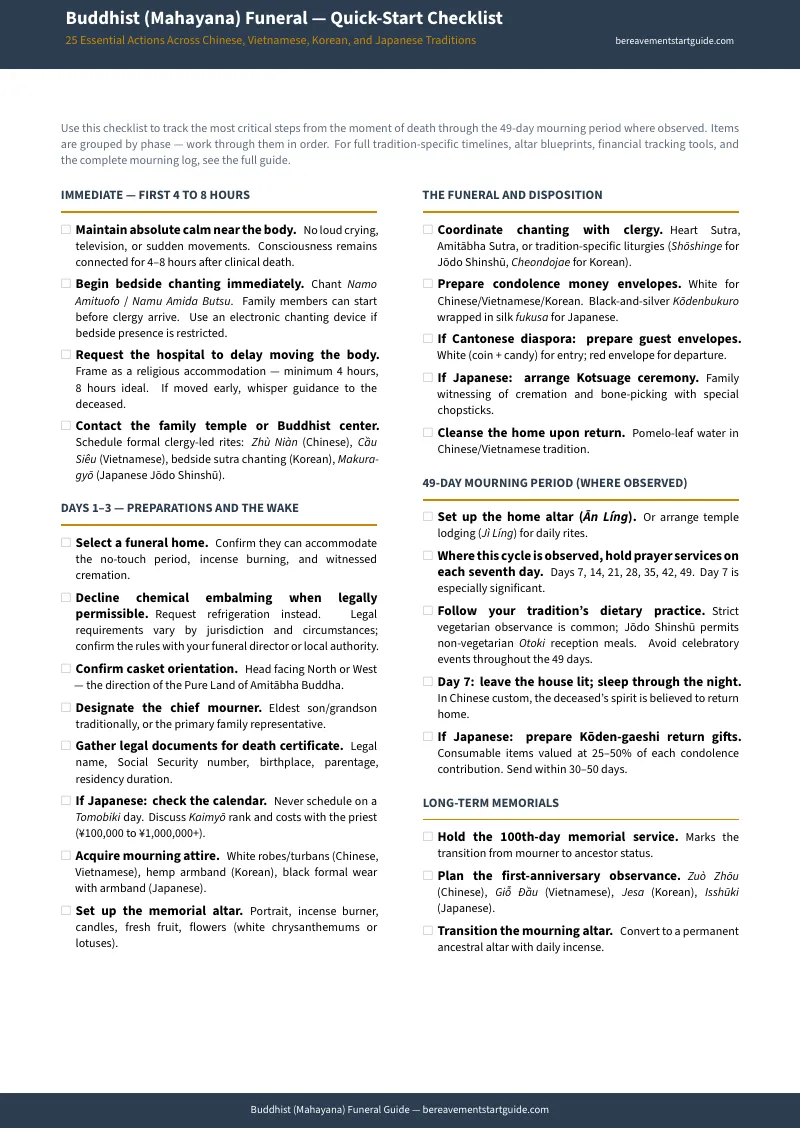
Download the free checklist for a single-page action sequence — the essential steps in order, with nothing extra. Or get the full guide for and access the complete coordination system: a 14-chapter guide plus 9 printable planning tools — tradition-by-tradition protocols, chanting guidance, funeral director negotiation sheets, hospital directives forms, a 49-day mourning log, condolence money registry, guest etiquette sheet, and more.