Your bereavement program has a gap. This toolkit closes it.
You became a hospice professional to help families through the worst days of their lives. Instead, you spend those days worrying about whether your documentation will survive the next state survey, whether the script you improvised on the phone last night crossed a boundary, and whether the family threatening to sue has any idea what post-mortem HIPAA actually allows you to share.
The Hospice Worker's Family Bereavement Support Guide is a 44-page operational system that gives you every clinical script, documentation template, and compliance protocol you need from the moment a patient dies through the 13-month bereavement discharge — organized the way your work actually happens, not the way a textbook describes it.
We call it the Bedside-to-Discharge Protocol System — because it covers the full arc of bereavement care in one coordinated toolkit, replacing the patchwork of borrowed scripts, improvised templates, and inherited spreadsheets that most programs run on.
What happens when the surveyor opens your bereavement files
Form CMS-2567 deficiency citations for incomplete bereavement documentation are among the most common findings in hospice surveys. The toolkit gives you the specific charting language, assessment frameworks, and care plan formats that satisfy 42 CFR § 418.64(d) — so your files are audit-ready before the surveyor arrives, not the night before.
Here is what you get:
- 13-Month Compliance Tracking System — milestone contacts at 1, 3, 6, 9, 12, and 13 months post-death, with documented touchpoints that prove your program delivered individualized, risk-appropriate care across the full bereavement period
- Clinical Risk Stratification Protocols — the BRAT scoring framework and the AAG Index of Vulnerability calculation, with risk-tiered routing that determines which families get volunteer outreach and which require licensed clinicians — so your resource allocation is defensible, not arbitrary
- Post-Mortem HIPAA Decision Trees — the two narrow disclosure pathways for deceased patient records, the personal representative verification process, and the exact language for declining unauthorized requests without rupturing the family relationship
- De-Escalation and Communication Scripts — word-for-word language for the 14-day condolence call, hostile family encounters, boundary-setting conversations with enmeshed caregivers, and the 13-month closure conversation. No more improvising at 2 a.m.
- Defensible Documentation Templates — progress note formats built to pass survey, missed-visit notification workflows, bereavement discharge summaries, and the specific charting patterns that eliminate vague entries like "processed grief with spouse"
- Medicare Billing Code Reference — Revenue Codes 0561 and 0569, the PM modifier, Occurrence Code 55, HCPCS G0155 and G0136, with documentation standards and the exact audit vulnerabilities each code creates. Stop losing reimbursement to documentation errors.
- Family Conflict Protocols — structured interventions for blended families, estranged relatives, custody disputes over the deceased's belongings, LGBTQ+ partners whose grief is invisible, and deaths carrying stigma that silences the survivors
- Clinician Well-Being Framework — secondary traumatic stress screening, moral injury recognition, structured team debriefing protocols, and boundary self-monitoring tools. Up to 43% of hospice workers report high burnout. This section treats your survival as a clinical priority.
- 6 Fillable Standalone Tools — a bereavement protocol tracker, AAG/IOV scoring assistant, post-death contact call log with SOAP note sections, volunteer hour tracking worksheet, clinical escalation decision tree, and external referral handoff form — all printable and ready to use on active shifts
Who this is built for
Bereavement coordinators managing dozens of active cases across the 13-month timeline. Social workers writing progress notes under audit pressure. Clinical managers responsible for survey readiness and QAPI metrics. Chaplains documenting spiritual assessments within the IDG. New hires who finished their MSW and walked into an agency with no operational playbook.
If you carry a caseload of grieving families and answer to both your clinical conscience and a regulatory framework, this toolkit was built for the way you actually work.
Why the things you have been using are not enough
The NHPCO guidelines tell you what standards to meet — but hand you no scripts, no templates, and no decision trees to meet them. Internal policy manuals give you legal precision with zero clinical warmth — they never address what to say when a daughter collapses on the phone. CE courses build knowledge across weeks but leave you with nothing to use during tomorrow's crisis call. Generic grief pamphlets comfort families but ignore the documentation, billing, and boundary-setting work that falls entirely on you.
The Bedside-to-Discharge Protocol System sits in the gap between all four. It translates regulatory language into bedside-ready tools, pairs every compliance obligation with the specific documentation to fulfill it, and treats the clinician's own emotional reserves as an operational concern rather than an afterthought.
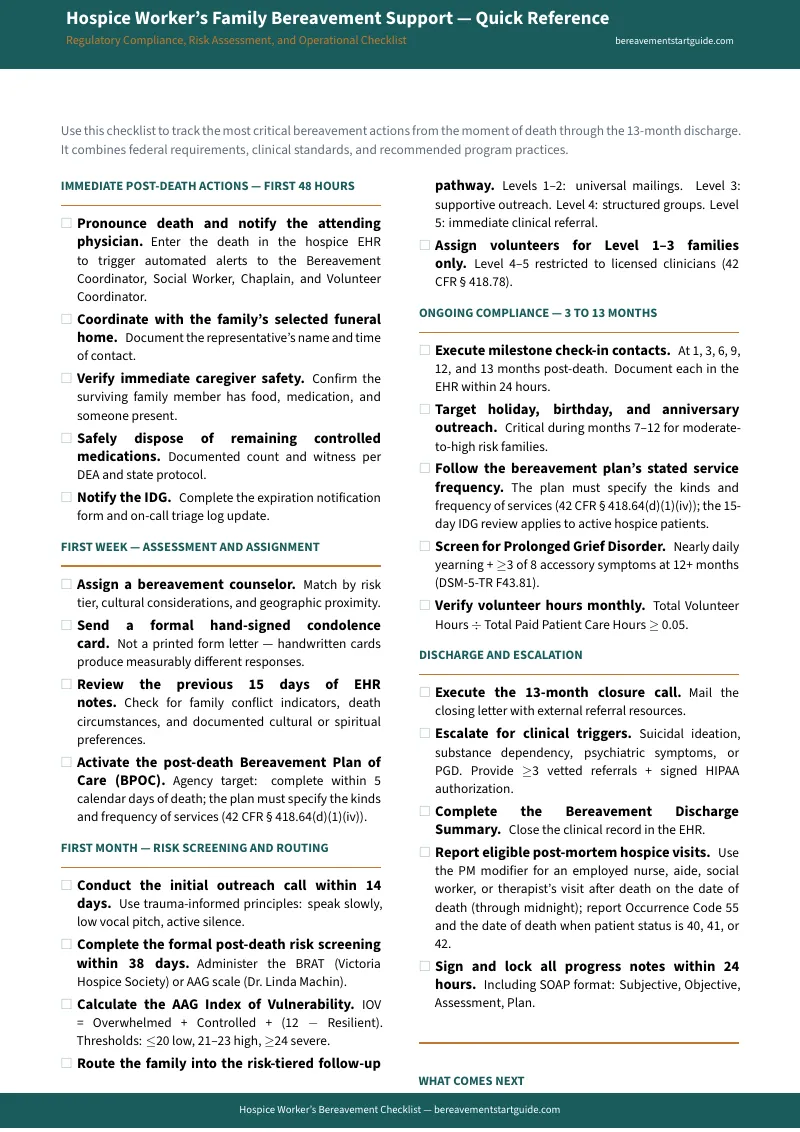
You also get a standalone quick-reference checklist
A printable, single-document walkthrough of every action from the moment of death through the 13-month discharge — built to live on your clipboard during active shifts. Download it free, no purchase required, and use it as the backbone of your daily bereavement workflow.
The full guide gives you the clinical depth behind every checkbox: the verbal scripts, the documentation templates, the HIPAA decision trees, and the risk stratification protocols that turn a checklist item into defensible, compassionate care.
Get the Hospice Worker's Bereavement Support Toolkit →
Satisfaction guarantee
Full refund, no time limit. If the toolkit does not serve your practice, email hello@bereavementstartguide.com and we will process the refund. No forms, no waiting period, no questions.