
Your body remembers the date before your brain does
Two weeks before the anniversary, the insomnia starts. Then the nausea. Then the fog that makes you forget your own phone number. You thought you were doing better — and then the calendar turns, and grief hits like it happened yesterday.
Meanwhile, there are still accounts to close, tax returns to file, family members to deal with, and a life that refuses to pause while your nervous system replays the worst moment of your year.
Free checklists tell you what to do. Books tell you how to feel. Neither one explains how to handle a probate deadline when you can barely get through breakfast, or how to stop your brother from skipping the memorial when your mother's belongings are still sitting in the living room.
The Anniversary Grief Navigation System
This is a 47-page toolkit built for the collision between grief neurobiology and real-world deadlines. It connects the science of why your body unravels around milestone dates to the administrative, family, and financial tasks that don't pause for your pain — and gives you a concrete system for getting through both.
It works because it treats anniversary grief as a full-spectrum problem: neurological, administrative, relational, and emotional — all in one place, designed for a brain running on cortisol and broken sleep.
What's inside
- Anniversary Reaction Science — the neurobiology behind why cortisol and amygdala activation hit weeks before the date, explained in plain language so you stop thinking you're losing your mind
- Dual Process Model Framework — the clinically validated approach to oscillating between grief and everyday life, so stepping away from sadness stops feeling like betrayal
- PGD Screening Tool — a structured self-assessment for Prolonged Grief Disorder that helps you know when grief has crossed into something that needs professional help, not just more time
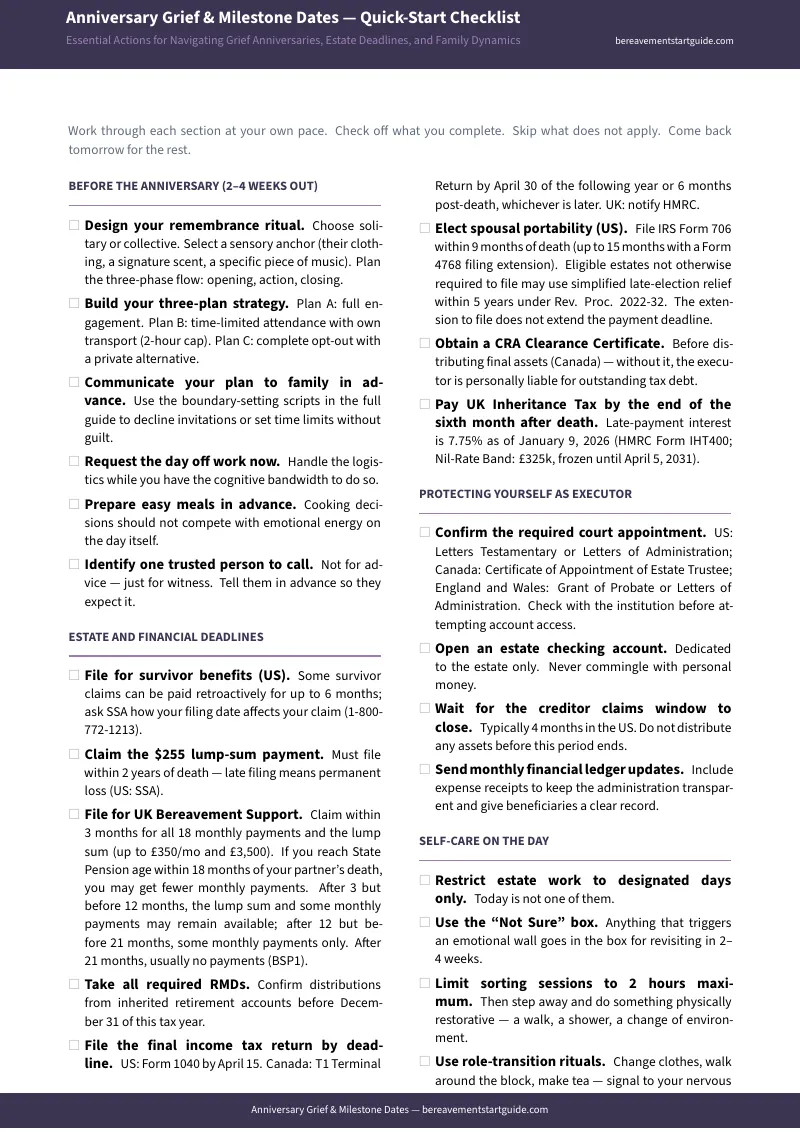
- Four-Jurisdiction Deadline Tracker — estate administration timelines for the US, UK, Canada, and Australia mapped against the emotional waves of the first year, so you never miss a filing window while your brain is offline
- Family Conflict Decision Trees — step-by-step frameworks for dividing belongings, handling the sibling who wants to skip the memorial, and navigating the relative who thinks you're moving on too fast or too slow
- Communication Scripts — copy-and-paste language for setting boundaries with pushy beneficiaries, declining invitations, requesting extensions from lawyers, and telling your employer you need the day
- Holiday Three-Plan Strategy — Plan A, Plan B, and Plan C for every gathering, because the day you thought you could handle may become the day you can't get out of bed
- Remembrance Ritual Worksheets — structured templates for designing meaningful tributes that feel authentic, not performative
- Fiduciary Checklists — for executors still managing open estates months after the funeral, covering asset inventories, creditor notifications, tax returns, and final distributions
- Pacing Tools for Grief Brain — micro-task breakdowns, the "Not Sure" box method for sorting belongings, two-hour session limits, and role-transition rituals that keep estate work from consuming your entire identity
Who it's for
This toolkit is for anyone who has lost someone and needs more than sympathy — they need a plan. Surviving spouses approaching the one-year mark. Adult children dreading a parent's birthday. Executors drowning in paperwork months after the funeral. Siblings navigating a family that grieves at different speeds. Anyone whose grief intensifies around dates the calendar refuses to skip.
Why free resources fall short
Grief books are warm and validating, but they won't tell you when your probate filing is due or how to stop your aunt from pressuring you to distribute jewelry before the creditor period closes. Government portals give you the legal requirements, but they assume you can read dense bureaucratic language while your prefrontal cortex is running at half capacity. Legal form sites sell you documents without acknowledging that the person filling them out is in clinical executive dysfunction. Funeral home articles stop at the first 30 days and then leave you on your own.
The Anniversary Grief Navigation System sits in the gap between all of them — connecting the neuroscience of why you're struggling to the specific administrative steps you need to take, with communication scripts and family mediation tools that none of those sources even attempt.
Full refund, no time limit
If this toolkit doesn't help you navigate your milestone dates with more clarity and less overwhelm, email hello@bereavementstartguide.com for a full refund. No questions, no time limit.
Start tonight
Download the free 24-item checklist to get the highest-priority actions right now. When you're ready for the full system — the science, the scripts, the deadline trackers, the family conflict frameworks, and the remembrance planning tools — get the complete toolkit.