The hospital is about to move the body. Do you know exactly what to say to stop them?
In the Vajrayana tradition, the hours immediately after clinical death are not a formality — they are the most spiritually consequential window of the entire funeral process. The subtle consciousness is still dissolving through the elements, still sensitive to every touch and sound. Premature handling can redirect the departing consciousness toward an unfavorable rebirth. And yet Western hospitals have protocols that require rapid body transfer, coroners that mandate refrigeration, and staff who have never heard of a no-touch period.
That is the gap this guide fills. Not philosophy. Not meditation theory. The Bardo Bridge System — a complete operational toolkit that translates Tibetan Buddhist funeral requirements into the specific language, documents, and step-by-step workflows that Western institutions actually respond to.
What makes this different from reading a book or asking online
You could read The Tibetan Book of Living and Dying. You could search Reddit forums and piece together conflicting advice from strangers who follow different lineages. You could call a dharma center and hope someone answers during the worst week of your life. Or you could open one document and have the exact script for the hospital administrator, the notification sequence for your lama, the 49-day prayer schedule, and the body preparation protocol — all organized by the hour you are living through right now.
The difference between scattered free information and this toolkit is the difference between knowing you should request a no-touch hold and having the pre-written Spiritual Care Directive that makes the hospital comply.
What's inside the Bardo Bridge System
- Emergency First-Hours Protocol — the five-contact notification chain, bedside shrine setup, and exact language for requesting a 4-to-12-hour body hold before any institutional handling begins
- Spiritual Care Directive Worksheet — a fill-in document that names your root lama, preferred mantras, no-touch duration, and authorized family contacts in a format hospital compliance officers recognize as a formal medical-religious accommodation
- Body Preparation Walkthrough — saffron-water washing, anointing protocols, orifice sealing, the two traditional postures (Sleeping Buddha and Crossed Vajra), seed syllable placement, and the Takdrol mandala orientation that families most commonly get wrong
- Tukdam Recognition and Protection Guide — the physical signs that distinguish postmortem meditation from ordinary death, how to communicate tukdam to medical staff who have no framework for it, and the signs that confirm the state has ended
- 49-Day Bardo Calendar — a week-by-week ritual schedule covering all seven bardo intervals, prayer assignments, merit-making activities, and the critical 7th/35th/49th day milestones where karmic turning points occur
- Lineage Variation Reference — side-by-side comparison of Gelug, Nyingma, Kagyu, Sakya, Jonang, and Bön funeral customs, so you follow your family's specific tradition rather than a generic Buddhist template
- Material Phowa Protocol — what to do when a lama cannot be physically present: consecrated items, recorded mantra loops, crown-hair guidance technique, and international monastery sponsorship contacts for remote bardo prayers
- Organ Donation Decision Framework — the bodhichitta argument and the traditional caution, with specific questions to ask your lama before making a decision under hospital pressure
- Institutional Navigation Scripts — pre-written language for declining embalming, requesting witnessed cremation, negotiating fire code accommodations for sur offerings, and coordinating with funeral directors unfamiliar with Vajrayana requirements
- Cost Planning Workbook — two fully worked budget examples with line items for monastery sponsorship (dana), cremation, tsa-tsa creation, ash disposition, and memorial services
- Funeral Director Intake Form — a handover document for the funeral home that specifies every Vajrayana requirement in plain, professional language
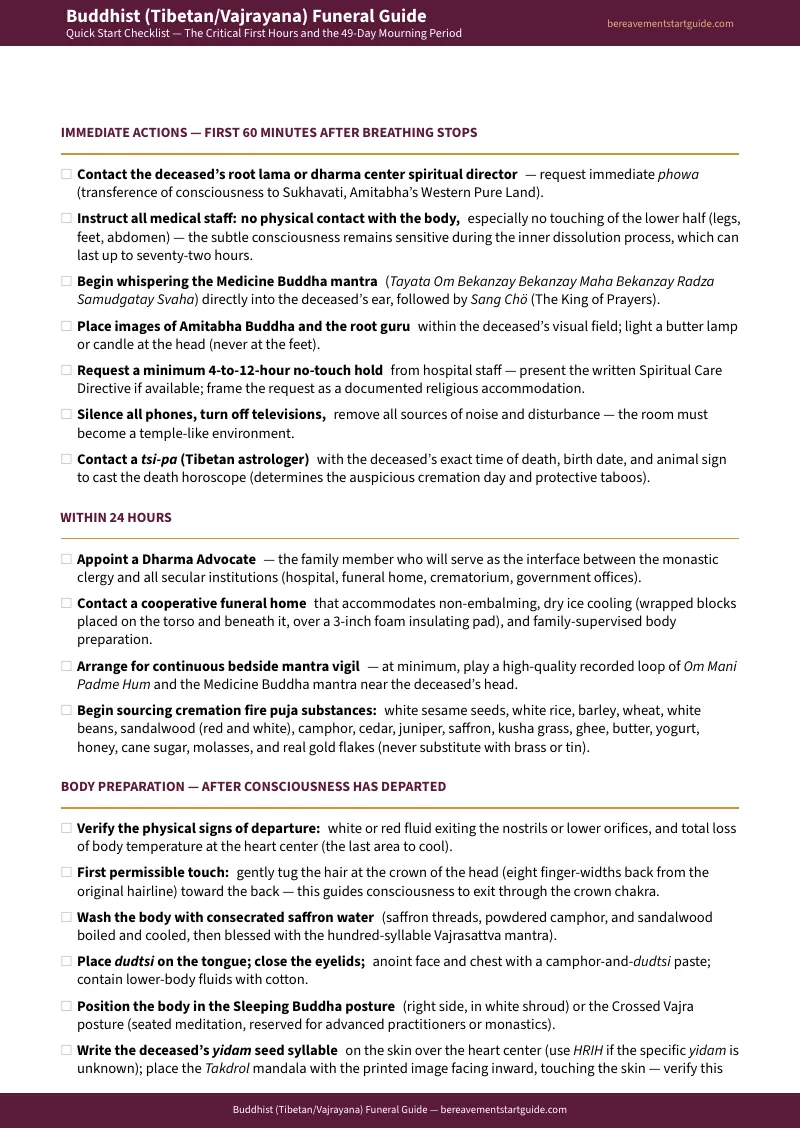
- Printable Quick-Start Checklist — one page, immediate actions only, designed for the family member standing in a hospital corridor at 2 a.m.
Who this guide is for
- Adult children and diaspora relatives who need to coordinate a Tibetan Buddhist funeral but did not grow up immersed in monastic protocol — the guide bridges the gap between what your family elders expect and what you know how to do
- Interfaith spouses and legal executors who are solely responsible for honoring a Vajrayana practitioner's wishes without any personal experience of the tradition
- Convert practitioners drafting end-of-life plans to ensure their non-Buddhist family members know exactly what to do — and what not to do — when the time comes
- Funeral directors and hospice professionals serving a Tibetan Buddhist family for the first time and needing a reliable reference for body handling, timing, and ceremony requirements
Why free online resources fall short
Monastic centers like FPMT publish authentic prayer sheets and ritual instructions — but they assume you already have a lama on speed dial, a dharma center within driving distance, and years of Buddhist education. Academic books offer deep philosophical frameworks — but a 400-page meditation guide is not what you need when the coroner is asking whether to refrigerate the body. Generic funeral planning sites lump all of Buddhism together, treating Theravada, Zen, and Vajrayana as interchangeable — which means they skip the no-touch period, phowa, sur offerings, and everything else that makes a Tibetan funeral fundamentally different from other Buddhist traditions.
This guide does not replace your lama, your family elders, or your funeral director. It makes you more effective in working with all three of them — with the right questions prepared, the right documents filled in, and the right timeline mapped out before the crisis arrives.
Satisfaction guarantee
If the guide does not give you the clarity and confidence you need to navigate this process, email us and we will refund you in full. No time limit, no questions. The traditions preserved in this toolkit deserve to be honored properly — if the guide does not help you do that, we do not want your money.
Start with the free checklist — or get the complete system
Download the free Quick-Start Checklist to see the immediate first-hours protocol. When you are ready for the full 49-day system — every script, every worksheet, every lineage variation — the complete Bardo Bridge toolkit is available for .