
When the Person Who Should Have Kept Them Safe Killed Them — and Every System Is Coming for You at Once
A detective at the door. A crime scene in the home. Child Protective Services evaluating the children. The perpetrator's parents calling about custody. An insurance company that just filed an interpleader and walked away. A reporter camped on the sidewalk. And you — running on adrenaline and three hours of broken sleep — trying to figure out which of these things will destroy your family if you get it wrong.
Free grief resources were not built for this. Government victim services pages explain what Crime Victim Compensation covers but not how to file under a pending death certificate. Law-firm blogs explain the Slayer Rule but only to funnel you into a retainer. Domestic violence nonprofits focus on prevention, not the administrative aftermath when prevention fails. And none of them talk to each other — so you are left assembling a survival plan from fragments at 2 a.m. while your brain can barely hold a phone number.
After a Death from Domestic Violence is the Family Triage System — a single structured toolkit that maps every legal, financial, custodial, and administrative decision onto a clear sequence, starting with the actions that protect your family's safety and evidence in the first 72 hours and moving through the estate, insurance, and custody proceedings that unfold over months.
It is not a book about grief. It is an operational manual for a family in crisis — built for cognitive shock, organized in checkboxes and copy-paste scripts, designed to be used in five-minute sessions by someone who has not slept and cannot think straight.
What the Family Triage System Covers
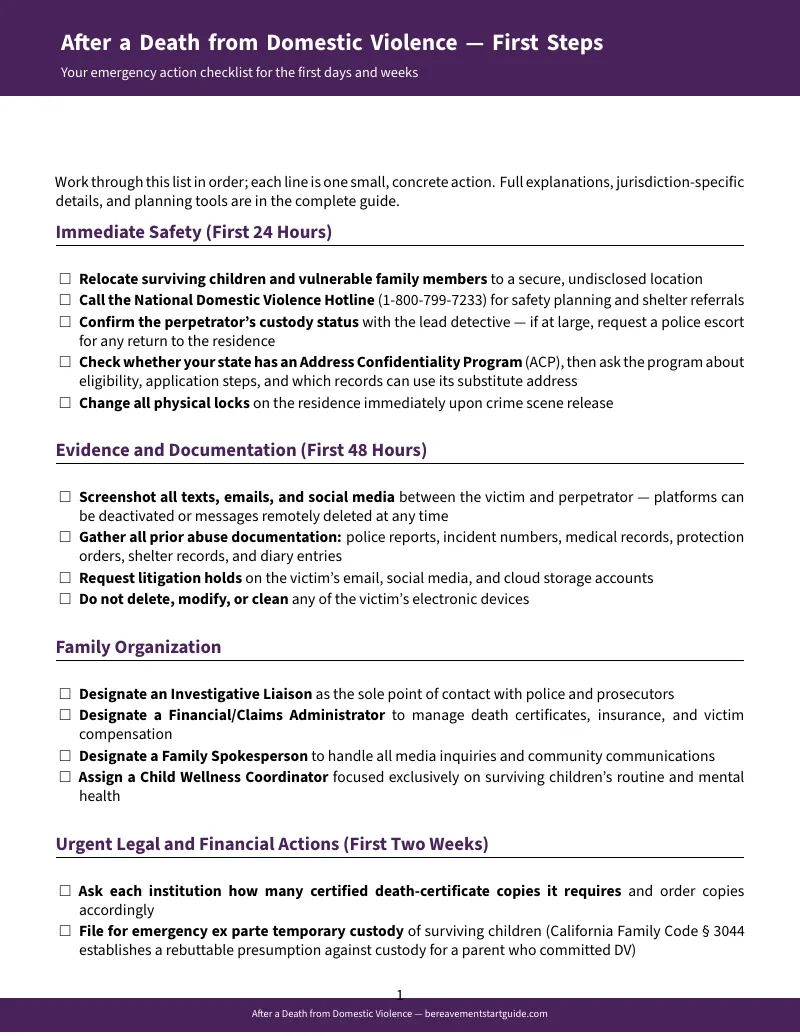
- First-72-Hour Safety Protocol — relocating survivors to a secure location, requesting police escorts, locking down the physical scene, preserving digital and historical abuse evidence before devices are seized or accounts are deactivated, and assigning five operational family roles so no single person collapses under the weight
- Emergency Custody Filing Sequence — because when a parent is arrested for killing the other parent, the custody vacuum fills fast. The toolkit covers ex parte emergency temporary custody orders, the affidavit requirements, how to demonstrate immediate risk, and what to do if the perpetrator's family files first
- Slayer Rule and Estate Protection — the legal mechanism that prevents a killer from inheriting, but requires someone to invoke it. Covers the civil preponderance standard when there is no conviction yet, the insurance interpleader process, contestability clause risks on recently purchased policies, and the documentation trail you need
- Crime Victim Compensation Navigation — state-by-state application guidance for funeral reimbursement, biohazard cleanup, emergency cash, relocation, and counseling, with the deadlines and documentation requirements that trip up most applicants
- Forensic Process Timeline — what happens during the mandatory autopsy, why the death certificate stays "Pending" for weeks, how a Proof of Death Letter bridges the financial gap, and what the final "Homicide" designation triggers in probate and insurance
- Media Boundary Toolkit — pre-drafted press statements, scripts for declining interviews, social media lockdown steps, and boundary protocols for the community members and extended family who want information you are not ready to share
- Age-Specific Scripts for Children — concrete, honest language for telling a child their parent was killed by the other parent — tailored for toddlers, school-age children, and teenagers — plus the behavioral signals that distinguish normal grief from clinical intervention thresholds
- Criminal Justice Navigation — victim-witness advocate assignments, Victim Impact Statements, plea bargain notification rights, restitution orders, and how to endure repeated court appearances without re-traumatization
- Traumatic Grief and Somatic Healing — the clinical distinction between acute grief, PTSD, and Prolonged Grief Disorder, with grounding techniques designed for the specific intrusive memories that follow a violent domestic death
- Ten Printable Worksheets — Safety and Relocation Assessment, Evidence Preservation Checklist, Role Delegation Worksheet, CVC Application Tracker, Insurance Claim Timeline, Emergency Custody Filing Checklist, Media Response Script Cards, Children's Stabilization Plan, Court Appearance Preparation Sheet, and Resource Directory
Who This Is For
You are the surviving parent, sibling, or adult child who just became the family's crisis manager. You are the grandparent who needs to file for emergency custody before the perpetrator's relatives do. You are the aunt or uncle who is holding the children while their world disintegrates. You are the friend running the GoFundMe and screening the calls while the family cannot function. You are anyone who needs to know what to do next — right now, tonight — and cannot afford to miss a deadline because you did not know it existed.
Why Free Resources Are Not Enough
Government victim services pages cover CVC eligibility but are written in dense bureaucratic language and organized by statute, not by crisis. Law-firm wrongful death pages explain legal theories but stop short of the administrative steps you need to execute before you retain a lawyer. Domestic violence hotlines provide safety planning and emotional support but do not walk you through insurance interpleader defense, emergency custody filings, or evidence preservation checklists. Hospital handouts cover the first phone numbers to call but are often lost in the chaos before you need them.
The Family Triage System consolidates every critical process — safety, evidence, custody, estate, insurance, CVC, media, criminal justice, children's trauma, and grief — into one structured, printable document. You do not need to search. You do not need to assemble. You open to the chapter that matches the crisis in front of you and follow the checkboxes.
Satisfaction Guarantee
Full refund, no time limit. If the toolkit does not serve your family's needs, email hello@bereavementstartguide.com and we will refund you immediately — no form, no questions, no waiting period.
Get the Complete Toolkit
The free checklist covers the first 48 hours. The full After a Death from Domestic Violence toolkit covers the first year — every legal, financial, custodial, and emotional dimension, with the scripts, worksheets, and timelines that keep your family from falling through the cracks in the system.
For less than what the courthouse charges for a single certified copy, you get the complete Family Triage System —