
The call that changes everything — and the protocol your handbook doesn't have
A manager just told you an employee died over the weekend. Or an employee is asking for bereavement leave and you aren't sure whether your state mandates it. Or someone returned from their mother's funeral two weeks ago and their manager wants to start a performance improvement plan because they've been "unfocused."
Your employee handbook says "3–5 days of paid bereavement leave for immediate family members." It does not tell you whether California's AB 1949 overrides that number, whether Illinois requires you to offer leave for a miscarriage, what the OSHA 8-hour reporting deadline actually means when the supervisor heard about the death at 11 p.m., or how to process a deceased employee's final paycheck when wages cross a calendar-year boundary and the IRS rules change.
The free resources you've found are either too legalistic to use under pressure or too clinical to help with payroll. SHRM articles explain policy frameworks but cost a membership. Law-firm blogs detail AB 1949 compliance but end with "consult counsel." Grief counseling handouts support the employee's emotional needs but say nothing about COBRA timelines or Form 300 documentation.
The Bereavement Operations Manual — compliance and compassion in the same document
The HR Manager's Bereavement Policy & Support Guide is the operational manual that sits between legal compliance articles and clinical grief resources. It translates employment law, OSHA regulations, and trauma-informed practice into the specific checklists, scripts, decision trees, and templates an HR professional uses during the actual crisis — and treats every protocol as something that needs to work at 2 a.m. with an anxious manager on the phone.
What's inside
- First-24-Hours Crisis Protocol — the complete operational sequence from verified death through HRIS payroll freeze, IT credential lockdown, email auto-reply deployment, and internal communication cascade, with decision gates at every stage so nothing falls through when you're running on adrenaline
- OSHA Reporting Framework — the 8-hour fatality reporting rule, the 24-hour hospitalization rule, Form 300 and 301 documentation, five-year log retention under 1904.33, and the 30-year medical record retention under 1910.1020 — because the clock starts when you learn of the death, not when your investigation is done
- State-by-State Bereavement Leave Matrix — California AB 1949, Illinois FBLA (including reproductive loss and child homicide extensions), Oregon OFLA, Maryland Flexible Leave Act, Colorado HFWA, Minnesota ESST/PFML, and every other state mandate — with employer-size thresholds, durations, covered relationships, and documentation rules in a single reference table you can check in under a minute
- Global Leave Compliance — statutory bereavement requirements across the UK, EU, Canada, Australia, and key Asia-Pacific jurisdictions for organizations managing cross-border teams
- FMLA and ADA Intersection Analysis — how grief-induced major depression or PTSD transforms a bereavement into a protected medical event or an ADA accommodation obligation, and the documentation pathway that prevents a premature performance write-up from becoming a retaliation claim
- COBRA Post-Death Timeline — the 30-day employer notification window, 14-day administrator dispatch, 60-day election window, and 45-day initial premium deadline for surviving dependents — laid out as a calendar-based checklist, not a legal memorandum
- Family Liaison System — scripts for the first condolence call, ongoing case management, personal effects return, estate administrator handoff, and the case note template that prevents five different departments from contacting a grieving family with contradictory information
- Final Pay and Tax Workflows — the IRS Form 1099-MISC vs. W-2 decision tree for post-death compensation, FICA withholding rules that change based on calendar year, state-by-state wage-payment timelines, and worked calculation examples that make the abstract rules concrete
- Communication Scripts for Every Stage — what to say to close colleagues in the first hours, how to run the team announcement meeting, company-wide notification templates, manager condolence call scripts, return-to-work check-in frameworks, and the specific phrases that convey institutional empathy without creating legal exposure
- Crisis Debriefing and Team Recovery — Psychological First Aid deployment, Critical Incident Stress Debriefing protocols, EAP coordination, memorial management, and the structured recovery timeline that prevents the quiet productivity collapse that follows every workplace death
- Secondary Trauma Protection for HR — recognition frameworks for the secondary traumatic stress and moral injury that accumulate in HR professionals who absorb the weight of workplace death, with peer support structures and professional boundary protocols
- Return-to-Work Accommodation Planning — phased return schedules, modified duty frameworks, the ADA interactive process for grief-related conditions, manager coaching scripts for separating temporary grief-related productivity dips from genuine performance issues, and the documentation approach that protects both the employee and the organization
Who this is for
- HR Managers and HR Business Partners who carry the operational responsibility when an employee dies or a team member needs bereavement leave — and need the complete compliance and communication framework, not a two-paragraph handbook clause
- People Operations Leaders building or updating bereavement policies and wanting state-by-state compliance coverage, customizable templates, and a framework that balances legal defensibility with real human support
- Frontline Managers and Team Leads who will be the first person an employee tells about a death in the family and need to know what to say, what not to promise, and when to bring in HR
- Small Business Owners without dedicated HR who must handle the condolence call, the leave calculation, the final paycheck, and the COBRA notice themselves — and need the same protocols the enterprise HR team uses, in a format that doesn't assume a legal department down the hall
Why free templates fall short
Free bereavement policy templates cover the basics: define "immediate family," set three days, require an obituary. They don't cover California's five-day mandate for employers with five or more employees. They don't address Illinois' requirement to offer leave for a miscarriage or failed adoption. They don't explain what happens when an employee's grief develops into a diagnosed condition that triggers ADA accommodation obligations. And they certainly don't include the communication scripts for the moment a manager calls you because they found an employee crying in the break room and want to know whether they can write them up for it.
The gap between a generic template and a defensible protocol is where lawsuits happen — and where grieving employees lose faith in their employer.
Full refund, no time limit
If this guide doesn't give you what you need, email hello@bereavementstartguide.com for a full refund. No time limit, no questions.
Get the HR Bereavement Policy & Support Guide →
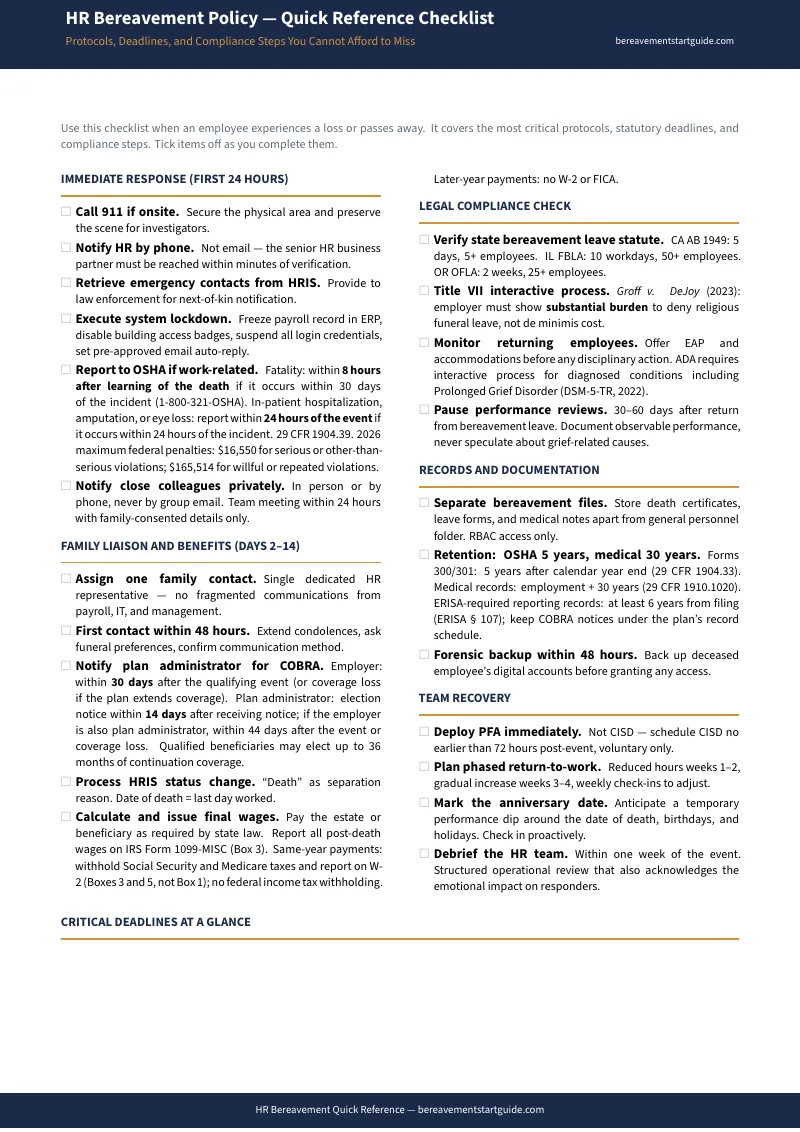
Download includes the complete 12-chapter guide, the quick-reference checklist, and eight standalone printable tools — the death response protocol, OSHA reporting worksheet, family liaison case note, COBRA deadline tracker, final pay worksheet, return-to-work accommodation plan, incident debrief log, and policy audit checklist.
Or start with the free quick-reference checklist — 22 items covering every critical action from initial notification through the 90-day follow-up — and see the depth of the framework before you commit.