You chose water cremation. Now you have 48 hours to make it happen.
Forty-eight hours before the hospital transfers the body to whatever funeral home is on their referral list. Forty-eight hours to confirm that aquamation is legal in the state where the death occurred, find a provider who actually has operational equipment (not just a license), arrange transport if there is no local facility, and explain the process to your uncle who has never heard the word "alkaline hydrolysis" and thinks you want to flush his mother down a drain.
That is the real timeline. And nowhere — not on provider websites, not in state statutes, not on Reddit — can you find all of it in one place, sequenced for crisis use.
The Aquamation Coordination System
The Aquamation / Water Cremation Guide is not an explainer about how alkaline hydrolysis works. It is a logistical planning kit — built for the family member who has already made the decision and now needs to execute it under pressure, across jurisdictions, through family resistance, and against a clock that does not pause for grief.
It replaces the 30 hours of panicked cross-referencing that most families do during the worst week of their lives with a 45-page guide plus eight printable planning tools you can act on immediately.
What's Inside
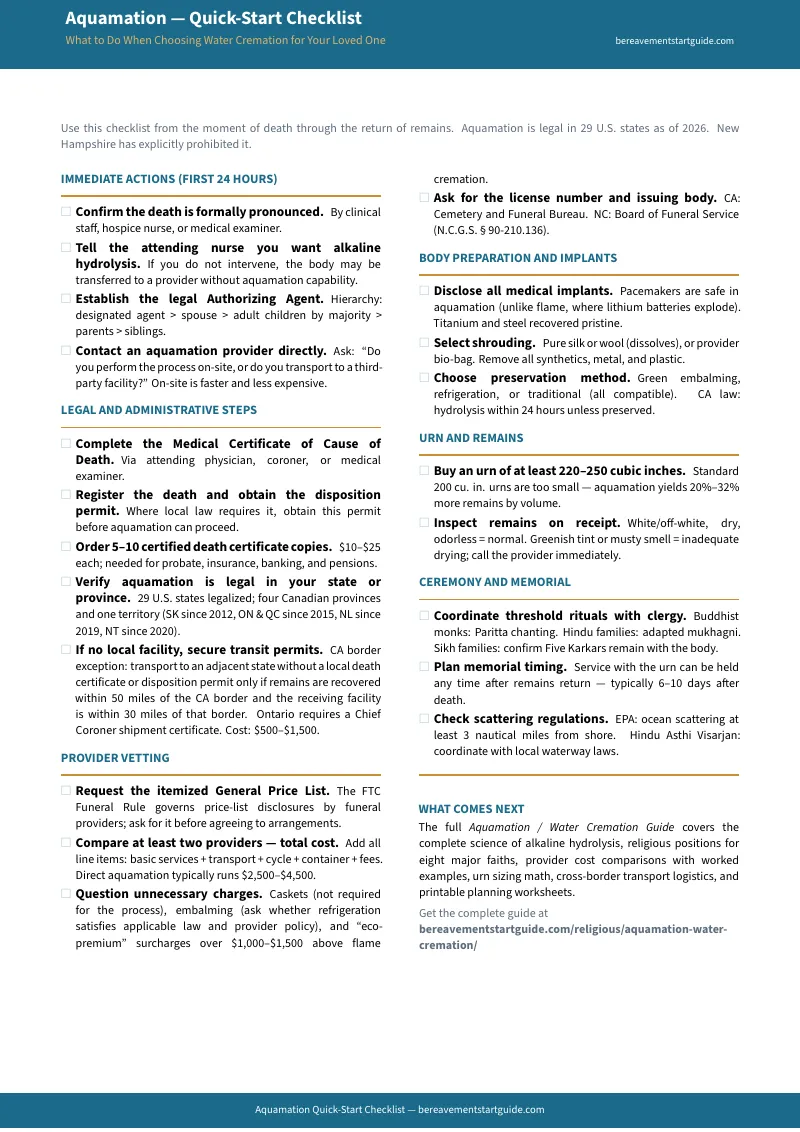
- First-24-hours crisis checklist — who to call, what forms to sign, and how to prevent the default transfer to a flame crematorium before you have confirmed aquamation availability. Expected deaths and sudden deaths each get their own track.
- State-by-state legality map — which states have active providers with operational alkaline hydrolysis chambers, which are legal in statute only (no equipment), and which are not yet legal. For each "legal but no local provider" state, the guide covers the specific transit permits, medical examiner authorizations, and cross-border paperwork required to transport the body to the nearest operational facility.
- Provider vetting checklist — the exact questions to ask about equipment capacity, processing duration (3–16 hours depending on system type), tissue dissolution protocols, implant handling, hydrolysate discharge methods, and drying procedures. Because a provider who subcontracts to another facility may add days to your timeline and hundreds of dollars to the bill.
- Religious and cultural framework — where aquamation stands with seven major traditions: Catholic (explicitly prohibited, but a traditional Mass before the process is permitted), Orthodox Jewish (forbidden under Halakhah), Reform Jewish (permissible with bone fragment interment), Protestant (generally permissible), Islamic (prohibited), Hindu (conditional — the mukhagni ritual can be adapted), and Buddhist (broadly acceptable). Each section includes the theological reasoning, specific compromise options, and scripts for conversations with clergy.
- Urn volume calculations — aquamation returns 20–30% more bone mineral than flame cremation, which means standard adult cremation urns (200 cubic inches) are almost always too small. The guide provides the math to estimate the correct volume before the process begins, so you never face the traumatic last-minute scramble for a larger container.
- Cost negotiation worksheet — a line-by-line vendor comparison tool that exposes eco-premium markups ($500–$1,500 above fair pricing at some facilities), unnecessary casket rental fees, and embalming charges that are physically unnecessary for alkaline hydrolysis. Aquamation typically costs $1,295–$4,600; the guide shows where the range comes from and how to land on the lower end.
- Two worked cost comparisons — aquamation at $2,200 vs. traditional flame cremation at $3,800 vs. full-service casketed burial at $12,000+, each broken down by line item so you can see exactly what you are paying for and what you can legally decline.
- Family communication scripts — non-confrontational language for explaining water cremation to relatives who associate it with "flushing someone down the drain," for responding to clergy who consider the process a violation of human dignity, and for navigating funeral directors who steer families away from aquamation because they lack the equipment.
- Remains care guide — what aquamation ashes actually look like (whiter and finer than flame cremation ashes), how to ensure proper drying to prevent mold growth in the urn, memorial and scattering options by religious tradition, and which customs require interment vs. permit dispersal.
Who This Is For
- Families in active grief who need to coordinate aquamation within 24–72 hours of a death
- Adult children choosing a greener, gentler alternative while navigating conservative family expectations
- Executors and diaspora relatives coordinating arrangements across state or national borders where aquamation availability is fragmented
- Interfaith families reconciling conflicting theological positions on body disposition — especially where flame cremation is rejected but traditional burial is not feasible
- Pre-planners establishing advance directives that specify water cremation, so their family is not left guessing
- Death doulas, celebrants, and funeral planners who advise families on green alternatives
Why Free Resources Fall Short
Aquamation provider websites explain the science clearly — then omit pricing, skip the transport logistics for out-of-state families, and never mention that silicone implants may need to be addressed before processing.
State regulatory boards publish the statutes — in dense legal language that does not tell you whether a licensed facility actually has operational equipment or just a permit on paper.
Religious community resources present monolithic positions (permitted or forbidden) without discussing the pastoral compromises that clergy actually negotiate in practice — like holding a traditional Catholic funeral Mass with the body present before transferring to an independent aquamation facility.
Reddit threads carry genuine first-hand accounts from technicians and families — alongside graphic descriptions of incomplete tissue dissolution, skull puncturing protocols, and implant melting that cause secondary trauma in grieving readers who are already anxious about the physical handling of their loved one's body.
General end-of-life books provide thoughtful philosophical explorations — designed for leisurely pre-planning, not for the 72-hour crisis window when every hour counts.
This guide covers all of it — legal, logistical, religious, financial, and emotional — verified against current statutes and provider practices, sequenced for crisis use, and written so you can act on it the hour you need it.
Your Guarantee
Full refund, no time limit. If the guide does not give you what you need, email hello@bereavementstartguide.com and we will refund you. No forms, no waiting period, no questions.
Two Ways to Start
Download the free one-page checklist — 21 critical tasks from body release through remains return — and see whether the approach resonates. When you are ready for the full provider vetting framework, religious compromise scripts, urn calculations, and cost negotiation tools, the complete guide is waiting.