When Sorry Business Starts, Nobody Hands You a Manual
A death in an Aboriginal or Torres Strait Islander family triggers two parallel crises. The institutional crisis — hospital paperwork, death certificates, workplace notifications — moves on a Western clock that expects everything wrapped up in a week. The cultural crisis — kinship notification, name avoidance, smoking ceremonies, extended mourning, community mobilization — moves on customary law that cannot be compressed, rushed, or shortcut without causing lasting harm.
The person caught between these two systems is usually someone who has never managed Sorry Business before. A daughter who always watched her grandmother lead the process, now standing where her grandmother stood. An interfaith partner who has never encountered a smoking ceremony, a name avoidance protocol, or a kinship structure where a legal stranger carries more authority than a legal spouse. A nephew living in Melbourne, three thousand kilometres from Country, trying to coordinate repatriation of a body while a hundred relatives begin travelling.
Free resources exist — government clinical guides written for healthcare workers, Land Council grant forms buried in bureaucratic language, Reddit threads mixing lived experience with dangerous generalizations. None of them do what this person actually needs: pull everything into one place, in plain language, with the tools to act on it immediately.
The Sorry Business Cultural Navigation System
This is not a generic funeral checklist adapted with an Indigenous section at the back. It is a structured cultural navigation framework built specifically for the collision between Western institutional systems and Aboriginal and Torres Strait Islander customary law — the collision that creates almost every preventable crisis during Sorry Business.
The guide separates the frameworks that recur across most Aboriginal and Torres Strait Islander communities — notification through kinship hierarchies, name and image avoidance, communal mourning obligations, smoking and cleansing — from the practices that vary by nation, language group, island community, and family. Where protocols diverge, it names the community and explains the variation. Where specific cultural knowledge is needed, it provides structured scripts for the conversation with your Elders — so you approach that conversation prepared, not panicked.
Four standalone planning tools — printed, filled in by hand, carried into real conversations — bridge the gap between what the guide teaches and what you need to do next.
What You Get
- Culturally safe notification protocols — who to contact and through which channels when a death occurs in an institutional setting, how to engage hospital Aboriginal Liaison Officers, and why bypassing the kinship notification hierarchy causes irreversible harm
- Name and image avoidance reference — regional substitute terms (Kunmanara, Kwementyaye, Kumantjayi, Barlang), digital media handling protocols, social media and workplace announcement guidance for families observing restrictions
- Torres Strait Islander Sad News system — the Mari Gedth spokesperson role explained in operational detail, with the Mari Gedth Coordinator Sheet to track every contact, decision, and outstanding task through the designated in-law
- Body preparation and mortuary care instructions — cultural requirements you can hand directly to a hospital or funeral director, including traditional preparation protocols and extended viewing and storage negotiations
- Smoking ceremony logistics — sourcing native eucalyptus in metropolitan areas, negotiating fire and smoke-alarm policies with modern venues, establishing who holds the authority to lead the ceremony, and integrating smoking with chapel or graveside formats
- Kinship decision-making framework — how Indigenous kinship authority works (and how it differs from legal next-of-kin), managing disputes when urban and remote family wishes clash, and documenting decisions before they become permanent sources of tension
- Secondary ceremony planning — Torres Strait Islander Tombstone Opening protocols (wrapping, capari food preparation, marigetal gift obligations), Tiwi Pukumani ceremony structure, and Yolngu hollow log traditions
- Financial assistance roadmap — state-specific Land Council grants with exact eligibility rules and exclusions, Transport for NSW fuel subsidies, Centrelink urgent payments, and emergency relief through Aboriginal Medical Services
- Workplace leave strategy — compassionate leave under the National Employment Standards, ceremonial and cultural leave clauses in Modern Awards and Enterprise Agreements, and a fill-in letter template your employer can actually act on
- Elder Consultation Script — a structured conversational template for approaching Elders with humility to discuss funeral arrangements, covering acknowledgement of Country, stating your relationship, and documenting responses
- Vendor Question Checklist — specific prompts for funeral directors, cemeteries, and venues covering cultural body preparation, smoking ceremony accommodation, extended timeline, storage fees, and large-gathering logistics
Who It's For
- Adult children and spouses managing their first Sorry Business without the elder who always led it
- Interfaith and inter-cultural partners navigating mourning customs for the first time under intense family expectations
- Diaspora and urban-raised Aboriginal and Torres Strait Islander families reconnecting with ancestral protocols across vast distances
- Torres Strait Islander families coordinating through the Mari Gedth system, including Tombstone Opening preparation
- HR managers and workplace advocates supporting First Nations employees through extended bereavement
- Funeral directors and healthcare workers providing culturally safe services to First Nations families
Why Free Resources Fall Short
Government clinical guides — like the Queensland Health palliative care frameworks — are written for healthcare workers, not families. They explain policy without giving you scripts, templates, or a sequence of actions. Land Council grant terms sheets assume you already know the application landscape; they don't tell you that NSWALC grants are paid directly to the funeral director with no retrospective reimbursement, that viewing fees and body transport between towns are explicitly excluded, or that processing can take weeks while costs pile up.
Mainstream funeral home websites treat cultural elements as optional add-ons. They will offer a "cultural service" that amounts to a brief acknowledgement of Country before a standard Anglo-Australian order of service. They do not know about extended mourning timelines, kinship-based decision authority, smoking ceremony fire-safety logistics, or the name avoidance protocols that determine whether a death notice can even include the deceased's name.
This guide fills the structural gap between clinical compliance documents and community-specific oral tradition — consolidating the administrative, legal, financial, and logistical information that no single free resource covers in a format you can act on during the worst week of your life.
Full Refund, No Time Limit
If the guide does not give you what you need, email hello@bereavementstartguide.com for a full refund. No time limit, no questions, no forms to fill out.
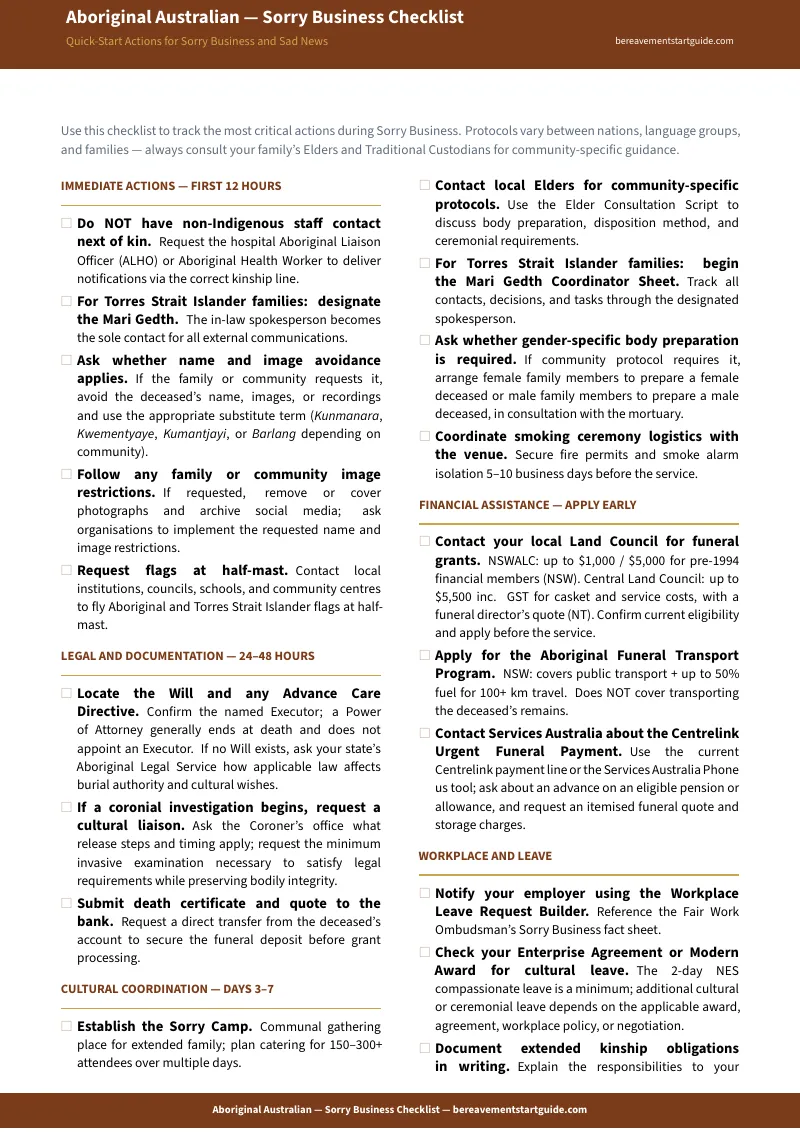
The free checklist gives you the 25 critical actions in sequence. The full guide gives you the how — with the cultural context, the planning tools, the financial roadmap, and the scripts you can carry into every conversation.