The funeral home will show you what it sells. This toolkit shows you everything that exists.
Someone you love has died — or will, soon — and you need to choose a final disposition method. The funeral home is presenting options: traditional burial, maybe cremation. But alkaline hydrolysis is now legal in 26 states. Human composting is legal in 14. Green burial cemeteries operate in every region. And nobody at the arrangement conference is going to walk you through the options they do not offer.
The gap between the most expensive and least expensive legal disposition method in the United States exceeds $10,000. Traditional burial runs $7,848 to $12,000+. Direct cremation runs $995 to $3,000. The difference is not quality — it is information. Families who know what exists and what it costs make structurally different decisions than families who see only what one provider puts in front of them.
The Disposition Decision System is a side-by-side comparison toolkit that covers every legal final disposition method, with real cost data, state-by-state legal status, religious compatibility, consumer rights at the arrangement conference, and decision worksheets built for someone whose cognitive capacity is temporarily impaired by grief.
What's Inside the Full Toolkit
- Side-by-Side Comparison Worksheet — every method the guide covers on one printable page: traditional burial, green burial, direct cremation, traditional cremation with a service, alkaline hydrolysis (aquamation), and natural organic reduction (human composting). Cost ranges, space for the quote you were given, legal availability in your state, and a checkbox to pick one — because you cannot compare options you do not know exist.
- State-by-State Legal Status Maps — current legal authorization for alkaline hydrolysis and natural organic reduction in every state, plus what to do when your preferred method is not yet available where you live. Out-of-state transport logistics, pending legislation, and which locally available alternatives achieve similar goals.
- Religious and Cultural Compatibility Tables — which methods are permitted, prohibited, or conditionally acceptable across major world religions and cultural traditions. Not marketing claims from providers, but positions drawn from religious authorities: Orthodox Judaism's earth burial requirement, Islam's prohibition on cremation, Catholic acceptance of cremation with restrictions on scattering, Buddhist and Hindu cremation traditions, and more. One reference table instead of searching ten denominational websites.
- FTC Funeral Rule Rights Checklist — the specific consumer protections you hold at every arrangement conference, as a one-page fillable sheet. The funeral home must provide an itemized General Price List before showing caskets. You can buy a casket from any third party without a handling fee. Embalming is almost never legally required. Refrigeration is a legal alternative in every state. Communication Scripts give the language to exercise each right — because knowing a right exists and being able to invoke it under grief-induced stress are two different things.
- Family Consensus Meeting Agenda — the 60-minute structured meeting form for families who disagree on the disposition method. Includes the legal hierarchy of decision-making authority (the executor does not automatically control disposition), space for equal-priority relatives, and a Family Consent Agreement for the chosen method, provider, and budget.
- Decision Pacing Worksheet — grief temporarily impairs working memory and impulse control, making urgent decisions feel more permanent and permanent decisions feel more urgent. The worksheet logs every vendor proposal and sorts it by reversibility: immediate logistics that genuinely cannot wait, medium-term decisions that benefit from 48 hours, and permanent choices that deserve a full week. Designed for someone who cannot hold five variables in mind simultaneously.
- Provider Evaluation Scorecard — the standardized comparison form for evaluating funeral homes, crematories, and alternative disposition providers on equal terms. Prevents the common trap of comparing one provider's bundle against another's itemized list.
Who This Is For
You just became the person making this decision. The funeral home wants an answer this week. You know cremation is cheaper than burial, but you have heard about newer options and cannot tell which are legal, which are legitimate, and which are compatible with your family's values. The toolkit gives you the full comparison before your next meeting — so you walk in knowing more than the salesperson expects.
Your family cannot agree. One person wants traditional burial. Another insists on cremation. A third read about human composting. Nobody is working from the same information, and the disagreement is getting personal. The guide puts everyone in front of the same cost table, the same legal status chart, and the same religious compatibility data — and the conversation changes.
You are planning ahead. You want to choose your own method, document it legally, and spare your family from guessing. The guide covers every option honestly and walks you through the specific legal steps that make your wishes enforceable — not just a mention in a will, but the formal designation that actually controls what happens.
Why Not Just Google It?
The information is out there. It is on funeral home websites (which describe only what they sell), state government databases (which confirm legality but not availability or cost), green burial advocacy sites (which cover one method enthusiastically and others briefly), and religious authority pages (which address one tradition at a time). Assembling the comparison yourself means reconciling different cost formats, different legal update dates, and different definitions of "green" across dozens of sources — while grieving, while your family waits, and while the funeral home's deadline approaches.
The toolkit is that research, already done. One comparison system. Current legal status. Real cost ranges from 2026 data. Religious positions from authoritative sources. Formatted for someone who does not have days to spend synthesizing it.
Your Decision Is Protected
Full refund, no time limit. If the toolkit does not give you the clarity you need to choose a disposition method with confidence, email hello@bereavementstartguide.com and you will get every cent back. No questions, no deadline.
The Decision Has a Deadline. The Comparison Does Not Have to Be Rushed.
The toolkit costs — less than the markup on a single optional service at the arrangement conference. The family that walks in knowing every legal option, every cost range, and every consumer right makes a fundamentally different decision than the family that sees only what the funeral home presents.
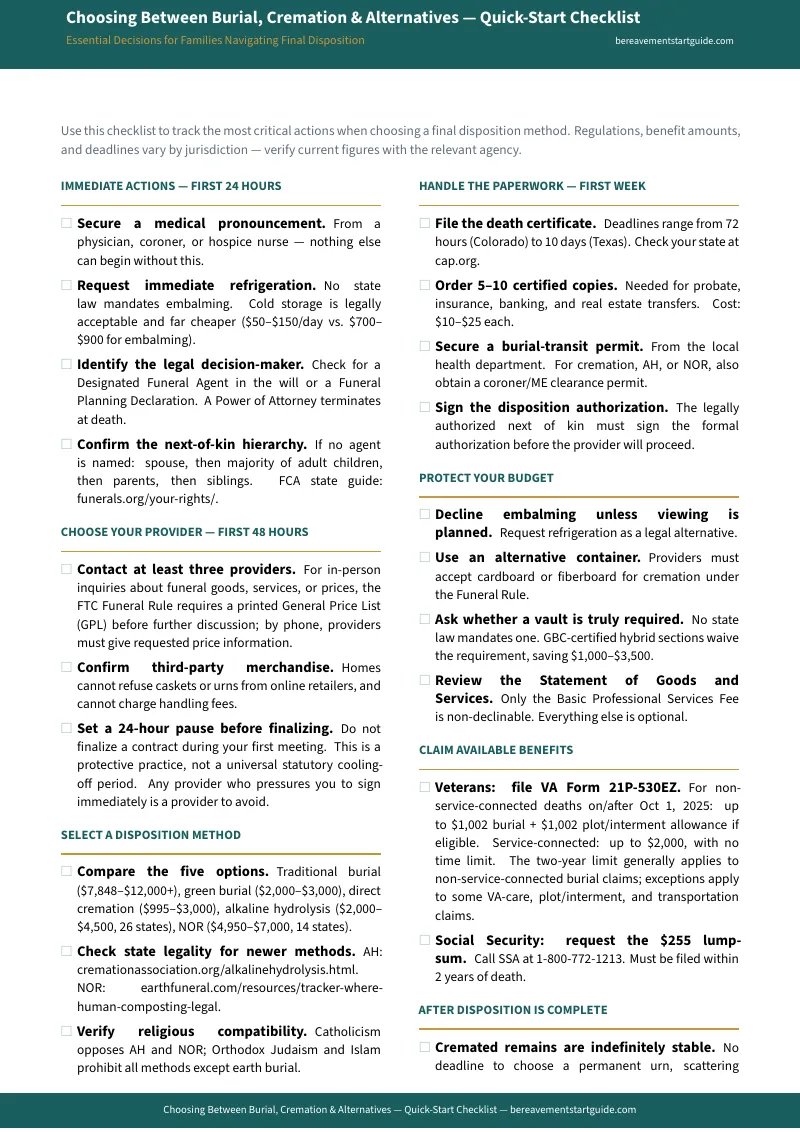
Not ready for the full toolkit? Download the free Quick-Start Checklist — a 2-page, 23-item reference covering the first critical decisions and the questions to ask before you agree to anything.