No clergy. No standard protocol. And the funeral home has never handled one of these before.
When a Bahá'í dies, the family becomes the project manager for a funeral that the commercial deathcare industry was not designed to accommodate. No chemical embalming — the body must decompose naturally. No cremation — burial is the only permitted disposition. Where Eastern casket guidance applies, the coffin is crystal, polished stone, or hard fine wood — oak, maple, hickory, birch, beech, or cherry — not pine, not metal. The body must be washed, perfumed with rosewater or attar of rose, and wrapped in a cotton or silk shroud (a five-piece layout totalling about six to seven metres of fabric, or a single sheet). A burial ring inscribed with a specific verse must be placed on the finger of a believer aged fifteen or older, where that practice applies. And the cemetery must be reachable within one hour's travel from the city limits where death occurred.
Meanwhile, the funeral director is Googling "Bahá'í funeral" and getting Islamic washing guides. The hospital is scheduling automatic embalming. The family is scattered across three time zones. And nobody has a written set of instructions that translates sacred law into the forms, phone calls, and vendor conversations that actually make a funeral happen.
The Sacred Law Translation System
The Bahá'í Funeral Guide is a structured bridge between the scriptural requirements of the Kitáb-i-Aqdas and the operational reality of arranging a funeral through secular institutions. It does not replace the Local Spiritual Assembly's spiritual guidance or the funeral home's professional services. It coordinates them — translating the theological "what" into the logistical "how" so that nothing falls through the gap between sacred law and municipal code.
The guide maps the full process from the moment of passing through the graveside prayer and estate administration, with parallel tracks for the spiritual obligations (managed in consultation with the LSA) and the legal requirements (managed by the family or executor). Where those tracks collide — embalming refusals, casket material compliance, cemetery distance calculations — the guide provides the exact scripts, worksheets, and decision trees you need to keep both sides aligned.
What's Inside
- Notification-to-Burial Timeline — the full sequence from initial death notification through the graveside service, broken into discrete steps with the responsible party and critical deadlines identified at each stage. Covers the dual-track notification system: contacting the Local Spiritual Assembly for spiritual coordination while simultaneously managing the legal paperwork with hospitals, funeral homes, and government agencies.
- Body Preparation and Shrouding Protocol — the washing sequence, rosewater application, and five-panel shroud layout with specific fabric dimensions (head piece, upper body, lower body, legs, and full-body wrap). Clearly distinguishes Bahá'í requirements from Islamic Ghusl practices that dominate search results, so interfaith families and funeral directors are never confused about which tradition they are following.
- One-Hour Travel Limit Calculator — explains the scriptural rule (measured from municipal city limits to cemetery gates, not from the hospital or funeral home), walks through the calculation method for metropolitan areas, and provides a cemetery selection worksheet for mapping eligible burial sites within the boundary.
- Casket Material Compliance Reference — which materials qualify (crystal, stone, or hard fine wood: oak, maple, hickory, birch, beech, cherry; concrete or sturdy composite as an alternative), why pine and metal are not in keeping with the guidance, how concrete grave liners interact with the casket, and how to navigate certified green cemeteries that ban hardwoods. Confirm local practice with the LSA: this guidance is binding in Eastern communities and optional or not yet universally applied in the West.
- Prayer for the Dead Structure — the congregational prayer's six verses repeated nineteen times, with the gender-specific pronoun variations marked. Explains who may lead the prayer (any believer present — there is no clergy requirement), the standing position, and the protocol when the prayer is recited at the graveside versus at a separate memorial.
- Interfaith Family Scripts — talking points for the cremation conversation with non-Bahá'í relatives, framed to convey that burial is a non-negotiable religious commitment rather than a casual preference. Covers the common pressure points: cost arguments, logistics of distributed ashes, and the emotional case for "simplicity."
- Bahá'í Intestate Inheritance Explained — the 2,520-share default distribution across seven categories of heirs (children, spouse, father, mother, brothers, sisters, teachers), why non-Bahá'í family members receive nothing under the scriptural default, and exactly how a civil will overrides these rules to protect an interfaith family. Includes estate planning action items.
- Funeral Director Instruction Sheet — a printable one-page reference to hand directly to the mortician: no embalming (mechanical refrigeration only), approved casket materials, shroud accommodation, burial ring placement, and the one-hour transport boundary. Fits into the funeral home's existing intake workflow.
- Printable Worksheets — Bahá'í Funeral Planning Checklist, Cemetery Selection Worksheet, Shroud Cutting and Layout Guide, Estate Priority Worksheet, Guest Etiquette Card, Communication Script for Healthcare Providers, Agency Communication Log, Interfaith Family Scripts, and Qiblih Direction Calculator. Letter-size sheets you can take to the funeral home, the LSA meeting, or the cemetery visit.
Who It's For
Bahá'í families planning ahead or managing an immediate passing. You know the sacred laws but need the logistics assembled into a sequential workflow — what to tell the hospital to halt automatic embalming, how to source six to seven metres of cotton or silk under time pressure, how to coordinate three people for washing and four to lift the shrouded body into the casket, and how to calculate whether your chosen cemetery falls within the one-hour boundary.
Interfaith relatives and secular executors who have inherited responsibility for a Bahá'í funeral without any background in the faith. You need to know which rules are binding sacred law and which are flexible cultural traditions, so you can honour the deceased without accidentally violating a scriptural requirement — or spending days researching distinctions that should take minutes.
Funeral directors and death-care professionals serving a Bahá'í family for the first time. The instruction sheet gives your team the handling rules in a format that integrates with your standard intake process, preventing the well-intentioned professional misstep — automatic embalming, a pine or metal casket, extended transport — that can permanently damage a community's trust.
Why Free Resources Fall Short
The information exists. The Kitáb-i-Aqdas establishes the laws. The compilations from Shoghi Effendi and the Universal House of Justice provide authoritative clarifications. The Local Spiritual Assembly offers administrative guidance. Online forums share real-world experiences.
The problem is not scarcity. It is fragmentation — and it hits hardest in the first forty-eight hours after a death, when the family's cognitive capacity is at its lowest and the decisions are irreversible.
Sacred compilations provide theology but not shroud dimensions or funeral-director scripts. The LSA offers spiritual coordination but cannot negotiate embalming exemptions at 2 a.m. or calculate cemetery distances from municipal boundaries. Forum threads blur the line between binding law and optional tradition, and search engines systematically confuse Bahá'í queries with Islamic washing guides. A family piecing together answers from four separate sources under grief and time pressure is a family at risk of a mistake they cannot undo.
The guide consolidates all of it — theology, logistics, legal requirements, vendor communications — into a single chronological workflow designed for someone who does not have the bandwidth to cross-reference eighty-page compilations while the funeral home is waiting on the phone.
Start with the free checklist, or get the full guide
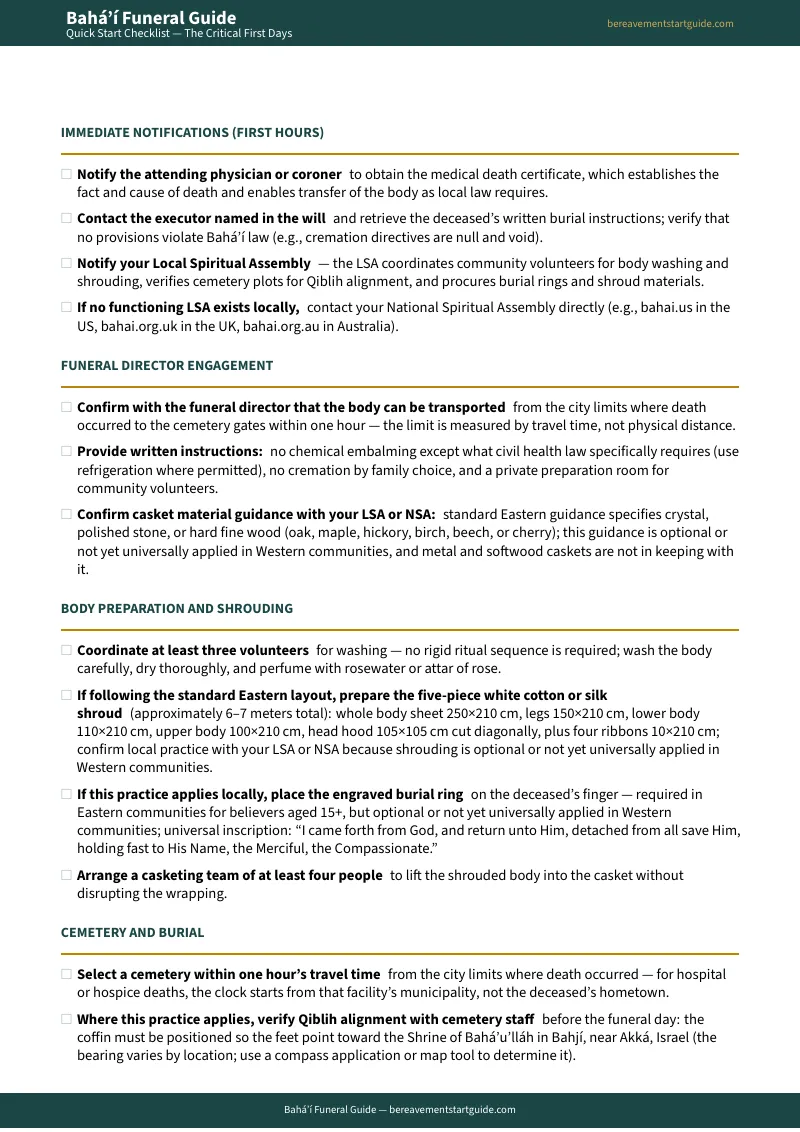
The free checklist covers the essential actions from notification through burial — the sequence of steps, the parties responsible, and the critical non-negotiables. It tells you what to do.
The full guide tells you how — with the shroud diagrams, the cemetery calculator, the funeral director scripts, the interfaith family talking points, the inheritance breakdown, and the printable worksheets that turn a compressed, high-stakes timeline into a process you can manage step by step. Get the full Bahá'í Funeral Guide →
Both options come with a full refund guarantee, no time limit. If the guide does not give you the clarity you need, email [email protected] and we will make it right.