You just got the worst phone call of your life — and now two countries want paperwork.
Your family member died in Canada. Within hours, a Canadian funeral director needs a signed authorization before they can take custody of the body. A provincial coroner may have ordered an autopsy you cannot refuse. Your travel insurer needs documentation you have never heard of before they will authorize a single dollar of reimbursement. And behind all of that, the clock is already running on a 60-day deadline for the Canada Pension Plan death benefit.
Meanwhile, the U.S. Embassy will open a case file, hand you a referral list, and wish you well. They cannot pay for repatriation, cannot intervene in Canadian legal proceedings, and cannot help you navigate the probate court back home.
You are on your own — managing two legal systems, ten-plus provincial bureaucracies, airline cargo rules, customs declarations, and cross-border tax obligations — while grieving.
The Cross-Border Repatriation Roadmap
The American Dies in Canada — Family Emergency Guide is a 47-page chronological workflow that takes your family from the first emergency phone call through final estate settlement. Every chapter produces a specific document that feeds the next step, so nothing falls through and nothing stalls waiting for a piece of paper you did not know you needed.
This is not a generic "what to do when someone dies" checklist padded with condolence advice. It is a cross-border operations manual — built around the actual document chain, provincial timelines, and regulatory requirements your family will encounter when an American citizen dies on Canadian soil.
What You Get
- First 72 Hours Crisis Protocol — the exact sequence of calls, authorizations, and document retrievals that prevents the most expensive bottlenecks, including the three qualifying questions to ask before signing any funeral home contract
- Province-by-Province Death Certificate Timelines — from British Columbia's 2–5 business day processing to Ontario's 16-week registration backlog to Quebec's Directeur de l'état civil delays, so you can set realistic expectations for every downstream process
- Next-of-Kin Authority Tables — the statutory priority hierarchy for British Columbia, Alberta, and Ontario (including the Bill 46 modernization), so your family knows exactly who has legal authority to authorize cremation, burial, or international transport
- Hague Apostille Provincial Guide — which of the six competent authorities handles your document (Ontario, BC, Alberta, Quebec, Saskatchewan, or Global Affairs Canada), what each charges, and the dual-step notarization requirement in Quebec that catches almost every family off guard
- Three Repatriation Paths with Worked Cost Examples — full-body air freight, local cremation with ash transport, and ground hearse repatriation, each broken down by component cost so you can make an informed decision instead of accepting the first (and most expensive) option a funeral home offers
- Airline Cargo and TSA/CATSA Rules — Air Canada Compassion and WestJet Compassionate program specifics, fleet restrictions, X-ray-friendly urn requirements for carry-on ashes, and the USPS Box-CRE packaging mandate effective March 2025
- Social Security Fairness Act Survivor Recovery — the GPO and WEP are repealed; what this means for benefits payable from January 2024 onward, how automatic adjustments work, and the critical distinction between active-beneficiary retroactive payments and never-applicant new claims that cannot be filed online
- CPP Death Benefit and Cross-Border Tax Compliance — the restructured 2025 benefit up to $5,000 CAD, the 60-day filing deadline, ancillary probate for Canadian assets, deemed disposition rules, Form T2062, and Canada-U.S. Tax Treaty provisions
- 5 Printable Planning Tools — a repatriation cost-comparison worksheet, provincial death certificate tracker, apostille submission log, insurance claim tracker, and agency communication log, each designed to be printed and filled in as you work through the process
Who This Guide Is For
- U.S. families managing a death in any Canadian province or territory — whether the person was traveling, retired, working, or visiting
- Executors and administrators handling cross-border estates with Canadian assets or dual tax obligations
- Adult children coordinating arrangements remotely while trying to keep their own lives together
- Anyone who needs to move remains or ashes across the Canada-U.S. border and has no idea where to start
Why Not Just Google It?
You could. Here is what you will find: a U.S. State Department page that has not been updated since the Apostille Convention took effect. Provincial vital statistics websites that explain their own process but tell you nothing about the five other agencies that need the same document. Reddit threads from 2019 that still describe the old multi-step super-legalization process Canada replaced in January 2024. Funeral home blogs that conveniently recommend the $15,000 full-body air freight option without mentioning that cremation and ash transport costs a fraction of that.
The information exists — scattered across dozens of government portals, airline cargo policies, postal regulations, and tax treaties. The guide brings it into one document, organized in the order your family actually needs it, updated for 2026 law.
The Free Checklist vs. the Full Guide
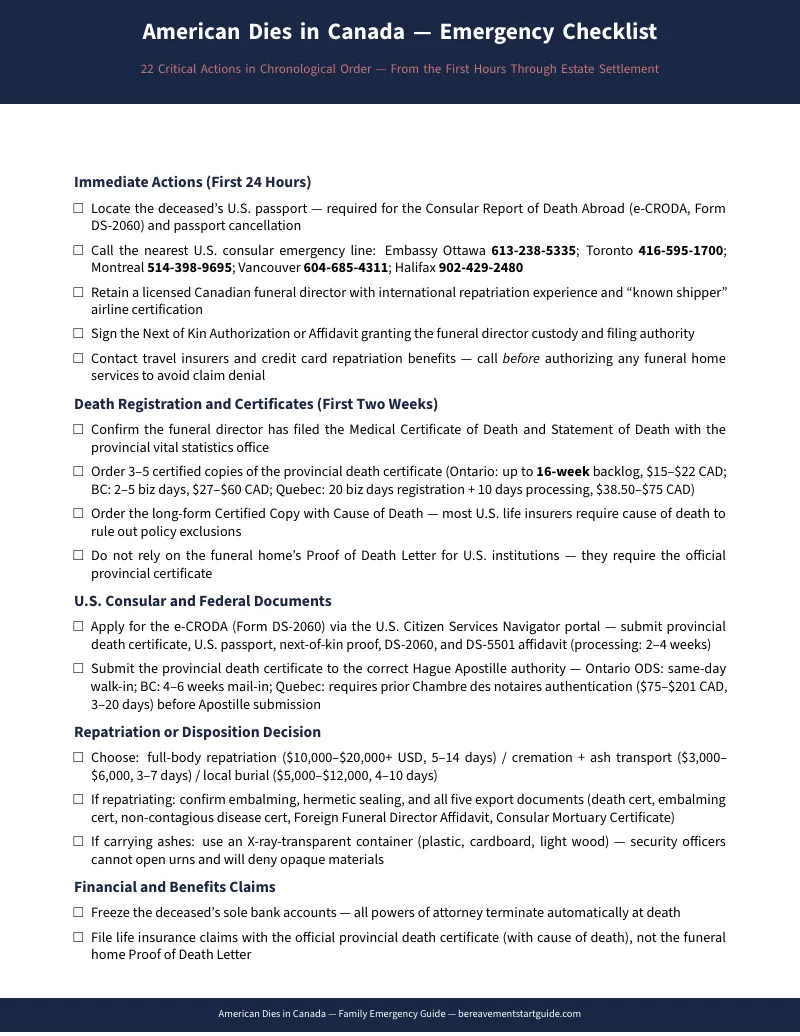
The free emergency checklist gives you the first-48-hours action list — enough to stabilize the situation and avoid the most immediate mistakes. The full guide takes you from there through the entire process: provincial death certificates, apostille procedures, repatriation logistics, Social Security recovery, CPP claims, cross-border tax filing, and estate settlement.
The checklist tells you what to do. The guide tells you how, when, where, and how much.
Full Refund, No Time Limit
If the guide does not help your family, email hello@bereavementstartguide.com for a full refund. No time limit, no questions, no hoops.
Get the American Dies in Canada Guide →
Your family is dealing with enough right now. The paperwork should not be the part that breaks you.