The State Killed Your Person. Now the Same Institutions Control Every Piece of Evidence You Need to Find Out What Happened.
A supervisor or chaplain delivered the news in careful, vague language designed to protect the agency, not to inform you. Within hours, the involved department has secured the scene, collected the body-camera footage, and issued a preliminary press statement that frames everything their way. Meanwhile, you are standing in a hallway somewhere trying to process words that refuse to become real — and a county risk-management representative has already left a voicemail about a "release of claims."
Your brain has stopped functioning in the ways it usually does. You are reading the same text three times. You forgot why you walked into the room. You cannot sleep but you cannot stay awake. That is not weakness — it is a clinically documented peritraumatic stress response. And it is happening at the exact moment when every decision you make carries legal, financial, and evidentiary consequences that can follow your family for years.
The agencies responsible for your person's death also control the investigation, the evidence, and the public narrative. Nobody is going to hand you a fair process. You have to build one.
The Custody Death Accountability System — An External Brain for Families Fighting an Adversarial Crisis
The After a Death in Police Custody toolkit is a 13-chapter triage system built for families navigating a death that the state has every institutional incentive to minimize. Not a grief memoir. Not a government victim-services pamphlet written by the same system under scrutiny. Not a law firm's intake page disguised as information. This is a sequenced operating manual covering both U.S. and UK frameworks — with fill-in templates, non-confrontational scripts for every institutional encounter, and a deadline tracker — designed to be used in five-minute intervals at 2 a.m. by a brain in crisis.
The toolkit covers what no single free resource does: evidence preservation before footage is overwritten, independent autopsy navigation, the insurance felony-exclusion trap, Notice of Claim deadlines that permanently bar wrongful death lawsuits if missed, UK inquest procedures, and family role coordination — all in one printable system that works when nobody is answering the phone and you are searching in the dark because you cannot sleep.
What's Inside the Toolkit
- First 48-Hour Triage Protocol with Family Role Assignment — because when one person is fielding calls from internal affairs, the coroner, the press, the insurer, and extended family, critical evidence-preservation tasks get missed and that person collapses. The role assignment system distributes responsibilities across defined positions — Evidence Coordinator, Financial Coordinator, Communications Coordinator, Family Caretaker — so the time-sensitive work gets done without destroying any single person in the process.
- Evidence Preservation Under Adversarial Conditions — because the agencies involved in your person's death also control the body-camera footage, the cell-check logs, the booking records, and the CCTV. This chapter provides fill-in spoliation notice templates, explains data retention windows for digital evidence, and walks you through requesting records through multiple channels simultaneously — before institutional retention policies can make them disappear.
- Independent Autopsy Navigation — because the official cause of death is determined by a coroner or medical examiner whose office has an ongoing working relationship with law enforcement. This chapter covers how to secure a private forensic examination before embalming, what it costs (typically $3,000 to $10,000), who provides reduced-fee or pro bono services, and how to challenge autopsy findings that rely on the discredited diagnosis of "excited delirium" — now formally rejected by the National Association of Medical Examiners, the AMA, and ACEP.
- Insurance Claims and the Felony Exclusion Trap — because life insurance policies contain exclusions for deaths during "resisting arrest" or the "commission of a felony," and insurers routinely cite un-cross-examined police incident reports to deny claims. This chapter explains the "No Conviction" defense — your person was never tried, never convicted, and is presumed innocent under law — and tells you exactly what to demand in writing from the insurer, including state prompt-payment statute citations when a "pending" cause of death is used to stall your payout indefinitely.
- Notice of Claim Deadlines and the Section 1983 Pathway — because under state tort claims acts, a wrongful death lawsuit against a public entity requires a formal Notice of Claim filed within 90 to 180 days of the death. Miss that window and your state-law claims are permanently barred. This chapter maps the federal civil rights pathway under 42 U.S.C. § 1983, explains how the statute of limitations borrows from each state's personal injury deadline, and covers what to do if you cannot afford an attorney immediately.
- HIPAA, Probate, and the Records Blockade — because to access jail medical records, intake screenings, psychiatric logs, and medication administration records, you need legal standing as the personal representative of the estate. Facilities cite federal HIPAA privacy law to refuse access until probate court confirms your appointment — a process that takes weeks while evidence-preservation windows close. This chapter walks you through expediting the appointment and using alternative channels to access records before probate is finalized.
- UK Inquest and Oversight Navigation — because England and Wales operate an entirely different system. Every death in state custody triggers a mandatory coroner's inquest. If state negligence is suspected, the inquest expands under Article 2 of the ECHR. This chapter explains the IOPC and PPO investigation processes, legal aid eligibility for bereaved families, the pre-inquest review timeline, and what to expect from the full jury inquest — which often takes six months to two years.
- Media, Public Attention, and Litigation Risk — because a custody death attracts reporters, activists, and social media commentary within hours, and anything your family says publicly can be used against you in future litigation. This chapter provides a template media statement, a protocol for declining press without appearing uncooperative, a social media lockdown checklist, and guidance on separating public advocacy from legal strategy.
- Supporting Children After a Custody Death — because children who lose a parent or family member to state violence do not grieve the way adults expect. They develop intense fear of authority figures. Their imagination fills every information gap with scenarios worse than the truth. This chapter provides age-appropriate language, behavioral warning signs that distinguish normal grief from childhood traumatic stress, and guidance on navigating school environments where other children have heard a version of the story.
- Non-Confrontational Communication Scripts — read-aloud scripts for speaking with medical examiners, jail administrators, county public information officers, insurance adjusters, and family members. Each script is designed to extract information and establish a paper trail without triggering institutional defensiveness — because the moment a conversation turns adversarial, cooperation stops and the paper trail goes dark.
- Crowdfunding and Benefits Protection — because a GoFundMe campaign that exceeds certain thresholds can disqualify your family from means-tested benefits and trigger tax reporting obligations that nobody warns you about before the campaign goes viral. This chapter covers how to structure fundraising to protect eligibility, the IRS gift vs. income distinction, and funeral assistance programs that exist independently of public campaigns.
- Funeral Planning Under Active Investigation — because the coroner or medical examiner has legal authority over the remains and can hold the body for weeks or months. This chapter covers delayed release timelines, your rights regarding the condition and preparation of the remains, and how to coordinate funeral planning around an investigation you cannot control.
Who This Guide Is For
- Partners carrying sudden single parenthood, the probate filing, the insurance battle, and the weight of a public narrative that is blaming the person they loved — all before you have slept a full night
- Parents whose protective instinct has been shattered by the one institution that was supposed to keep their child safe — now facing the exhausting choice between public advocacy and private survival
- Siblings running the FOIA requests, gathering witness contacts, preserving digital evidence, and coordinating family logistics while the support network focuses on the parents or the partner — the forgotten mourners absorbing heavy operational duties in silence
- Adult children navigating a loss that is both deeply personal and inescapably political — fielding calls from investigators, journalists, and community activists while processing disbelief
- Anyone managing the aftermath — executor, next of kin, or the person the family has silently designated as the one who can still function
Why Free Resources Leave You Exposed
Government victim-services pages are written by the same system under scrutiny. The language is cold, bureaucratic, and scattered across dozens of websites — one for the coroner, one for internal affairs, one for victim advocacy — each assuming you already know how the system works. Critically, they never advise you to challenge official findings or pursue civil litigation against their own agency.
Law-firm wrongful death pages provide useful legal summaries, but every page is engineered to funnel you into a retainer agreement. The emotional, logistical, and family-support dimensions of your crisis are invisible to them — and they only cover one jurisdiction.
Nonprofit advocacy organizations like INQUEST and the National Police Accountability Project produce excellent systemic resources, but their information is spread across dozens of separate PDFs, policy reports, and web pages. A traumatized brain cannot synthesize fragmented resources from five different organizations while operating under deadline pressure.
The After a Death in Police Custody toolkit exists in the space none of these resources occupy: high operational utility combined with genuine empathy, covering both U.S. and UK frameworks in a single sequenced system. It translates the dense institutional requirements into clear, human, step-by-step instructions — without trying to sell you a lawsuit, protect a government agency, or impose a political framework on your grief.
Satisfaction Guarantee
If the toolkit doesn't help — for any reason — email hello@bereavementstartguide.com and we will refund you in full, no time limit. You are dealing with enough right now. The last thing you need is purchase anxiety on top of everything else.
You Don't Have to Navigate This Alone
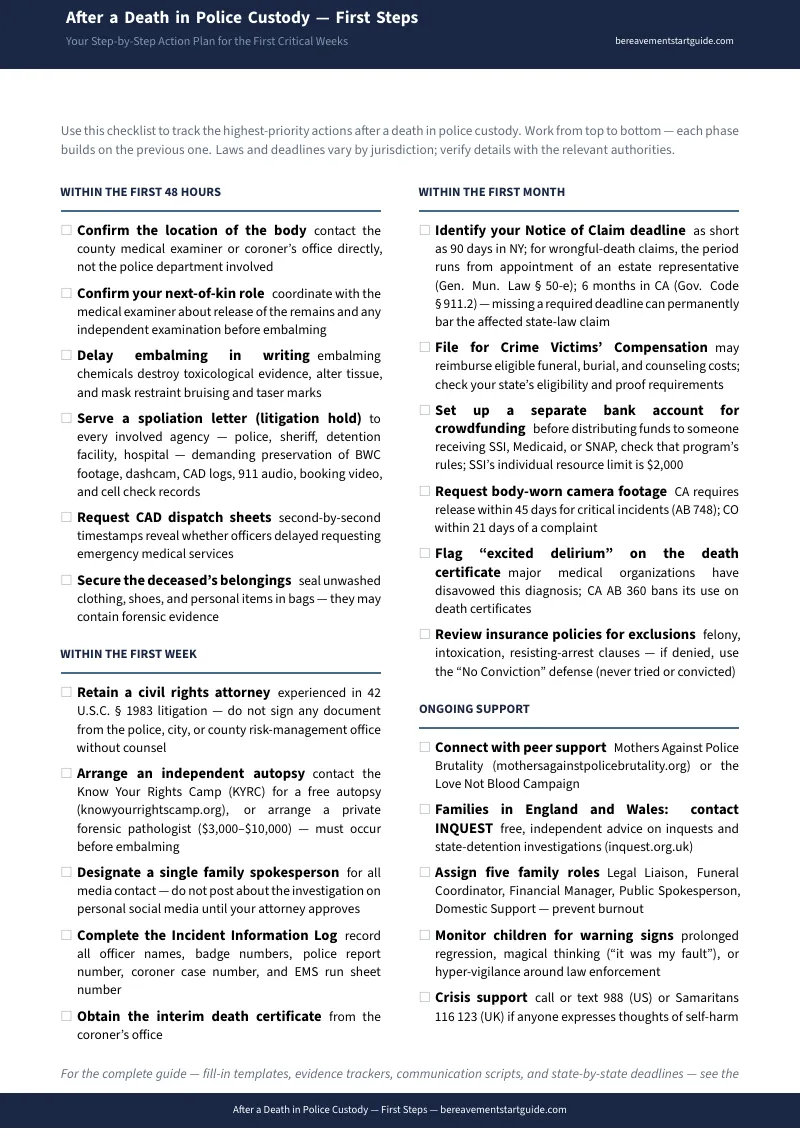
The free checklist gives you the sequence — what to do and when. If that is all you need right now, take it. But if you need the spoliation notice templates, the insurance appeal framework, the communication scripts, the UK inquest guide, and the chapter-by-chapter system that walks you through every institutional encounter — get the full After a Death in Police Custody toolkit and give your family a structured operating system that works when your brain cannot.
You are away from having an external brain for the most adversarial crisis of your life.