The Hospital That Was Supposed to Save Them Is Now Protecting Itself. You Have Hours to Protect Your Family.
The surgeon is suddenly unavailable. The risk-management team has sent a representative to your waiting room with a concerned expression and a folder of forms. The nursing staff, who were reassuring you twelve hours ago, are now speaking to you through carefully worded scripts. The treating physician's notes — the ones that documented your person's deterioration in real time — are sitting in an electronic health record system that can be edited, amended, and copy-pasted after the fact. And nobody has told you that.
Meanwhile, the IV lines, infusion bags, and medical devices connected to your person during their final hours are being cleared away as routine biological waste. The funeral director is asking whether you want cremation — a decision that permanently destroys every piece of forensic evidence you may need. Someone from hospital billing has already left a voicemail about outstanding charges. And the death certificate being drafted may list "cardiac arrest" as the cause of death, which is technically accurate in the way that "gravity" is the cause of every fall — true, unhelpful, and potentially devastating to any future claim.
Your brain cannot process any of this. You are experiencing what clinicians call peritraumatic stress response — elevated cortisol, cognitive fragmentation, and an inability to retain complex information at the precise moment when every decision you make carries legal, financial, and forensic consequences that cannot be undone.
The Clinical-Legal Triage System — An Independent Operating Manual for Families Navigating a Suspected Medical Error
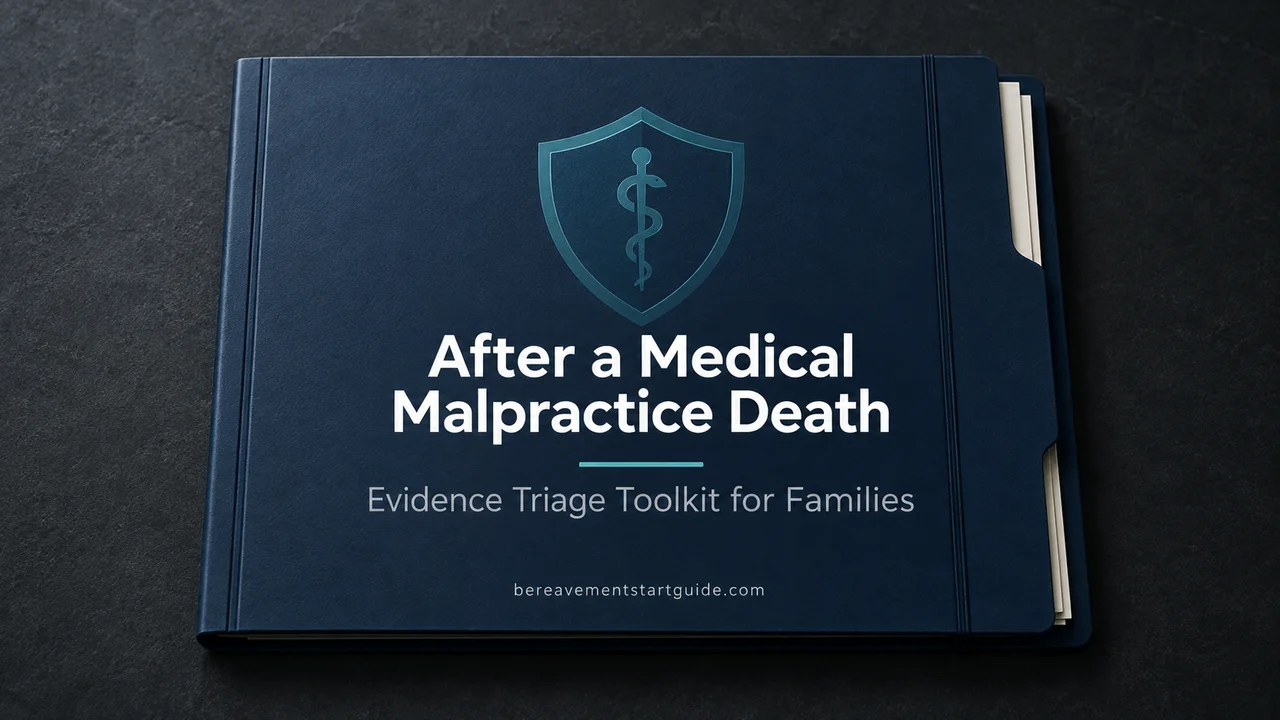
After a Medical Malpractice Death is the forensic-administrative triage toolkit built specifically for families who suspect a medical error killed their person. Not a law firm's intake funnel designed to sign you as a client. Not a hospital's risk-management handout designed to guide you toward a quiet settlement. Not a grief memoir. This is a 12-chapter sequenced operating system that tells you exactly what to preserve, what to demand, what to refuse to sign, and who to contact — designed to be used at 2 a.m. by a brain in crisis, before the hospital opens the next morning and another day of evidence vanishes.
The toolkit covers what no single free resource does: physical evidence preservation, EHR audit trails, death certificate disputes, hospital disclosure protocols (CANDOR and CARe), wrongful death and survival actions, insurance subrogation traps, medical bill defense, traumatic grief, and international frameworks for the UK, Canada, and Australia — all in one printable document with pre-written scripts, demand letters, and tracking worksheets.
What's Inside the Toolkit
- First 72-Hour Evidence Triage Protocol with Family Role Assignment — because the window to preserve physical evidence closes within hours, not weeks. The role assignment system divides the forensic, administrative, and emotional responsibilities across defined family positions — Evidence Coordinator, Records Manager, Communications Lead, Financial Coordinator, and Family Caretaker — so the most critical steps are covered before anyone burns out or breaks down.
- Physical Evidence Preservation — because IV lines, PCA pumps, infusion bags, surgical equipment, and implantable devices are routinely discarded as biological waste within hours of a patient's death. This chapter explains exactly what to demand in a pre-litigation preservation letter, who at the hospital must receive it, and what happens if the institution destroys evidence after receiving your written demand (spoliation of evidence — and it shifts the legal burden in your favor).
- EHR Audit Trail and Medical Records Access — because the electronic health record is not a static document. Clinicians can add late entries, copy-paste prior notes, and amend records after the fact. The audit trail — the system metadata tracking every access, edit, and modification with millisecond timestamps — is the forensic backbone of your case. This chapter walks you through securing it under HIPAA, establishing your personal representative status, and understanding what "quality assurance privilege" means when the hospital refuses to share internal review findings.
- Death Certificate Navigation — because a death certificate listing "cardiac arrest" or "natural causes" as the manner of death can freeze insurance claims, block wrongful death filings, and quietly erase the clinical error from the public record. This chapter explains how death certificates work, why the certifying physician may have listed a misleading cause, and the specific process for requesting an amendment based on forensic evidence or an independent autopsy.
- Hospital Disclosure Protocols — CANDOR and CARe — because many hospitals now use structured early-resolution programs designed to settle potential claims quickly and privately. These programs can be genuinely well-intentioned, but they are built by the institution's legal and risk-management team. This chapter explains exactly how these protocols work, what quality-assurance privilege shields from you, and why you should never sign any document — including a seemingly routine "acknowledgment" — without independent legal counsel reviewing it first.
- Wrongful Death Actions, Survival Claims, and the FTCA — because three distinct legal pathways may apply, each with different statutes of limitations, damage caps, and procedural requirements. Wrongful death compensates the family. Survival actions recover what the patient suffered before death. And if the death occurred in a federal facility (VA hospital, military treatment center, federal prison), the Federal Tort Claims Act creates an entirely separate process with a mandatory administrative claim before any lawsuit can be filed. This chapter maps each pathway so you can protect your deadlines before meeting an attorney.
- Financial Defense — Medical Bills, Liens, and Insurance Subrogation — because the hospital may bill your family for the very care that killed your person, including upcoded charges and phantom procedures. Meanwhile, insurance subrogation clauses and hospital lien statutes can claim a share of any future settlement before your family sees a dollar. This chapter covers how to audit the itemized bill, dispute fraudulent charges, and understand the lien landscape before you agree to pay anything.
- Traumatic Grief and Institutional Betrayal — because grief after a medical error is fundamentally different from natural bereavement. The person you trusted most — the medical system — is the entity that harmed your family and is now defending itself against you. This chapter addresses the somatic symptoms (elevated cardiac risk, sleep disruption, cognitive impairment), the guilt cycle (why families blame themselves for trusting the doctor), and when to seek trauma-specific clinical support rather than general grief counseling.
- Communication Scripts — because your brain cannot compose clear, protective language while in cognitive crisis. Pre-written, read-aloud scripts for speaking with the hospital risk manager, the coroner or medical examiner, the funeral director, the insurance adjuster, your own family, and anyone who asks intrusive questions — each script tells you exactly what to say and what never to volunteer.
- UK, Canadian, and Australian Frameworks — because the coroner's inquest (UK), provincial medical examiner systems (Canada), and coronial investigations (Australia) each have distinct processes for investigating suspected clinical negligence. This chapter maps each system, including the UK's Prevention of Future Deaths reports, Canada's Patient Safety Death Review Committees, and Australia's reportable death obligations — so international families know their specific rights and timelines.
Who This Guide Is For
- Surviving spouses and partners managing shock, children's questions, and a hostile institutional landscape while the hospital that was supposed to save their person deploys risk-management protocols designed to protect the institution, not your family
- Parents whose child died under medical care — carrying the unbearable weight of having approved the procedure, signed the consent form, trusted the surgeon — alongside administrative and legal tasks that feel impossible to process
- Adult children whose parent died during routine care — fielding calls from hospital administrators, insurance adjusters, and funeral directors while trying to determine whether what happened was preventable
- Siblings whose grief is being overlooked because the support network has focused on the spouse or the parents — often the family member quietly absorbing the heaviest operational burdens
- Anyone managing the administrative aftermath — executor, next of kin, or the person everyone assumes "has it handled" while they are falling apart behind closed doors
Why Free Resources Leave You Exposed
Law-firm wrongful death pages are highly specific about proving liability, but every paragraph is designed to funnel you into a litigation contract. The emotional, forensic, and administrative dimensions of your first week are invisible to them — they want you as a client, not as a protected family.
Government victim-service portals cover basic procedures in cold, bureaucratic language scattered across dozens of websites. None of them address the adversarial reality of dealing with a hospital that suspects you may file a lawsuit — because they were written by the same institutional system that is now managing its liability exposure.
Hospital-issued bereavement handouts are, at best, written to comfort you. At worst, they are designed to guide you into compliance with the institution's risk-management timeline — signing forms, accepting settlement offers, and making irreversible decisions about the body before you have had time to think.
The After a Medical Malpractice Death toolkit exists in the space none of these resources occupy: forensic rigor combined with genuine empathy. It treats you as a person in crisis who deserves both emotional support and the institutional knowledge to protect yourself — without trying to sell you a lawsuit, a settlement, or a spiritual framework.
Satisfaction Guarantee
If the toolkit doesn't help — for any reason — email hello@bereavementstartguide.com and we will refund you in full, no time limit. You are dealing with enough right now. The last thing you need is purchase anxiety on top of institutional betrayal.
You Don't Have to Navigate This Alone
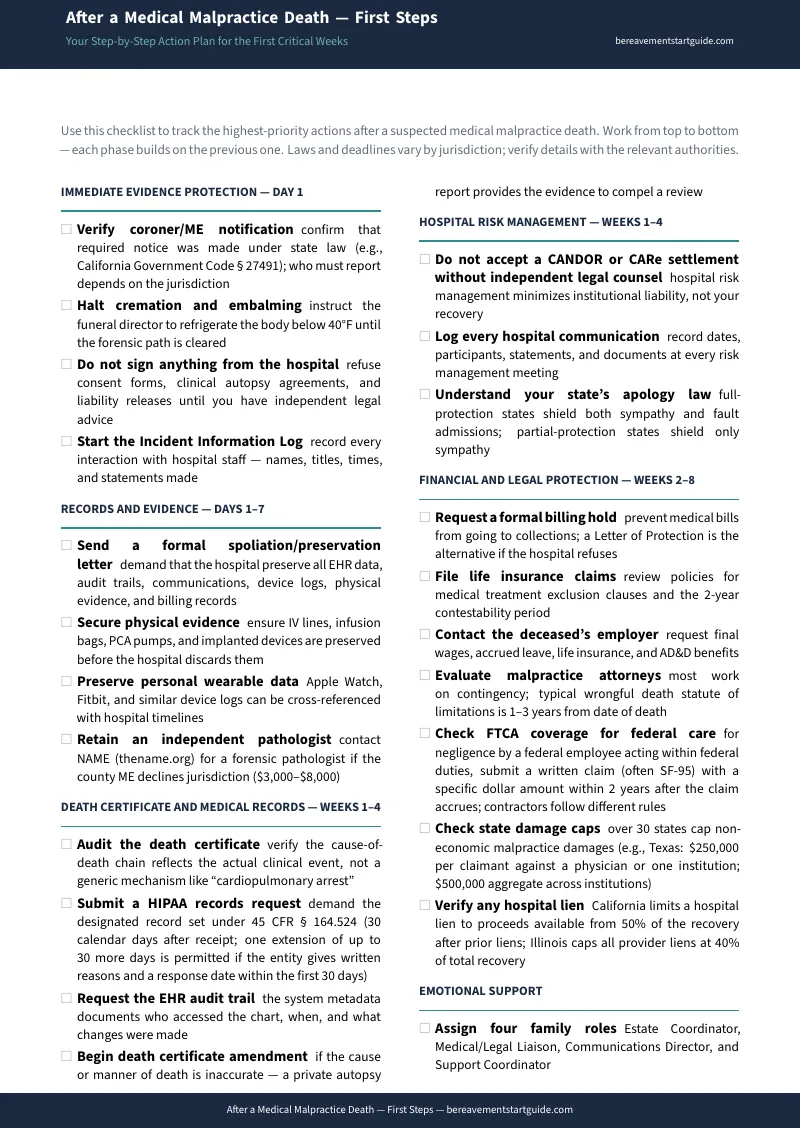
The free checklist gives you the sequence — what to do and when. If that is all you need right now, take it. But if you need the evidence preservation letters, the HIPAA request forms, the communication scripts, the insurance defense strategy, and the chapter-by-chapter guidance that walks you through every institutional encounter from the hospital to the coroner to the courtroom — get the full After a Medical Malpractice Death toolkit and give your family the forensic-legal operating manual that works when your brain cannot.
You are away from having an independent triage system for the most adversarial week of your life.