Your Person Collapsed and Died Without Warning. Now Every Institution in the Country Wants a Decision from You This Week.
A heart attack at the kitchen table. A stroke at the office. An aneurysm that gave no warning at all. There was no diagnosis, no hospice bed, no time to say goodbye — and now the coroner is asking about an autopsy, the insurance company wants a death certificate you don't have yet, the bank may have frozen the accounts, and the funeral home is quoting numbers you've never seen before.
Meanwhile your brain has stopped working properly. You're reading the same paragraph three times and retaining nothing. You're standing in the kitchen forgetting why you walked in. You picked up the phone to make a call and couldn't remember who you were calling.
That is not a personal failing. It is a documented neurological response to sudden traumatic loss — your executive function has shut down at precisely the moment when every decision carries legal and financial consequences that can follow your family for years.
The Sudden Death Triage System — an External Brain for the Worst Week of Your Life
After a Sudden Death (Heart Attack, Stroke, Aneurysm) is the practical triage toolkit built specifically for the aftermath of a cardiovascular death nobody saw coming. Not a grief memoir. Not a pamphlet. A sequenced operating system that tells you exactly what to do, in what order, with copy-paste scripts for every phone call and every institution — designed to be read in five-minute intervals by a brain in shock.
The toolkit covers what no single free resource does: the coroner process, the autopsy rights landscape, the insurance contestability minefield, the death certificate error traps, the digital estate lockout, the family communication breakdown, and the CPR survivor trauma — in one printable document that works at 2 a.m. when you are googling in the dark because you cannot sleep.
What's Inside the Toolkit
- The Coroner and Medical Examiner Chapter — because nobody explains why the police are at your house, why the body was taken to the county morgue, or what "jurisdiction over the remains" actually means for your family's timeline. This chapter translates the entire ME/coroner process from institutional language into plain steps.
- Autopsy Rights and Religious Objection Protocol — because families with Orthodox Jewish, Islamic, or other faith-based objections to invasive autopsy have a statutory 48-hour window to file an emergency injunction in most jurisdictions, and nobody hands them that information at the hospital. Includes the legal basis (NY PHL 4210-C, Ohio RC 313.131), the distinction between full autopsy and external examination with ancillary studies, and the financial risk if the cause of death is classified as "undetermined."
- Death Certificate Error Trap Audit — because one misspelled middle name, one wrong digit, or a cause of death listed as "pending" can freeze your insurance claim for months. How many certified copies to order, how to check every field before accepting the document, and how to get corrections made after the fact.
- Life Insurance Contestability and AD&D Claims Guide — because if the policy was issued or reinstated in the past two years, the insurer can audit the deceased's entire medical history and deny the claim for an undisclosed condition that had nothing to do with the death. This chapter covers post-claim underwriting, the premium trap (never stop paying premiums until the claim is approved), Accidental Death & Dismemberment policy exclusions, and what to do when the insurer says "pending investigation."
- FTC Funeral Rule Consumer Shield — because you have federal rights at the funeral home that nobody will tell you about at the worst moment of your life. The itemized General Price List they must hand you, the embalming you can decline, the casket you can buy elsewhere, and the 5–15% cash-advance markups most families never notice.
- Bank Account and Financial Asset Lockdown Protocol — because whether a joint account stays accessible or gets frozen depends on your bank's compliance procedures and your state's survivorship rules. What to secure in the first 48 hours, which accounts freeze and which don't, and how to keep household bills paid while the estate is in limbo.
- Digital Estate Recovery Procedures — because a locked iPhone without Apple Legacy Contact requires a probate court order to access, Google Inactive Account Manager has its own timeline and documentation requirements, and social media platforms each have a separate process for memorialization or deletion. What to do before the phone's battery dies and the Face ID window closes.
- Family Communication Scripts and Role Assignment — because the hardest phone calls happen when your voice cannot hold steady. Copy-paste text messages and phone scripts for relatives, friends, employers, schools, and social media, plus a role-assignment worksheet so the family divides tasks deliberately instead of defaulting to whoever picks up first.
- CPR Survivor Trauma and Lay-Rescuer Support — because if you performed chest compressions and your person did not survive, you are probably carrying intrusive sensory memories — the sound of ribs, the feeling of a chest that would not respond, the paramedics who could not bring them back. This chapter addresses lay-rescuer PTSD directly, not with platitudes, but with grounding techniques built for this specific kind of flashback.
- Children and Prolonged Grief Disorder Screening — because about 10% of children who lose a parent or sibling suddenly develop Prolonged Grief Disorder (DSM-5-TR), which is diagnosable after six months and looks different in children than in adults. Age-appropriate language scripts, the behaviors that signal normal grief versus PGD, and what the surviving parent can do to reduce risk.
- Genetic Screening After a Sudden Cardiac Death — because when a heart attack, arrhythmia, or aneurysm kills someone under 50, the surviving family may carry heritable conditions — hypertrophic cardiomyopathy, long QT syndrome, familial thoracic aortic aneurysm. What first-degree relatives should ask their cardiologist, and how molecular autopsy results can protect your children.
- Nine Standalone Printable Tools — notification scripts for every institution, a first-30-days task calendar, a funeral cost comparison worksheet, an insurance claim status tracker, a death certificate audit and distribution sheet, a family role assignment chart, an agency communication log, a document collection tracker, and a medical facts record. Every administrative artifact you would otherwise have to invent while cognitively impaired — each one a separate printable PDF you can hand to a family member or bring to a meeting.
Who This Guide Is For
- Surviving spouses and partners who lost someone without warning and are managing shock, an estate, and children's questions simultaneously
- Adult children whose parent collapsed at home or at work — who are fielding calls from every institution while processing their own disbelief
- The family member who performed CPR and is carrying the physical memory of trying to save someone they loved
- Siblings whose grief is being minimized because the support network is focused on the spouse or the children
- Anyone managing the administrative aftermath of a sudden cardiovascular death — executor, next of kin, or the person everyone assumes "has it handled"
Why Free Checklists and Google Searches Fall Short
Government bereavement pages give you accurate legal information in bureaucratic language that your brain cannot process right now. Hospital handouts stop at the funeral home's door. Law-firm blogs are written to sell consultations. Grief memoirs are beautiful and important — later. Right now, at 2 a.m., you need someone to tell you whether the insurance company can actually deny a claim because your spouse didn't disclose a mild cardiovascular condition eight years ago, and what to do about it.
No free resource consolidates the coroner process, the autopsy rights landscape, the death certificate error traps, the insurance contestability rules, the funeral consumer protections, the digital estate procedures, and the CPR trauma support into one sequenced document. That consolidation is the product. It exists so you do not have to search six different government websites, three grief forums, and a law-firm FAQ at 2 a.m. while your hands are shaking.
Guarantee
Full refund, no time limit. If the toolkit does not help your family, email hello@bereavementstartguide.com and we will refund you — no forms, no justification required. The guide is completely independent and does not accept affiliate fees or referral commissions from funeral homes, estate attorneys, or insurance companies.
Get the Toolkit
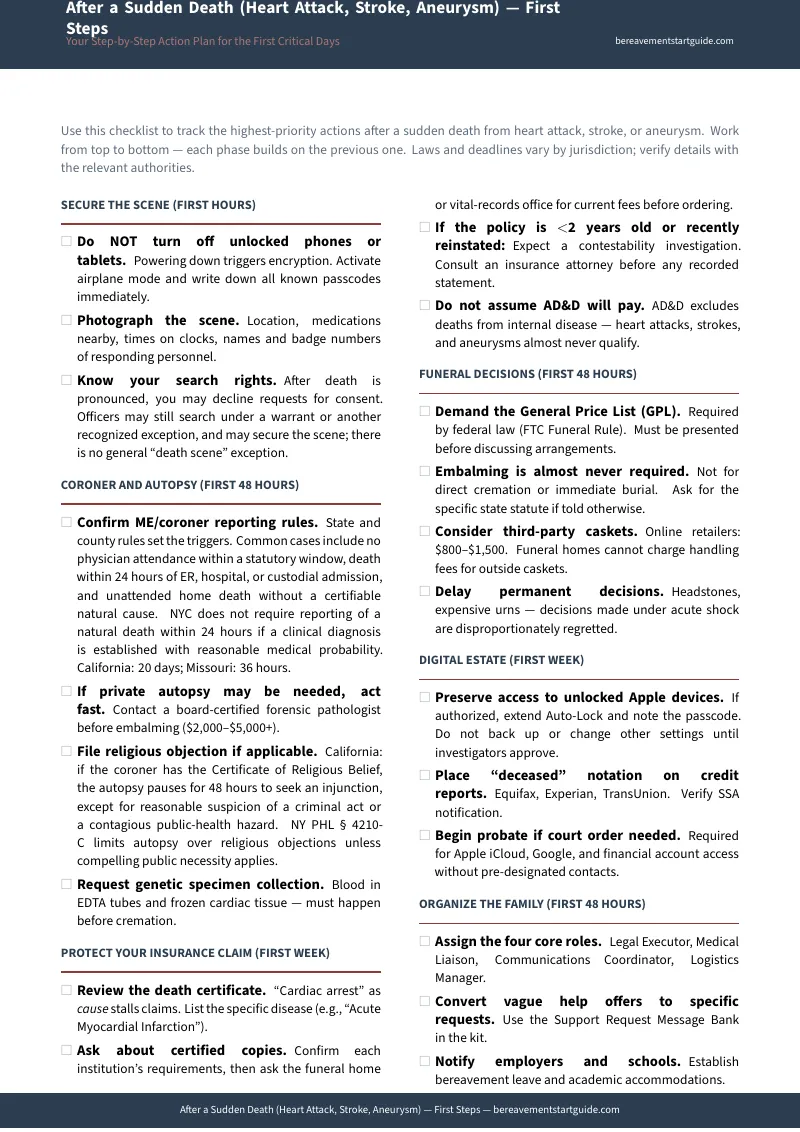
You can download the free one-page emergency checklist right now — it covers the immediate first steps for the first 48 hours. When you are ready for the complete system — all thirteen chapters, every template, every script — the full toolkit is available for as an instant download.