The facility controls the evidence. This toolkit puts you back in control.
When someone you love dies in a jail, prison, or detention center, you are thrust into a crisis that operates on two clocks. The first is grief — raw, disorienting, and isolating in ways that most people around you will never understand. The second is institutional — surveillance footage overwriting every 24 to 72 hours, autopsy objection windows as short as eight hours, and unclaimed remains timelines that can strip you of the right to bury your own family member.
Generic grief guides do not address this. Law firm websites want to sign you as a client, not teach you how to protect yourself. Government handouts explain the system from the system's perspective. And the free information that does exist is scattered across dozens of PDFs, state codes, and advocacy blogs — none of it organized for a family member searching at 2 a.m. for what to do right now.
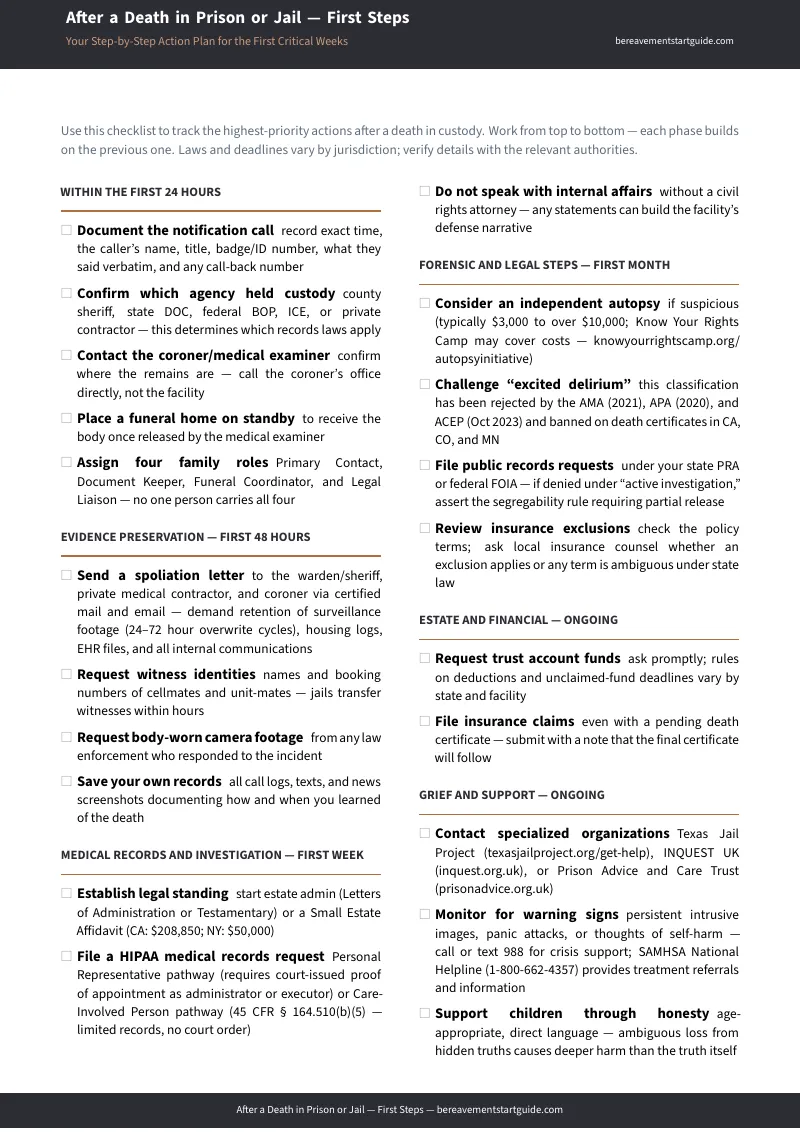
The Custody Death Triage System is different. It is not a grief book. It is a 43-page administrative and legal triage toolkit — plus six printable worksheets — built for the specific emergency of losing someone in custody. It includes ready-to-send letter templates, step-by-step records request procedures, and plain-language explanations of the legal mechanics that will shape your family's options for months to come.
What's inside the toolkit
- Preservation of Evidence Letter — a ready-to-customize template that puts the facility on formal notice to retain surveillance footage, medical records, housing logs, body-worn camera footage, and forensic evidence before automatic overwrite schedules destroy them. You do not need a lawyer to send it.
- HIPAA and medical records walkthrough — because correctional facilities routinely deny families access to medical charts, this section maps every pathway: next-of-kin verification, small estate affidavits, probate appointment, and the HIPAA rule that allows disclosure for up to 50 years after death under 45 CFR §164.502(f).
- Independent autopsy guide — when to commission a private forensic autopsy, typical costs ($3,000–$10,000+), how to spot ghost autopsy services that let a technician do the work while a pathologist signs off later, and organizations that fund second autopsies for in-custody deaths at no charge to the family.
- Insurance claim navigation — how confinement exclusions, felony exclusions, and suicide provisions actually work in practice, plus the three legal defenses (mental incapacity, accidental death presumption, contra proferentem) that your attorney can use to challenge a denial.
- FOIA and public records templates — separate procedures for county jails, state prisons, Federal Bureau of Prisons, and ICE detention, with the specific statutory references and mailing addresses each agency type requires.
- Unclaimed remains timeline tracker — state-by-state deadlines before a correctional facility can proceed with state-funded burial or cremation, so you never lose the right to claim your loved one's body because a clock ran out while you were trying to figure out what happened.
- Estate and financial recovery — how to retrieve personal property from the facility, recover inmate trust account balances, navigate a pending death certificate that is freezing insurance payouts, and handle estate administration when the decedent was incarcerated.
- Media and privacy scripts — because carceral deaths attract press attention and social media speculation, the toolkit includes scripts for handling reporters, managing online rumors, and working with accountability-focused journalists without compromising your legal position.
Who this is for
You are here because someone you love died in a correctional facility — a county jail, a state prison, a federal BOP facility, an ICE detention center, or a private contract facility — and you need to know what to do. You may be a spouse, a parent, an adult child, a sibling, or a close friend who has been designated as next of kin. You may suspect medical neglect, deliberate indifference, or a cover-up, or you may simply need to navigate the administrative machinery of releasing a body, filing insurance claims, and settling an estate under circumstances that no standard bereavement guide was built for.
This toolkit was written for families in the first hours and first months after a custodial death, whether the death occurred from natural causes, suicide, drug overdose, homicide, or medical neglect — and whether your loved one was a convicted person serving a sentence or a pretrial detainee who was never found guilty of anything.
Why free information is not enough
The free resources that exist for families after a custodial death fall into three categories, and each one has a structural gap that this toolkit fills:
Government and victim services guides explain the process from the facility's perspective. They tell you what the system is supposed to do. They do not tell you what to do when the system fails to do it — how to force evidence preservation, how to challenge a biased autopsy, or how to navigate an insurance denial rooted in the fact that your loved one was incarcerated.
Wrongful death law firm websites are lead generation tools. They describe the legal theories behind a civil rights claim clearly enough to convince you to call. They do not give you the self-help tools, letter templates, or records request procedures that would let you protect your position during the critical hours before you have retained an attorney.
Nonprofit advocacy resources are often excellent — organizations like INQUEST, the Texas Jail Project, and the Know Your Rights Camp Autopsy Initiative do invaluable work. But their materials are scattered across dozens of PDFs and web pages, organized by topic rather than by urgency, and rarely cover the full administrative picture from notification to estate settlement in one place.
This toolkit consolidates all of it — the legal triage, the administrative procedures, the emotional guidance — into a single, sequenced system that you can work through from the moment you get the call.
Your purchase is protected
Full refund, no time limit. If the toolkit does not help you, email hello@bereavementstartguide.com and you will receive a complete refund. No forms, no questions, no expiry date.
The toolkit costs less than a single hour of the professional guidance it replaces — and it is yours to keep and refer back to for as long as you need it.
Get the full toolkit and start protecting your family's rights today.