Something Is Wrong With the Will — and the Clock Is Already Running
You found out the estate plan changed. The person who moved in during the final months walked away with everything. Or the executor refuses to answer your calls while the assets quietly disappear. You know something is wrong, but you do not know what you are allowed to do about it — or how long you have before it is too late.
Contesting a will is not about greed. It is about protecting a person's true wishes when someone else may have overridden them through pressure, manipulation, or outright fraud. But the legal system does not wait for you to process your grief. Statutes of limitation in some jurisdictions are as short as 14 days. Miss that window, and a probate court treats your silence as consent.
Attorney retainers for contested probate start between $5,000 and $10,000 — before a single deposition is taken. Most people facing a suspicious will cannot afford to commit to litigation before they know whether their case is viable.
The Dispute Navigation System — Clarity Before Commitment
The Contesting a Will toolkit is built around a single idea: you should understand your situation, protect the estate from further damage, and organize your evidence before the legal fees start — not after.
This is not a legal textbook. It is an operational system that walks you through the entire dispute process one structured step at a time, from the moment you suspect something is wrong through resolution. Every chapter pairs practical legal guidance with the emotional pacing strategies that keep grief-related decision fatigue from derailing your case.
What You Get
The Four-Ground Self-Assessment — a structured evaluation framework that walks you through each recognized legal basis for contesting a will (undue influence, lack of testamentary capacity, fraud, and improper execution). You answer a series of specific questions about the circumstances and the framework maps your answers to the strength of each potential claim — so you know where you stand before you spend anything on legal consultations.
Jurisdiction-Specific Deadline Maps — clear filing windows for the U.S. (state-by-state probate codes), the U.K. (Inheritance Act 1975, Wills Act 1837, caveat procedures), and Australia (state-specific family provision legislation). Each deadline identifies which clock is running, what triggers it, and what happens if you miss it.
The Evidence Assembly Framework — a systematic method for gathering and organizing medical records, financial statements, visitor logs, caregiver records, digital communications, and witness statements. Every document type is mapped to the legal ground it supports, so you build an evidence file that tells a coherent story — not a disorganized box of papers.
Caveat and Probate Block Instructions — step-by-step guidance for filing administrative blocks that freeze estate assets before an executor can sell property, empty accounts, or distribute funds to the wrong people. Covers the U.S. petition process, the U.K. caveat system (including the 14-day warning/appearance procedure), and Australian caveats.
12 Communication Scripts — copy-and-paste templates for demanding a copy of the will from a hostile executor, requesting a formal estate accounting, notifying banks and registries, proposing mediation to siblings, responding to guilt-tripping messages, and escalating to the probate court when cooperation fails. Every script is written in a firm-but-measured tone that protects your legal position without burning bridges you might need later.
Sibling Dispute Decision Trees — structured resolution paths for the three conflicts that drive most will contests: the caregiver sibling who sacrificed years and was promised compensation the will does not reflect, the child excluded by a suspicious late-stage will change, and the executor who refuses to communicate or distribute. Each tree maps from the specific conflict through evidence gathering, mediation options, and formal filing — so you know exactly which path applies to your situation.
The Mediation-First Strategy — a practical framework for resolving the dispute without going to court, covering how to select a qualified mediator, structure settlement proposals, set mediation ground rules, and protect your position if talks fail. Courts in Australia resolve roughly 80% of estate disputes through mandatory mediation — even in adversarial systems, settlement is usually cheaper and faster than trial.
Professional Advisor Roadmap — which specialist to consult at each stage (probate litigator for caveats and standing, estate CPA for tax and settlement calculations, family mediator for emotional blocks). Includes the exact questions to ask during initial consultations and a framework for evaluating whether the strength of your case justifies the financial risk of litigation.
The One-Hour Daily Protocol — a grief-aware pacing system that limits estate dispute work to a single structured block each day. Grief-related cognitive overload leads to avoidance, and avoidance leads to missed deadlines. This protocol keeps the process moving without letting it consume your life.
Printable Evidence Tracker and Case Organizer — worksheets for logging communications, documenting suspicious transactions, building a timeline of events, and tracking professional contacts. When you sit down with an attorney for the first time, you arrive with an organized case file instead of a disjointed narrative — which means fewer billable hours spent getting them up to speed.
Who This Is For
- You believe a parent was pressured, isolated, or cognitively impaired when they signed or changed their will
- You were unexpectedly excluded from an estate plan or received a drastically reduced share
- An executor is refusing to share the will, provide an accounting, or communicate with beneficiaries
- A suspicious new will or codicil appeared during the final weeks of a parent's life
- You are the caregiver sibling who was promised compensation that the current will does not reflect
- You discovered that estate assets are being depleted, sold, or transferred before probate is complete
- You need to evaluate whether you have a viable case before committing to an attorney retainer
What Free Resources Get Wrong
Free articles about contesting a will are published by law firms to funnel readers toward retainer agreements. They explain legal concepts in enough detail to demonstrate expertise, but they never give you the tools to act on what you learn. They define "undue influence" without showing you how to document it. They mention "filing a caveat" without walking through the procedure. And they completely ignore the hardest part: managing the family conflict, the grief-induced paralysis, and the terror of making an irreversible mistake while your brain is running on fumes.
Generic legal template sites sell individual forms without context. A probate caveat form does not tell you when to file it, whether you have standing, what evidence to attach, or what happens after the 14-day warning lands. The form without the strategy is a blank page.
This toolkit connects every step to the next. The self-assessment tells you which ground applies. The evidence framework tells you what to gather. The deadline map tells you how much time you have. The communication scripts give you the exact words. And the pacing protocol keeps grief from shutting down the whole process.
Your Purchase Is Risk-Free
Full refund, no time limit. If the toolkit does not help, email hello@bereavementstartguide.com and we will refund every penny — no questions, no expiration.
Get Started Now
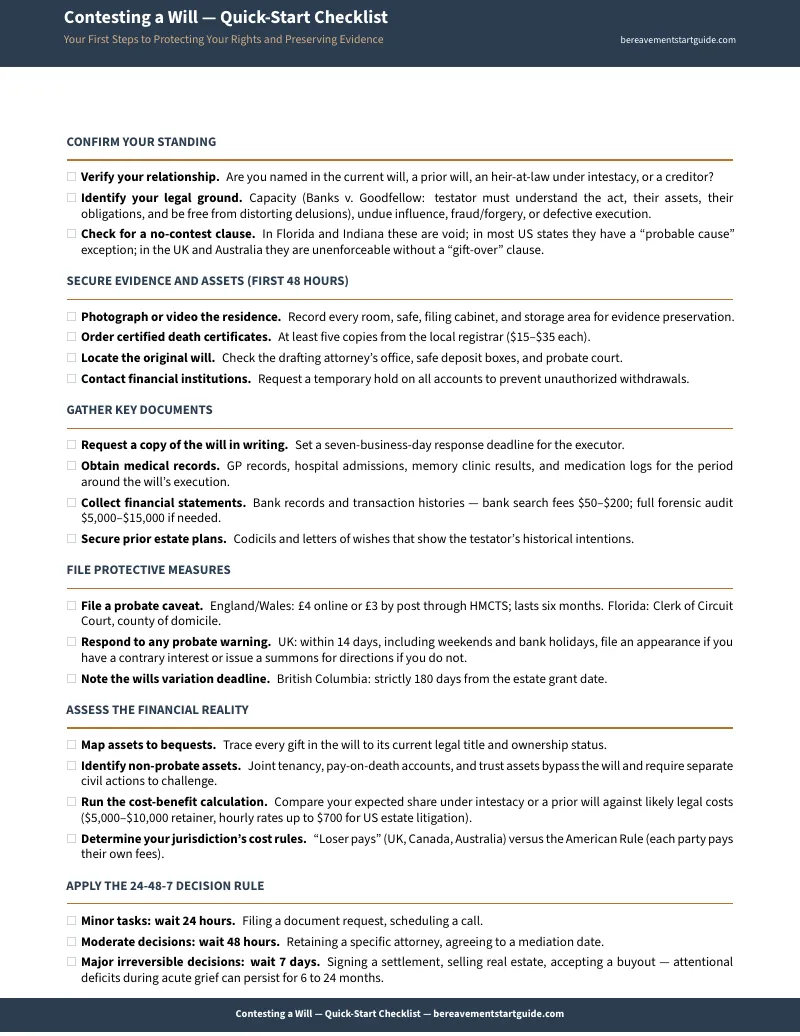
Download the free Quick-Start Checklist to see the structure and scope of the toolkit. When you are ready for the complete system — the full guide, all 12 communication scripts, 9 printable worksheets, the deadline maps, and the decision trees — get the full Contesting a Will toolkit for .