The collector does not care that you are grieving
Within days of a death, the calls start. A credit card company wants the full balance — today. A hospital billing department sends a statement marked "final notice." A debt collector leaves a voicemail implying that you, the surviving family member, are personally responsible for every dollar.
You do not know if that is true. You cannot tell whether paying this bill protects the estate or drains it. And every hour you spend Googling conflicting advice is an hour closer to a statutory deadline you did not know existed.
The Debt Settlement & Creditor Notification Toolkit is an Executor's Liability Shield — a complete system for managing estate debts in the legally correct order while protecting yourself from personal exposure. It replaces the panic of guessing with the precision of knowing exactly which debts to pay, which to reject, and which disappear on their own when the claims window closes.
What is inside
Every tool is designed for someone settling an estate for the first time, under pressure, with no legal background:
- Ready-to-send creditor notification letters — templates for banks, credit card issuers, medical billers, mortgage servicers, utility companies, and collection agencies, each citing the correct federal and state provisions so the recipient knows you understand the law
- FDCPA and Regulation F scripts — word-for-word language for responding to collector calls, demanding written validation, invoking a thirty-day dispute window, and sending a cease-and-desist letter via certified mail that legally stops further contact
- Priority-of-claims worksheet — the law dictates a strict hierarchy for which debts get paid first; this worksheet organizes every claim by its statutory priority class so you pay in the order courts require, not the order collectors demand
- Fifty-state spousal liability matrix — community property rules, the Doctrine of Necessaries, and homestead exemptions vary dramatically by state; the matrix shows exactly which debts transfer to a surviving spouse and which belong solely to the estate
- Claims window tracker — monitors publication dates, individual creditor notice dates, and statutory bar deadlines so you know exactly when the window closes and late claims become permanently unenforceable
- Insolvent estate worksheet — when debts exceed assets, this worksheet walks through the formal declaration process step by step, including which creditor classes receive partial payment and which receive nothing
- Communication scripts — word-for-word scripts for calling banks to report a death, declining pressure to pay personally, explaining estate insolvency to family members, and requesting claims extensions from creditors
- Document location tracker — tracks which death certificates, letters testamentary, tax returns, and account statements you have collected and which you still need, where each was found, and which institution holds the original
Who this is for
- First-time executors who did not expect to be named and have no experience with probate, creditor claims, or statutory deadlines
- Surviving spouses who need to know — tonight, not after a three-week wait for an attorney consultation — whether they are personally liable for their partner's medical bills, credit card balances, or mortgage
- Adult children settling a parent's estate while collection agencies call the family home and impatient siblings demand immediate distributions
- Co-executors who need a structured system to divide the administrative workload and document every decision to avoid disputes later
Why free checklists are not enough
Free online resources give you a list of things to do. They do not give you the order — and order is everything in estate debt settlement. Paying an unsecured credit card bill before the statutory claims window closes can make you personally liable to a secured creditor who files a valid claim later. Distributing assets to beneficiaries before debts are resolved can trigger a surcharge action that requires you to cover the shortfall from your own funds.
Government websites like the CFPB and FTC provide accurate regulatory interpretations, but in dense legal language with no editable templates, no tracking systems, and no guidance on how to pace the work across the twelve-to-twenty-four-month settlement timeline. Law firm blogs give thorough technical articles — followed by a prompt to book a consultation at $200–$400 per hour.
The Executor's Liability Shield fills the gap: professional-grade administrative tools at a fraction of what a single billable hour costs, organized in the sequence you actually need them.
Your purchase is risk-free
Full refund, no time limit. If the toolkit does not deliver what you need, email hello@bereavementstartguide.com and we will refund your purchase — no questions, no expiration date.
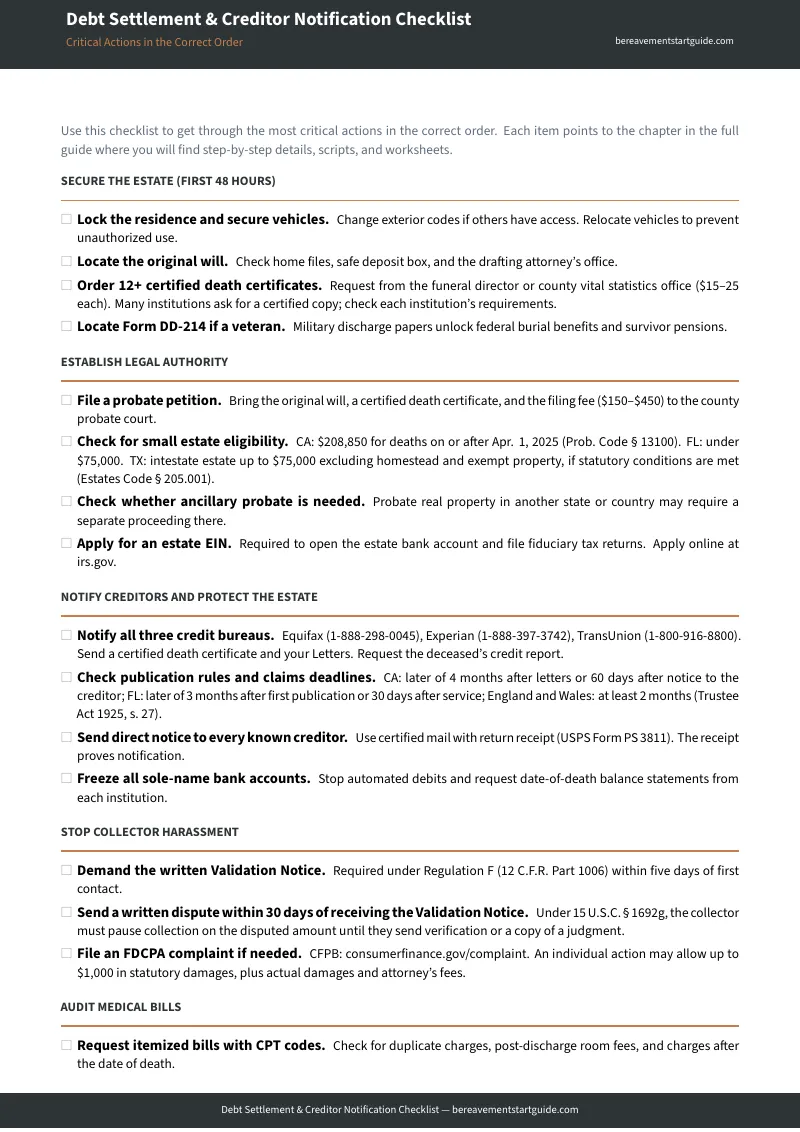
You keep the free checklist regardless.
Frequently Asked Questions
How is this different from the free checklist?
The free checklist tells you what to do — notify these institutions, gather these documents, watch these deadlines. The full toolkit tells you how — with ready-to-send letters, tracking worksheets, priority-of-claims calculators, and scripts for handling collector calls. The checklist is a roadmap; the toolkit is the vehicle.
Is this legal advice?
No. The toolkit provides educational guides, administrative templates, and organizational tools. Every template cites the relevant federal or state statute so you can verify the legal basis yourself. For active lawsuits, contested wills, or complex insolvency situations, the guide explains exactly when to engage a licensed probate attorney and what questions to ask.
Do I need this if I already have an attorney?
Yes — especially if you have an attorney. Approximately eighty percent of executor duties are administrative: organizing records, sending notifications, tracking claims, filing accountings. The toolkit handles this work so your attorney can focus on the legal questions that actually require their expertise, saving you billable hours.
Does this cover my state?
The guide covers federal protections (FDCPA, Regulation F, FCRA) that apply nationwide, plus the spousal liability matrix addresses community property rules, the Doctrine of Necessaries, and homestead exemptions for all fifty U.S. states. The notification templates and priority-of-claims structure work in every U.S. jurisdiction.
What format are the files?
Everything is delivered as downloadable PDFs you can print, fill in by hand, or complete on screen. The notification letter templates include fill-in fields for names, dates, and account numbers.
What if I need help after purchasing?
Email hello@bereavementstartguide.com. We read every message and respond within one business day.