
The Phone Is Locked. The Email Account Is Behind Two-Factor Authentication. The Subscriptions Are Charging a Credit Card the Bank Is About to Freeze. And Nobody Knows Which Passwords They Used.
You are holding Letters Testamentary, a death certificate, and the legal authority to manage this estate. None of those documents will unlock an iPhone. None of them override a platform's terms of service. None of them will stop Netflix, Spotify, Adobe, and fourteen other services from billing the estate next month while you wait for Apple to respond to a form you are not sure you filled out correctly.
You googled "how to access a deceased person's email" and got a Google support page that told you to submit a request. You submitted it. You have not heard back. Meanwhile, that email account is the master key to everything else — password resets, financial statements, insurance correspondence, tax documents. Every day it sits inaccessible is another day you cannot cascade through the rest of the digital estate.
The legal framework exists. The Revised Uniform Fiduciary Access to Digital Assets Act, adopted in nearly every U.S. state, gives executors a pathway to request digital account access. But RUFADAA does not hand you the keys. It establishes a priority system where platform-level tools (Google Inactive Account Manager, Apple Legacy Contact, Facebook Memorialization Contact) override your will, your court order, and your executor appointment. If the deceased never configured those tools — and most people do not — the platform's terms of service control the outcome. Most terms of service prohibit third-party access entirely.
The Digital Estate Toolkit is a Platform Recovery System — a sequenced, legally grounded manual that tells you what to secure in the first 48 hours, what to request from each platform and exactly how, where the line falls between fiduciary access and a federal offense under the Computer Fraud and Abuse Act, and how to handle the four categories of digital assets that trip up every executor: locked devices, cryptocurrency, email-as-master-key, and the subscription billing loop.
What's Inside the Platform Recovery System
A step-by-step guide, a quick-start checklist, and standalone worksheets — covering every phase of digital estate administration from the first 48 hours through final account closure, built on RUFADAA compliance, platform-specific recovery procedures, and the federal statutes that make this different from any other kind of estate work:
First 48 Hours: Device and Account Triage
The window for preserving digital access is shorter than most executors realize. A mobile carrier that learns of a death may deactivate the phone line — and with it, every two-factor authentication code the deceased's accounts rely on. A laptop that enters sleep mode may require a password on wake that nobody knows. The guide's triage protocol covers what to secure physically, how to keep the phone plan active long enough to receive verification codes, and how to document what you can see before you begin the formal request process for what you cannot.
The RUFADAA Access Hierarchy
RUFADAA creates a three-tier priority system. Platform-level directives (Google Inactive Account Manager, Apple Legacy Contact) sit at the top — if the deceased configured one, it overrides everything else. Traditional estate documents (wills, trusts) sit second, but only if they contain explicit digital asset authorization language — a general executor appointment is not enough to read email content. Terms of service sit at the bottom, and most terms of service deny all fiduciary access. The guide maps this hierarchy against the actual request procedures at each major platform, so you know before you submit a request whether your current legal documents are sufficient or whether you need specific will language the court may have to interpret.
The CFAA Line: When a Known Password Becomes a Federal Offense
The deceased's daughter knows the laptop password. The surviving spouse has the email login saved in a browser. A family member logged in yesterday "just to check." Every one of these situations raises a question under the Computer Fraud and Abuse Act, which criminalizes unauthorized access to protected computers. An executor with Letters Testamentary has stronger legal footing than a family member acting informally — but "stronger footing" is not the same as blanket authorization, and platform terms of service create a second layer of restriction. The guide explains where the line actually falls, provides the platform-approved alternative pathways, and includes a decision framework for the gray areas where the law has not caught up to the technology.
Platform-by-Platform Recovery Protocols
Google, Apple, Meta, Microsoft, X, LinkedIn, and major financial platforms each have their own death-notification process, their own document requirements, and their own timelines. Some respond in days; others take months. Some release content; others release only metadata. Some require a court order beyond Letters Testamentary; others accept a certified death certificate and a notarized ID. The guide provides the step-by-step procedure for each platform — what to submit, in what format, through which portal — and tells you what to do when your initial request is denied, which happens more often than the platforms acknowledge.
Cryptocurrency Triage
Assets held on a centralized exchange (Coinbase, Kraken, Binance) can generally be claimed through the exchange's inheritance process — slow, heavily documented, but achievable. Self-custodied assets in a hardware wallet or software wallet are a different category entirely: without the private keys or seed phrase, no court order and no amount of legal authority can unlock the wallet. The guide covers where to search for seed phrases and wallet files, how to approach each major exchange's estate process, and how to recognize when recovery is genuinely impossible versus when a forensic specialist might help — including realistic cost expectations so you do not pay $5,000 for a recovery attempt on a wallet holding $200.
Email as the Master Key
The primary email account is the most strategically valuable digital asset in the estate — not because of its contents, but because it is the password reset mechanism for everything else. Recovering email first lets you cascade through dozens of platform resets without submitting individual death-notification requests to each one. The guide explains why email should be your first recovery target, the legal distinction between content access and catalog (metadata) access under the Stored Communications Act, and the specific request procedures for Gmail, Outlook, Yahoo, and iCloud Mail.
The Subscription Billing Loop
The average person maintains subscriptions across streaming services, software platforms, cloud storage, gaming, news, fitness apps, and professional tools. Each one will continue billing until someone cancels it. The guide includes a system for identifying active subscriptions from bank statements and email receipts, a cancellation priority matrix based on billing cycle timing (annual renewals first — a missed cancellation on a $120 annual plan is ten times the cost of a missed monthly charge), and communication scripts that reference the card issuer's death notification to streamline each cancellation and secure refunds for charges after the date of death.
Social Media Memorialization and Deletion
Facebook, Instagram, X, LinkedIn, and TikTok each handle death differently. Some allow memorialization; others allow deletion; some allow data download before closure; others do not. The emotional weight of a public social media presence — friends still posting on a deceased person's wall, the profile appearing in "People You May Know" suggestions — makes this one of the most psychologically difficult parts of the process. The guide covers the specific procedure for each platform and provides a framework for the family decision: memorialize, download and delete, or leave it alone.
Communication Scripts and Templates
Pre-written letters and emails for requesting account access from platforms, canceling subscriptions, notifying service providers of a death, and escalating when an initial request is denied. Each template is built for the specific platform or service category it targets — a letter to Google's deceased user support team looks nothing like a letter to a streaming service's billing department.
Who This Guide Is For
- The executor who has Letters Testamentary but no idea which platforms the deceased used — who needs a systematic discovery process before they can even begin requesting access, starting with the email account, the phone, and the bank statements
- The surviving spouse locked out of shared photo libraries, financial accounts, or the family email — who needs to understand whether using a known password is a legal option or a legal risk, and what the platform-approved alternatives actually look like
- The adult child trying to stop subscription charges while preserving sentimental data — who cannot afford to accidentally delete a cloud photo library while canceling the storage plan, and who needs a sequence that handles billing and preservation in the right order
- The family dealing with cryptocurrency holdings on an exchange or in a hardware wallet — who needs to understand the difference between a custodial claim process and a self-custody recovery situation, and what realistic recovery looks like for each
- The executor who already made a mistake — who logged into an account using the deceased's password, or deactivated the phone line before capturing two-factor authentication codes, or deleted an account without downloading the data first, and needs to understand the consequences and next steps
- Estate attorneys and CPAs who handle traditional probate but encounter digital asset questions infrequently — who need a structured reference for RUFADAA compliance, CFAA exposure, and platform-specific procedures without spending billable hours researching each platform individually
Why Free Resources Will Not Get You Through This
The information exists. Google publishes its deceased user request process. Apple has a Digital Legacy page. Every major platform has a help article about what happens to an account after someone dies. Here is what you actually encounter when you try to navigate a digital estate using free sources:
- Each platform explains its own process but not how it connects to everything else. Google's help page tells you how to request a deceased user's data. It does not tell you that you should recover the email account first to cascade password resets across other platforms. It does not mention that deactivating the phone line before capturing two-factor codes will lock you out of the email account. Free resources answer one question at a time; a digital estate requires sixty decisions in sequence.
- Legal information is scattered across bar journals and law school papers. RUFADAA's three-tier priority system, the Stored Communications Act's content-versus-catalog distinction, and the CFAA's unauthorized access provisions are documented — in academic language, across dozens of sources, none of which tell a grieving executor what to actually do on Tuesday morning when the phone carrier calls to ask whether they should cancel the line.
- Competitor products require pre-loss setup. Digital vault services like Everplans, SharedAffairs, and DeadDrops provide secure storage and automated delivery — but only if the deceased populated the vault before their death. If they did not, these services offer nothing to the executor inheriting an unconfigured estate. This toolkit works retroactively.
- Generic bereavement guides skip the technical depth. Books and websites about estate settlement devote a paragraph to "digital accounts" and suggest making a list. They do not explain RUFADAA, they do not distinguish between content and catalog access, they do not address the CFAA, and they do not provide platform-specific request procedures. The digital estate is not a footnote — for many modern estates, it is the most complex and time-sensitive component.
Free resources give you one platform's help page at a time. The Platform Recovery System puts every platform, every legal framework, and every executor decision into one document, in the order you actually need them — from the first 48 hours through the final account closure.
— A Fraction of One Hour With a Digital Forensics Specialist
A digital forensics consultation runs $150 to $300 per hour. An estate attorney billing for digital asset research charges $250 to $500 per hour. Hiring a specialist to recover a single locked device starts at $500. This toolkit costs a fraction of one professional hour and gives you the complete digital estate recovery system — every platform procedure, every legal compliance framework, every communication template, and the sequenced timeline that prevents the mistakes most executors do not know they are making until it is too late.
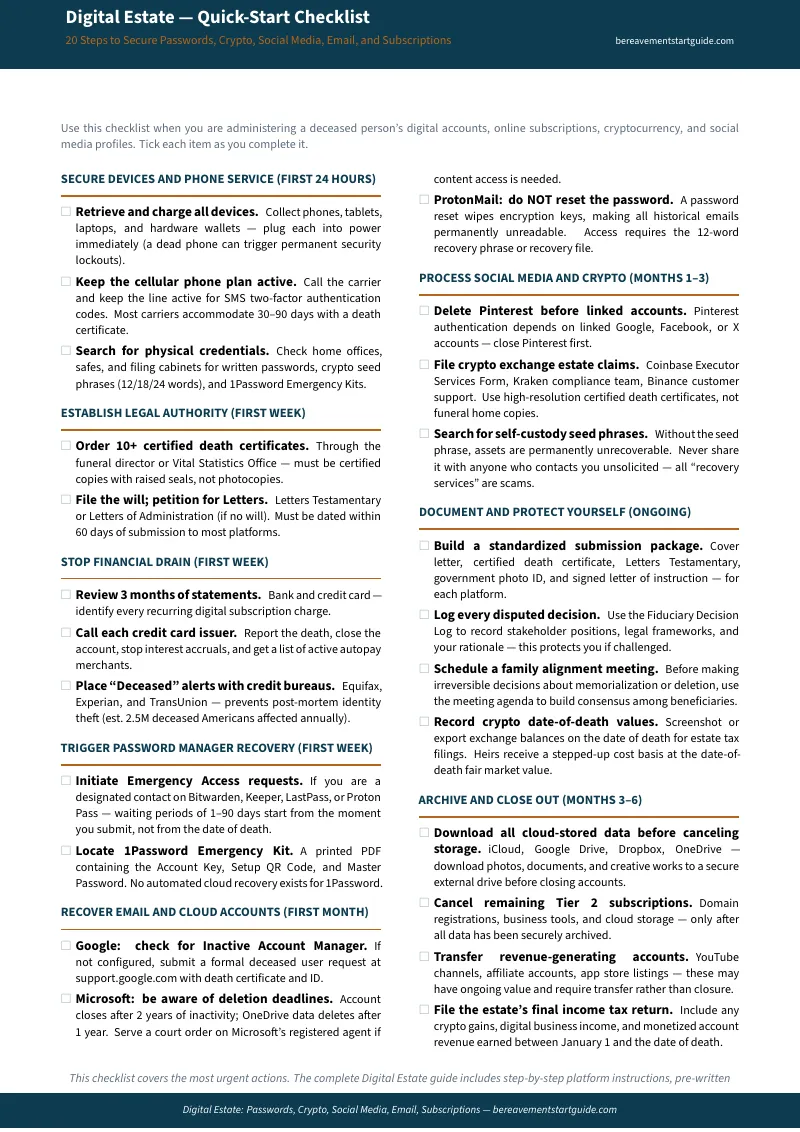
Your download includes the complete step-by-step guide covering RUFADAA compliance, platform recovery protocols, cryptocurrency triage, email recovery, subscription management, social media decisions, and family conflict navigation. Plus 6 standalone printable worksheets — a digital asset inventory, subscription cancellation tracker, platform request log, fiduciary decision log, family meeting agenda, and communication scripts — and the Digital Estate Quick-Start Checklist, a two-page companion covering the 24 most critical actions in the first two weeks after a death. 8 PDFs total, instant download, no account required.
Full refund, no time limit. If the toolkit does not give you clarity on what to secure, what to request, and how to navigate the legal and technical landscape of digital estate administration — email hello@bereavementstartguide.com for a full refund. No questions asked.
Not ready for the full toolkit? Download the free Digital Estate Quick-Start Checklist — a two-page overview of the most critical first steps, the platforms that require immediate attention, and the legal boundaries you need to understand before you touch anything. Enough to know what you are facing and whether you need the full guide.
Nobody trained you for this. The platforms were not designed for this. The law is still catching up. But the process works when you follow it in sequence — and the toolkit gives you the sequence.