The estate is tearing your family apart — and the clock is running.
Someone you love died, and now the family is fighting over what they left behind. One sibling changed the locks on the house. Another is demanding a full accounting and threatening to hire a lawyer. A step-parent has gone silent. The executor — maybe that is you — is caught between fiduciary duty and a grief so heavy that reading a bank statement takes three attempts.
You already know where this is heading. A probate attorney files a petition. The other side retains their own counsel. Discovery motions begin. The estate hemorrhages $15,000 to $50,000 per side in legal fees before anyone sees a courtroom. The process takes 18 to 36 months. Every filing becomes public record. And the family bonds that existed before the death are permanently fractured — not by the dispute itself, but by the adversarial system designed to resolve it.
There is another path. Estate mediation resolves 70% to 80% of inheritance disputes in a single confidential session — at a fraction of the cost of litigation, with a binding written agreement the family controls instead of a judge's ruling no one wanted.
But mediation only works when families prepare for it properly. And nothing available teaches you how.
The Conflict-to-Resolution System
The Estate Mediation toolkit is a structured preparation and execution system for families facing inheritance disputes. It replaces the scattered free articles, the law-firm blogs designed to funnel you into a retainer, and the grief books that validate your feelings without giving you a single actionable template.
Every chapter connects to the next. Every tool is designed for a brain operating under grief — short sections, clear next steps, and stopping points that tell you when you have done enough for today. The system works whether you hire a professional mediator or use the framework for structured family negotiations on your own.
What's Inside
- Conflict Mapping Framework — because estate disputes are never about the money on the surface. This structured tool documents each party's stated position, their underlying interest, and the historical context driving their behavior. When your sister says "I want the house," the framework helps you identify whether she needs financial security, a connection to childhood memories, or recognition for years of unpaid caregiving — and each of those needs has a completely different resolution.
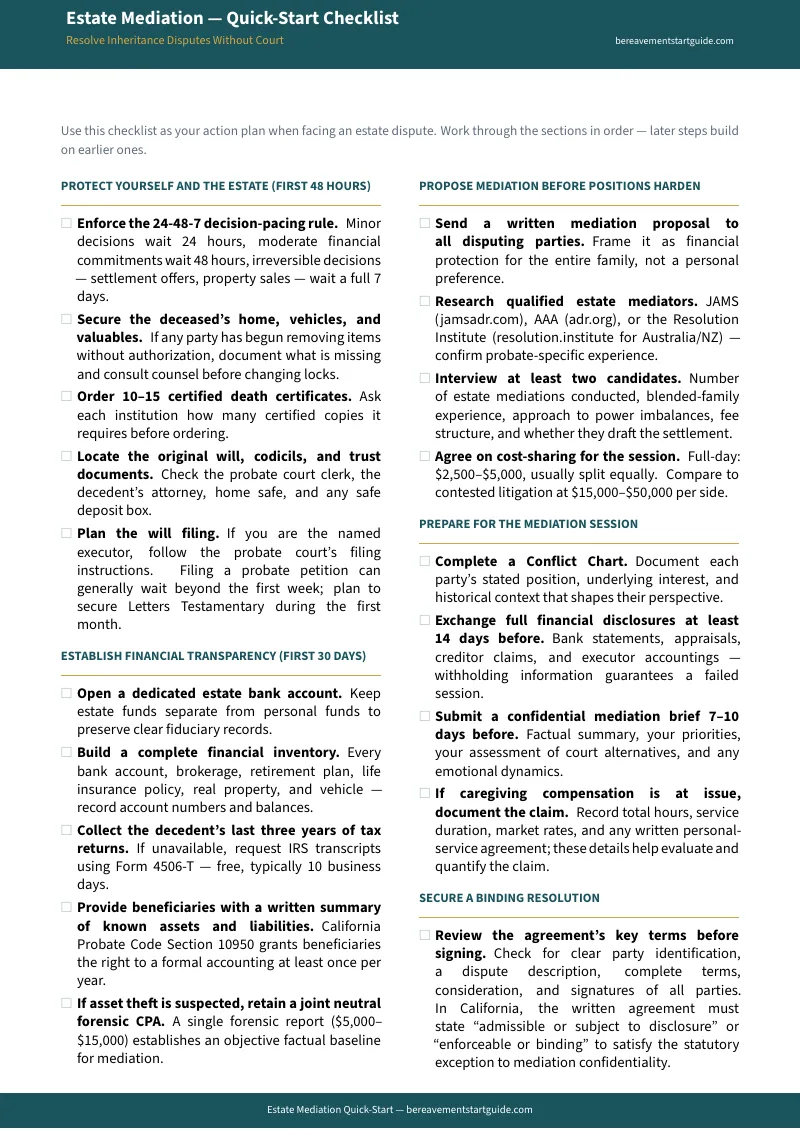
- The 24-48-7 Decision-Pacing Rule — because grief brain is real and costly. This framework categorizes every estate decision by impact level and enforces mandatory waiting periods. Minor decisions wait 24 hours. Financial commitments wait 48 hours. Irreversible decisions — settlement offers, property sales, asset distributions — wait a full 7 days. The included Decision-Pacing Worksheet tracks every pending decision so nothing slips through grief fog.
- Settlement Agreement Review Checklist — because a handshake is not a resolution. Chapter 7 walks you through party identification, dispute description, consideration language, and signature requirements — the specific elements that courts look for when a party tries to back out — including the statutory phrasing required in jurisdictions like California to ensure admissibility. Print the checklist and tick every clause before anyone signs.
- 4 Communication Scripts — because the hardest part of mediation is getting everyone to the table. Fill-in-the-blank letters for initiating an estate conversation, proposing mediation to a hostile sibling, declining pressure from creditors or vendors, and requesting a filing extension from the court. Each script is written for the specific emotional dynamics of estate disputes, not recycled corporate mediation language.
- Fair Division Systems for Personal Property — because the china set your mother promised you cannot be split with a calculator. The Symmetrical Rotation Draft gives heirs sequential turns choosing sentimental items. The Subjective Value Silent Auction handles high-value possessions through confidential bidding with estate offsets. When one heir wants the house and others want cash, Chapter 8 shows how to distribute the property to that heir and equalize the others with estate cash, so a post-distribution buyout does not trigger a property-tax reassessment.
- Tax Trap Navigation — because the IRS treats different settlement payments differently, and the wrong classification costs real money. How caregiving compensation is taxed under IRC § 61, how inheritance claims may be excluded under IRC § 102, when real property transfers trigger reassessment, and how unequal divisions create gift tax exposure. This chapter exists because most families discover these distinctions after signing, not before.
- Mediator Selection System — because not all mediators handle estate disputes, and the wrong choice wastes everyone's time and money. Interview questions, credential verification steps, and red flags for choosing an estate-specialized mediator through JAMS, the American Arbitration Association, or the Resolution Institute. Includes a comparison scorecard for evaluating multiple candidates side by side.
- Confidentiality Protection Guide — because families worry that anything they say in mediation can be used against them later. This chapter covers what mediation confidentiality actually protects, how protections vary by jurisdiction, and how to structure disclosures so that information shared during mediation cannot be weaponized if talks fail and the dispute moves to court.
Who This Is For
- You are the executor or administrator caught between siblings who cannot agree on asset distribution
- A blended-family dynamic — step-parent vs. adult stepchildren, surviving spouse vs. children from a prior marriage — is driving the conflict
- One heir provided years of unpaid caregiving and expects a larger share, while others insist on equal division
- Trust has collapsed because the executor is suspected of self-dealing, stalling distributions, or hiding assets
- You want to resolve the dispute before the estate loses tens of thousands of dollars to competing attorneys
- You are managing the dispute remotely from another state or country and need a structured framework that works across distance
Why Free Tools Get This Wrong
Law firm blogs about estate mediation are lead generators. They explain what mediation is — the concept, the process, the theoretical benefits — without giving you a single template to propose it, a script to handle the hostile sibling who thinks mediation is "giving in," or a framework for evaluating whether the settlement agreement you are about to sign actually protects your interests. Their business model depends on you concluding that you need a $5,000 retainer.
Government court portals provide official forms for probate filings but zero guidance on the family conflict behind the legal paperwork. They assume you are a legal professional, not a grieving person reading the same paragraph four times because your working memory is compromised.
General grief resources validate your emotional experience. They explain the stages of loss. They offer therapeutic frameworks for processing anger and sadness. What they do not offer is a single communication script, a conflict mapping tool, or a settlement agreement template for the administrative crisis unfolding in your family right now.
The Estate Mediation toolkit fills the structural gap between emotional support and full legal representation — the operational layer where families actually lose money, make irreversible mistakes, and destroy relationships.
The Guarantee
Full refund, no time limit. If the toolkit does not help you navigate your estate dispute more confidently, email hello@bereavementstartguide.com and we will refund your purchase completely.
Get Started
Download the free checklist for the essential first steps in any estate dispute, or get the complete Estate Mediation toolkit — the full Conflict-to-Resolution System with 4 communication scripts, a settlement agreement review checklist, fair-division methods, and printable worksheets for .