Your Family Has Three Days. Every Ritual Decision Carries Permanent Weight.
When a Cambodian or Lao family member dies, the spiritual clock starts before the body cools. The Praleung — the vital spirit — remains tethered to the nervous system for hours after clinical death, and Theravada cosmology holds that a chaotic environment can trap it as a wandering ghost. The body must be washed with blessed flower water in the correct direction. The sacred syllables ci ce ru ni must be inscribed and placed in the mouth alongside a silver coin. In Cambodia, the Tung Kropei crocodile flag must go up immediately. In Laos, the Gong Bung canopy bed must be rented from the temple and assembled before the first night of chanting.
Most diaspora families face this compressed, high-stakes sequence with nothing but scattered internet threads that mix Thai customs with Mahayana Chinese practices, monastery instructions delivered entirely in formal Khmer or Lao, and a funeral director whose "Buddhist package" was designed for a completely different tradition.
The Diaspora Ritual Navigator — One Document That Replaces Forty Hours of Panicked Research
This guide consolidates the complete Cambodian and Lao Theravada funeral sequence — from the first-hour stillness period through the hundredth-day memorial — into a single chronological manual. Every chapter is structured as a decision tree: what happens next, exactly how to do it, why it matters spiritually, and how to adapt it when you are organising a funeral in a Western country where health codes prohibit multi-day home vigils with an unembalmed body.
Where other resources treat all Southeast Asian Buddhist traditions as interchangeable, this guide separates Cambodian (Khmer) and Lao customs into clearly marked sections. You will know exactly which rituals belong to your family's tradition, which are shared across both cultures, and where the practices diverge — so you never accidentally follow the wrong processional rules or omit a merit-making ceremony that your elders expect.
What's Inside
- First-Hours Crisis Protocol — the exact notification sequence (temple, Achar or Achan, communal network, funeral director) with contact timing, so you know who to call first while the family is in shock and the four-hour stillness window is still running
- Complete Body Preparation Walkthrough — the ritual purification bath with blessed flower water, thumb-and-toe binding, sacred mouth placements (ci ce ru ni inscription and silver coin), and modern diaspora adaptations for each step when dealing with Western crematoriums or medical-examiner requirements
- Cambodian vs. Lao Wake Customs Side by Side — the Cambodian house of mourning with the Tung Kropei flag and Achar-led Smot chanting versus the Lao Heuan Dee vigil with the Gong Bung canopy bed and community feast logistics, so you execute the right traditions for your family
- Abhidhamma Chanting and Liturgical Guide — explains the Bangsukun cloth ritual, the Sai Sin sacred thread ceremony, and the rules around music and silence, including when traditional Smot funerary chanting is appropriate and when recorded chants are acceptable
- Monk Invitation and Lay Priest Protocol — how the Achar (Cambodia) or Achan (Laos) directs the entire funeral, pre-written invitation language for requesting a monastic chapter, and the Dana donation envelope etiquette so you never accidentally hand cash directly to a monk
- Funeral Procession Rules — Including the Lao 4-3-1-2 Numerology — the full Cambodian processional customs (eldest daughter dropping coins, spirit confusion tactics) and the Lao processional formation where four bearers, three parade members, one mantle-seated person, and two lead guides each carry deep metaphysical meaning
- Cremation Rites and Ash Collection — circumambulation of the pyre, the final face wash, pyre ignition sequence, ash and bone collection protocols, and the cultural context around bone amulets and personal relics
- Food Taboos and Financial Customs — the absolute ban on noodles at funerals, the prohibition on killing animals for funeral food, why the colour red is banned, the condolence money and reciprocal giving system, and the Lao takeaway food taboo
- Chinese-Cambodian and Chinese-Lao Blended Funeral Chapter — the white condolence envelope exchange, the return red envelope with red string, coin, and candy, altar configuration for blended families, and a practical framework for reconciling Theravada and Chinese traditions without violating either
- Diaspora Adaptations — how to condense a multi-day vigil into Western funeral-home hours, adapt the processional for urban settings, negotiate witnessed cremation with Western facilities, and estimate costs across major diaspora cities
- Post-Funeral Mourning Timeline — extends beyond the funeral to cover the seventh-day, forty-ninth-day, and hundredth-day memorials, annual merit-making festivals (Pchum Ben in Cambodia, Boun Khao Padap Din in Laos), and the transition from mourning to memory
- Eight Printable Worksheets — notification contact sheet, funeral timeline planner, reciprocal giving tracker, mortician communication sheet, elder interview template, feast planning sheet, monastic invitation worksheet, and repatriation document checklist — all designed for families operating under severe emotional stress
Who This Guide Is For
- Diaspora families organising a Cambodian or Lao Buddhist funeral in the US, Canada, France, Australia, or anywhere outside Southeast Asia — particularly second-generation children who understand the cultural significance but lack fluency in the ritual details
- Interfaith or non-Buddhist spouses and partners who have been thrust into the primary coordinator role and need absolute clarity on taboos, etiquette, and the theological meaning behind each ritual step
- Chinese-Cambodian and Chinese-Lao families navigating the friction between Theravada Buddhist traditions and Chinese Mahayana or ancestor-worship customs within the same household
- Professional funeral directors and celebrants serving Southeast Asian diaspora communities who need to understand why certain body-handling, cremation, and processional requirements are non-negotiable
- Long-distance relatives coordinating a funeral from overseas, including the logistics of repatriation and parallel merit-making ceremonies
Why Free Online Resources Fall Short
The free information on Cambodian and Lao Buddhist funerals falls into four categories, and each one has a critical gap:
Temple guidance from monks and the Achar provides pure spiritual authority — but instructions are delivered orally in formal, high-context Khmer or Lao. Younger diaspora relatives who grew up speaking English or French cannot readily understand or act on these directives. There are no printed checklists, no vendor guides, no breakdowns of expected Dana donation amounts.
Corporate funeral home blogs offer surface-level overviews of reincarnation and white clothing — but treat all Southeast Asian Buddhist traditions as a single monolith. They offer zero guidance on managing the Tung Kropei, constructing home altars, or handling the distinct Cambodian versus Lao processional rules.
Reddit and Facebook diaspora forums provide empathetic peer support — but advice is fragmented and contradictory. Users routinely argue over regional taboos, and following the wrong community's customs at your family's funeral creates exactly the kind of social violation that causes lasting regret.
Generic Buddhist funeral guides are built around Mahayana or Tibetan practices — the 49-day bardo timeline, Chinese altar traditions, Zen meditation guidance — and miss the unique Theravada syncretic animist practices that define Cambodian and Lao funerals entirely. You will not find the Achar's role, the Gong Boun merit feast, the crocodile flag, or the 4-3-1-2 procession numerology in any pan-Buddhist guide.
This guide replaces all four sources with a single, culturally verified reference written in English with phonetic Pali, Khmer, and Lao transliterations, so every family member — regardless of their language background or religious literacy — can participate with confidence.
Your Purchase Is Protected
If the guide does not give you the clarity and confidence you need, email us at any time for a full refund. No questions, no forms, no hoops. We would rather you have your money back than feel unsupported during one of the hardest weeks of your life.
Get the Guide — Or Start With the Free Checklist
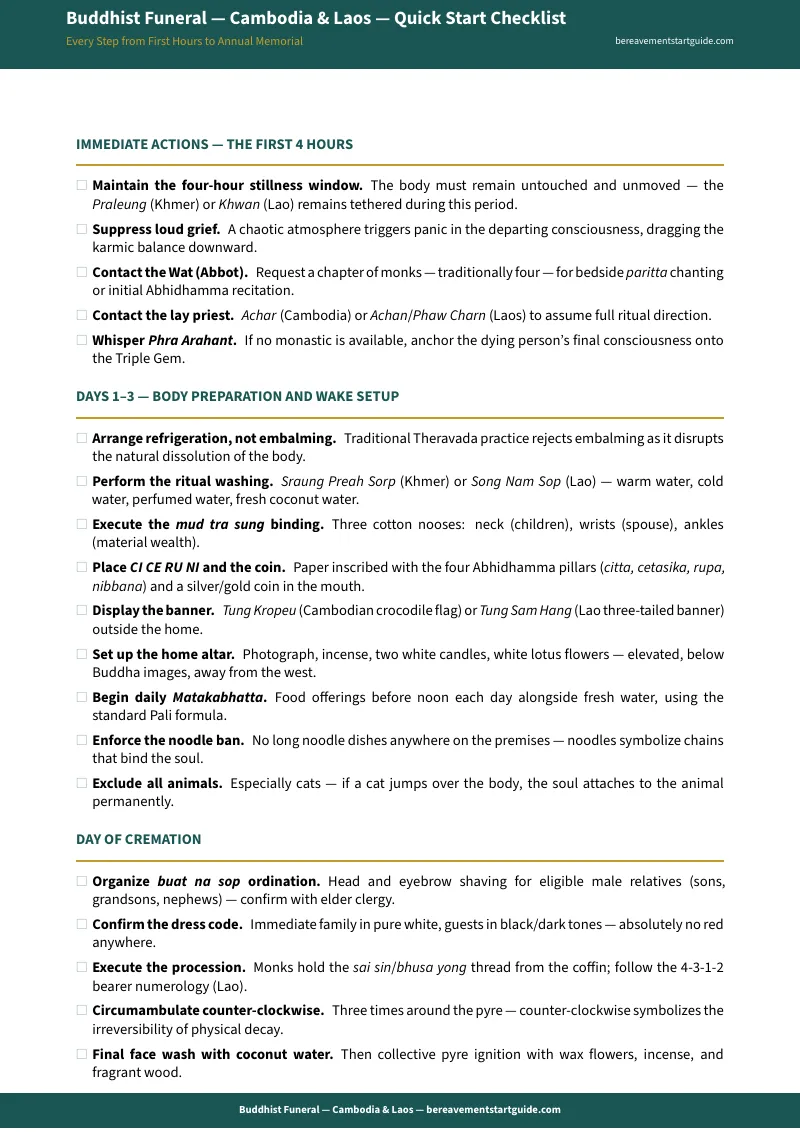
Download the free quick-reference checklist to see the mourning timeline at a glance. When you are ready for the complete ritual navigator — the 49-page guide, eight printable worksheets, every regional variation, the blended-family chapter, and the full diaspora adaptation framework — the full kit is available for immediate download at .
Frequently Asked Questions
What if the rules change after I buy?
We update the guide when the rules change. Email us any time, even years later, and we'll send you the current edition free.