A resident just died on your shift. The family is calling. The surveyor is coming. What do you say?
It is 2:14 a.m. and Mrs. Ramirez in Room 312 has stopped breathing. You check the chart — she is on hospice, her DNR is on file — and you call the hospice nurse. So far, so good. Then the phone rings. It is her son, and the first words out of his mouth are: "What did you people do to my mother?"
Your corporate policy binder says "notify the family." It does not tell you what words to use when a grieving son is screaming at you. It does not tell you what you are legally allowed to say about how his mother died. It does not tell you how to document this call so that when the state surveyor pulls the chart next week, your note holds up under the F580 critical element pathway.
That gap — between the regulation and the 2 a.m. reality — is where facilities get cited, staff lose sleep, and families lose trust.
The Shift-Ready Death Response Protocol
This toolkit closes that gap. It is not another policy manual written for a compliance binder. It is a Shift-Ready Death Response Protocol — a set of practical tools built for the clinician who is standing at the nurses' station right now, needing to know exactly what to say, what to document, and who to call next.
Every script, template, and checklist in this toolkit maps directly to the federal compliance standards your facility is surveyed against — CMS Tags F580 (Notification of Changes), F559 (Roommate Notification), and F640 (MDS Encoding) — so you are not just following a process, you are building a defensible record.
What You Get
- 12-Point Death Pronouncement Template — the exact clinical documentation structure that CMS Form 20074 auditors look for, formatted so you can fill it in at the bedside. Covers responsiveness assessment, respiratory observation, cardiac auscultation, pupillary check, physician notification, and body disposition — with time stamps for each step.
- Family Notification Call Scripts — word-for-word scripts for the three hardest phone calls in long-term care: the initial death notification, the follow-up when a family member becomes hostile, and the call to a family member who has cognitive impairment. Written so you can read them aloud without freezing.
- HIPAA Post-Mortem Decision Matrix — a visual flowchart that tells you exactly what you can and cannot disclose after a resident dies. Covers the 50-year rule, the Personal Representative standard, and the involved-in-care exception — translated from legal language into yes-or-no clinical decisions.
- Roommate Communication Protocol — step-by-step guidance for telling a surviving roommate that their friend has died, what you can legally say, what you cannot say, and how to support the roommate through the transition without triggering an F559 deficiency for premature room turnover.
- Coroner and Medical Examiner Escalation Flowchart — a quick-reference decision tree for determining whether a death must be reported to the local coroner or medical examiner, which categories of death are reportable, and what you must leave undisturbed on the body until the investigator clears the scene.
- Staff Debriefing Facilitator Guides — two structured debriefing models (a three-phase Name/Reflect/Support session and the STAR-T rapid debrief) formatted as facilitator cards, so charge nurses and DONs can run a structured debriefing session within 24 to 72 hours of a difficult death — without needing external training.
- Agency Handoff Coordination Map — a visual map of every external agency involved after a resident death (hospice, coroner, funeral home, OPO) with contact protocol and jurisdictional deadlines, so the charge nurse can see at a glance who needs to be called and in what order.
- Financial and Administrative Transition Checklist — covers MDS discharge coding (A2000), personal belongings inventory, trust account reconciliation, family billing notifications, and insurance communication — every back-office step that must happen within 7 to 14 days.
Who This Is For
- Night-shift RNs and charge nurses who need immediate, floor-ready tools when a death happens during low-staffing hours
- Directors of Nursing standardizing death response across all shifts and units
- Licensed Nursing Home Administrators looking to reduce F580 citation risk and build a survey-defensible facility record
- Facility social workers managing roommate grief, family coordination, and bereavement referrals
- Agency and travel nurses who do not have access to the facility's internal policy intranet
Why the Policy Binder Is Not Enough
Your facility almost certainly has a death notification policy. It was written by the corporate legal team, approved by the compliance officer, and placed in a binder on the administrator's shelf. It meets the regulatory requirement that a policy exists.
But that policy does not help the nurse who is standing in the hallway at 3 a.m. trying to remember whether she can tell the roommate what happened. It does not give the social worker a script for when the deceased resident's daughter accuses the facility of neglect. It does not show the new DON how to run a staff debriefing that actually reduces moral injury instead of just checking a box.
Free resources online cover pieces of this — a blog post about HIPAA after death here, a CE course on communication skills there. But they are scattered, they contradict each other, and none of them are designed for the specific operational reality of a long-term care facility where one nurse is covering forty residents and the attending physician is not answering the phone.
This toolkit takes the regulatory framework your facility is already accountable to and translates it into tools you can use on the floor tonight.
Built on Federal Standards Your Facility Is Already Surveyed Against
- CMS State Operations Manual, Appendix PP — Tags F550 (Dignity), F559 (Roommate Change), F580 (Notification of Changes), F640 (MDS Encoding)
- CMS Death Critical Element Pathway (Form CMS 20074) — the exact audit pathway state surveyors use to evaluate death management
- HIPAA Privacy Rule (45 CFR § 164.502(f)) — post-mortem PHI protections, Personal Representative standards, involved-in-care exception
- SPIKES and NURSE communication protocols — peer-reviewed models for delivering difficult clinical news
Satisfaction Guarantee
Full refund, no time limit. If the toolkit does not help your practice, email hello@bereavementstartguide.com and you will get your money back.
Get Started Tonight
Download the toolkit now. Print the pronouncement template and the notification scripts for the nurses' station. The next time a resident dies on your shift, you will know exactly what to say, what to document, and who to call — and you will have the defensible record to prove it.
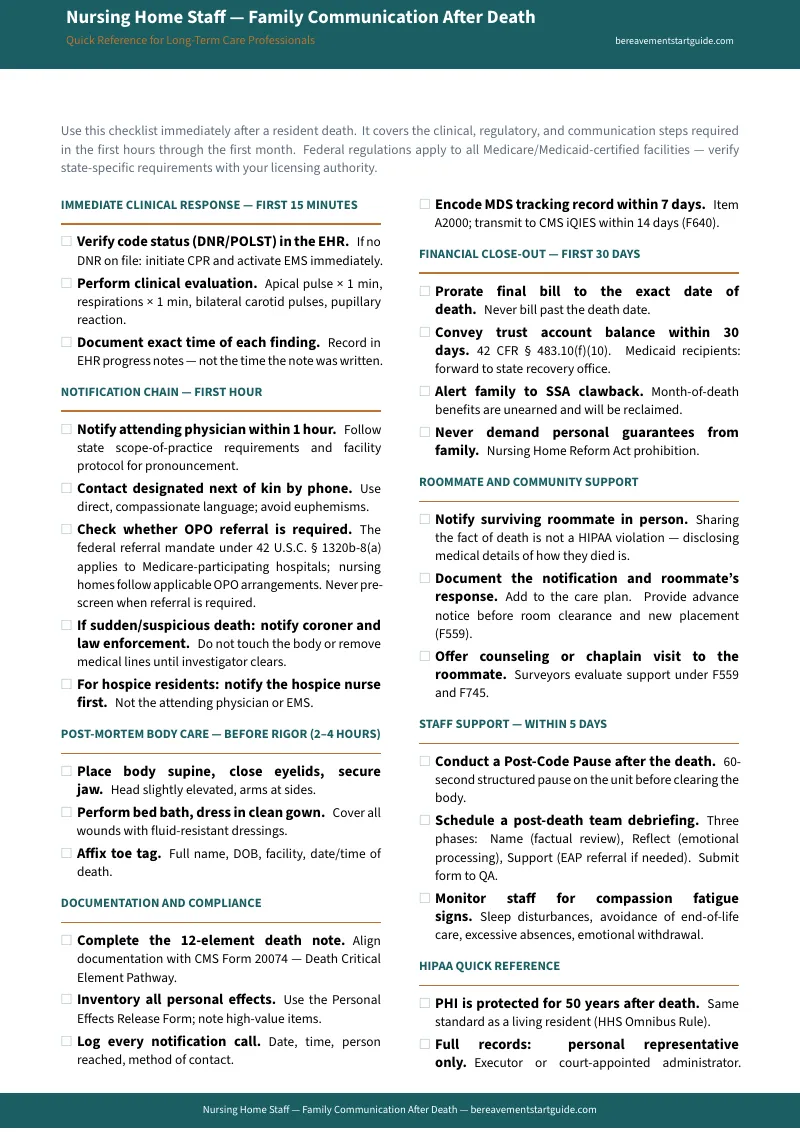
The free quick-reference checklist covers the basic notification sequence. The full Shift-Ready Death Response Protocol gives you the scripts, templates, flowcharts, and debriefing guides that turn compliance into confidence.