The Medical Team Has Left. The Administrative Maze Has Just Begun.
The procedure was gentle. The doctor pronounced death. The palliative care team made their final notes. And then, in the space of an hour, every institutional support structure that guided you through the clinical process disappeared — and left you standing in a room with a body, a set of unused controlled substances carrying legal disposal deadlines, and a silence that no government portal, hospital pamphlet, or grief memoir prepared you for.
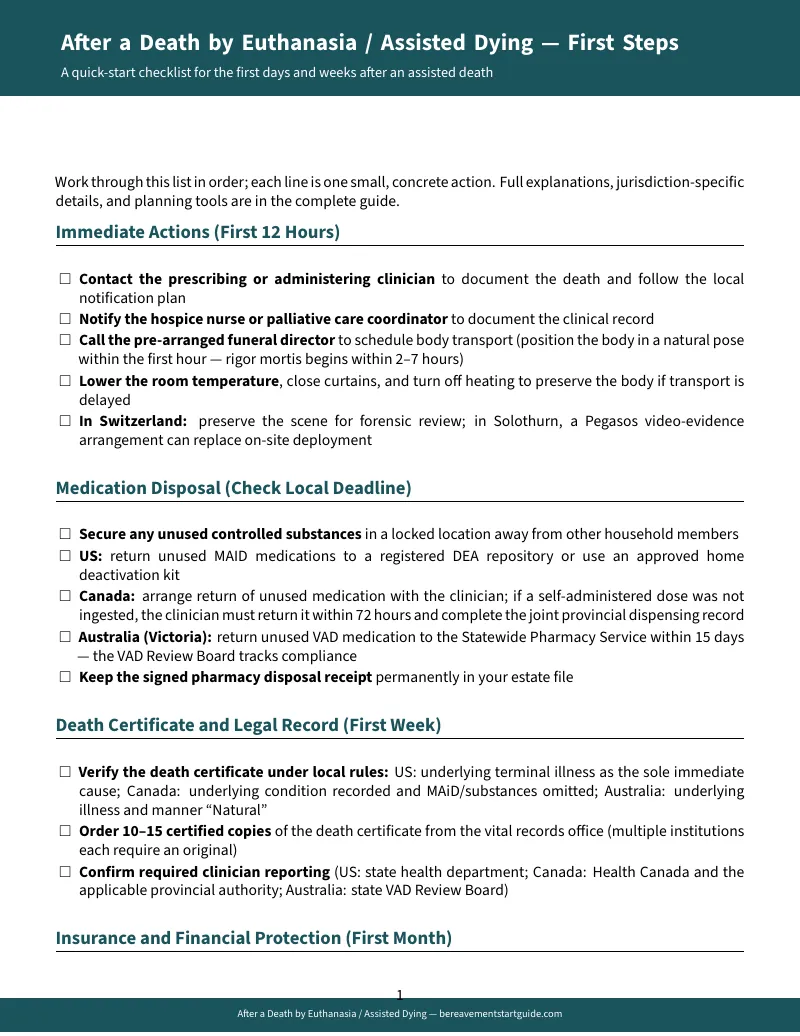
Within hours, you may need to return concentrated medications to a pharmacy or DEA-registered repository under a statutory deadline that varies by jurisdiction — 15 days in Victoria, 72 hours in most Canadian provinces, immediate DEA-regulated disposal in parts of the US. Within days, a life insurance company may open an audit file to determine whether the policy's suicide exclusion clause applies. Within weeks, a coroner's quality assurance committee may request the clinical capacity assessments you assumed somebody else was keeping. And through all of it, a relative who opposed the decision may be calling you complicit, a neighbor may be speculating about what really happened, and a child in your household may be afraid to fall asleep because someone told them Grandpa "chose to go to sleep."
This is not standard bereavement. The grief that follows an assisted death carries a cognitive signature unlike any other form of loss — relief that the suffering ended, guilt about feeling that relief, traumatic imagery from the procedure itself, and a social isolation that comes from mourning a death many people in your life may refuse to accept as legitimate.
The Post-Death Operations Manual — Practical Coordination for Families After Assisted Dying
After a Death by Euthanasia / Assisted Dying is the practical triage toolkit built for the hours, days, and months that follow a medically assisted death across six jurisdictions. Not a grief memoir. Not a clinical pamphlet. Not a law firm's intake funnel. A sequenced operational manual that tells you exactly what to do, in what order, with fill-in-the-blank worksheets, copy-paste communication scripts, and jurisdiction-specific checklists — designed to be used in five-minute intervals by a brain running on adrenaline and three hours of sleep.
The toolkit addresses what no single free resource does: the medication disposal rules that vary by country and carry real legal consequences, the death certificate protections you may not know exist, the life insurance claim defense that must start now, the hospice participation boundaries that catch families off guard, the family conflict that fractures when half the household sees the death as mercy and the other half sees it as betrayal, and the unique grief patterns that make all of it harder — in one printable document that works at 2 a.m. when you are searching for answers in the dark.
What's Inside the Toolkit
- The First Hours — What to Do at the Scene — because calling 911 after an at-home assisted death can trigger a traumatic, unnecessary police dispatch if the correct pre-signed clinical paperwork is not visible. The immediate action sequence: who to call first, how to care for the body, what physical responses to expect (muscle relaxation, post-mortem biological sounds, color changes), and how to manage the transition from clinical peace to administrative reality without destroying it.
- Medication Disposal — Jurisdiction-Specific Deadlines and Procedures — because in self-administered cases, the designated family contact takes legal custody of concentrated controlled substances, and the disposal rules are strict, confusing, and carry real penalties for non-compliance. DEA-regulated disposal pathways in the US. Pharmacy return requirements in Canada. The 15-day return window in Victoria and state-specific timelines across Australia. Procedures in Switzerland, the Netherlands, and Belgium. One chapter, six countries, every form and contact you need.
- Death Certificate Protections — Why It Will Not Say "Suicide" — because the most universal fear among families is that the official death certificate will permanently record "assisted suicide" or "lethal drug overdose." In every legalized jurisdiction, statutes mandate that the manner of death is classified as "Natural" and the cause is the underlying terminal illness. This chapter details those protections, explains the difference between the coroner's internal record and the certified extract that institutions receive, and prepares you for routine quality assurance reviews that feel like accusations but are not.
- Life Insurance Claim Defense — because nearly all life insurance policies contain a two-year contestability period and a suicide exclusion clause, and the documentation you compile right now determines whether the claim is paid or denied. The statutory protections that classify assisted death as natural for insurance purposes. The real risk: any policy purchased or modified within 24 months of death triggers an automatic insurer audit. The specific trap when someone travels abroad for assisted dying. Group life insurance — the simpler path. And the exact documentation checklist to build your evidence file before the insurer asks for it.
- Hospice Participation Boundaries — because some hospice programs participate fully in assisted dying coordination, others require their staff to leave the room during administration, and a few will discharge the patient entirely. The answer depends on the hospice's funding source, religious affiliation, and local regulations. Three levels of hospice participation mapped so you know what to expect, what to ask, and how to maintain palliative care continuity through the transition.
- Family Conflict, Blame, and Legal Exposure — because when a family is divided over the decision, the person who coordinated the clinical process becomes the target. Relatives who opposed the choice may accuse you of coercion, refuse to attend the funeral, threaten legal challenges to the estate, or tell extended family and neighbors a version of events designed to make you look culpable. A structural framework for assigning administrative roles based on each relative's alignment. Pre-written boundary scripts for hostile conversations. Guidance on protecting yourself from blame — legally and emotionally.
- Grief After Assisted Dying — The Relief-Guilt Cycle and Witness Trauma — because this grief has a cognitive architecture unlike any other. The countdown to a scheduled death creates intense anticipatory anxiety. The moment of death, though chosen, still shocks. The relief that suffering ended triggers guilt. Witnesses carry intrusive images — the IV, the rapid loss of consciousness, the post-mortem sounds that nobody warned them about. This chapter covers disenfranchised grief, the relief-guilt cycle, traumatic imagery, and the clinical boundary between normal grief and warning signs that require professional intervention — with somatic grounding exercises designed for the specific flashback patterns of assisted dying witnesses.
- Supporting Children — The Six C's and Age-Appropriate Language — because children are concrete thinkers and euphemisms like "went to sleep" or "chose to go to heaven" create anxiety, sleep disturbance, and magical thinking. Age-specific scripts using direct, honest language. The Six C's of childhood grief — confirming they did not cause the illness, cannot catch it, and are not responsible for fixing the family's sadness. Behavioral signals that distinguish normal grief from thresholds requiring clinical support.
- Communication — Obituaries, Disclosure, and Digital Lockdown — because how much to reveal about the manner of death is one of the most agonizing decisions families face. A disclosure spectrum from full transparency to complete privacy, with pre-written scripts for each level. Obituary templates that honor the choice and templates that protect it. Digital lockdown procedures for the first 24 hours. Boundary language for shutting down intrusive questions from neighbors, journalists, and social media commenters.
- Fillable Worksheets and Planning Tools — an Incident Information Log, Benefits and Policy Claims Tracker, Medication Disposal Record, Family Communication Plan, and a 12-Month Recovery Timeline. Every administrative artifact you would otherwise have to invent while cognitively impaired — each one a separate fillable page you can print and hand to a family member, carry to an insurer meeting, or complete at 2 a.m. with minimal cognitive energy.
- Key Resources and Contacts Directory — a curated directory of trusted organizations across the US, Canada, Australia, Switzerland, the Netherlands, and Belgium: Dying with Dignity Canada, Bridge C-14, Go Gentle Australia, Compassion & Choices, End of Life Washington, specialized MAID bereavement support groups, and 24/7 crisis lines — with plain-language descriptions of what each organization actually does and how to access their services.
Who This Guide Is For
- Surviving spouses and partners who supported the decision, stood at the bedside, and are now carrying both the administrative aftermath and a grief that alternates between relief and devastation — often in the same hour
- Adult children who coordinated the clinical process for a parent and are now managing insurance claims, estate matters, and relatives who may refuse to attend the funeral
- The family coordinator — the person who managed the medication custody, the appointments, the legal paperwork — and who is now expected to manage everything else while their own grief has barely started
- Parents grieving an adult child who chose assisted dying, navigating a loss that inverts the natural order and a social world that often cannot comprehend how a parent could support that choice
- Anyone who witnessed the procedure and is carrying intrusive visual memories that conventional grief support does not address
- Families navigating hostile dynamics — where one branch supported the decision and another considers it unforgivable, and every interaction from the funeral to the estate to the holidays requires a plan
Why Free Resources and Generic Grief Guides Fall Short
Government health portals give you accurate clinical information in bureaucratic language your brain cannot process right now. Hospital discharge pamphlets cover two pages and stop at the institutional door. Coroner's office FAQs address the death certificate but not the insurance audit, the medication disposal deadline, the family conflict, or the grief. Law-firm blogs are written to funnel you into a retainer. Grief memoirs are beautiful and important — later. Right now you need someone to tell you whether unused medication must be returned by Tuesday or by the end of the month, how to prevent an insurer from classifying this as suicide, and what to say to a relative who just called you a murderer.
No free resource consolidates the medication disposal procedures, the death certificate protections, the insurance claim defense, the hospice boundary navigation, the family conflict framework, the grief chapter written for the relief-guilt cycle and witness trauma, the children's support, and the communication templates into one sequenced document. That consolidation is the product. It exists so you do not have to search six government health departments, four law-firm blogs, three nonprofit handouts, and a grief forum at 2 a.m. while you are wondering whether you just committed a crime by not returning the medication fast enough.
Guarantee
Full refund, no time limit. If the toolkit does not help, email hello@bereavementstartguide.com and we will process your refund — no questions, no forms, no waiting period.
Get the Toolkit
Instant download. Printable, fillable PDF. No account required. Secure, encrypted checkout — the transaction appears on statements as a digital educational purchase. Store your completed copy wherever you choose, print as many copies as your family needs.
The free checklist gives you the first steps. The full toolkit walks you through every legal, financial, emotional, and relational dimension of what comes next — for .