You're One Phone Call Away from a Service You've Never Led Before
The family is fractured. The mother wants a traditional Jewish burial with a Shomer present from the moment of death. The spouse insists on Islamic Ghusl performed within 24 hours. The adult children want a secular celebration of life with a photo slideshow and pop music. The funeral home needs body preparation instructions by 8:00 AM.
And you — the clergy member, the chaplain, the funeral director — are standing in the middle of it with your seminary training, your denominational manual, and a growing awareness that neither one was built for this moment.
This is what the Defensible Compassion Protocol System was designed for. The Clergy's Multi-Faith Funeral Reference replaces the frantic midnight Googling with structured, tested protocols that protect your professional standing while honoring every tradition in the room.
What the Reference Puts in Your Hands
- Eight faith-tradition body preparation protocols — exact sequences for Jewish Taharah, Islamic Ghusl and Kafan, Hindu Antyesti, Buddhist merit transfer, Sikh Antam Sanskaar, Catholic Sacraments, Protestant variations, and Secular Humanist services. Each protocol lists mandatory steps, strictly prohibited actions, and timing constraints so you never authorize an irreversible mistake.
- Legal authority verification workflows — the Right of Sepulcher hierarchy with verification documents for each priority level, because proceeding on instructions from the wrong family member exposes the entire care chain to civil liability.
- FICA spiritual assessment scripts — adapted for crisis conditions when the family spokesperson is experiencing cognitive freeze. One question at a time. Silence built into the process. Every answer recorded in real time.
- Mandated reporting decision trees — in approximately 27 US states, clergy are enumerated as mandated reporters of child abuse. The guide maps when the clergy-penitent privilege applies, when it doesn't, and exactly how narrow courts interpret that exception.
- SOAP charting templates — EMR-compliant documentation that satisfies clinical colleagues, compliance auditors, and patients exercising their legal right to inspect records. Aligned with APC Standards of Practice and the ERICH five-step charting model.
- Family conflict de-escalation scripts — cognitive, emotional, and behavioral active listening techniques for when grief-driven anger turns on you. These aren't abstract frameworks; they're word-for-word scripts you can use when a relative is shouting at you in a funeral home lobby.
- Non-appropriative facilitation protocols — how to hold dignified space across traditions without performing sacred rites you're not ordained to lead. Acknowledge boundaries, invite authorized faith leaders, and structure the shared liturgy around universal themes.
- Secondary traumatic stress screening — self-assessment tools plus the seven-phase Critical Incident Stress Debriefing model for team processing after difficult deaths. Because the professional who absorbs everyone else's grief without a structured outlet is the one who burns out first.
Who Needs This on Their Phone at 2:00 AM
This reference was built for professionals who serve families across faith boundaries under time pressure:
- Ordained clergy in increasingly diverse congregations where a single-faith liturgy fails half the room
- Healthcare and hospice chaplains managing death notifications, post-mortem spiritual care, and EMR documentation in clinical settings
- Military and police chaplains responding to line-of-duty deaths in pluralistic units where the next-of-kin's religion is an unknown
- Funeral directors coordinating body preparation across traditions where one procedural error — embalming a body that must not be embalmed — creates irreversible harm
- CPE supervisors and training directors who need a structured reference for residents encountering multi-faith deaths for the first time
Why Free Resources Don't Work at 2:00 AM
There is no shortage of free information about multi-faith funerals. The problem is where it lives and who wrote it.
Professional association toolkits (APC, UKBHC) are academically rigorous and peer-reviewed — and completely impossible to parse in a crisis. They're written for certification portfolios, not bedside reference.
Institutional policy manuals (NHS Trusts, police chaplain guides) handle regulatory compliance but treat a multi-faith death as an administrative checkbox event. They manage the logistics and ignore the human being in the room.
Law firm compliance articles are legally precise and pastorally useless. They instruct you to restrict contact and speak through rigid disclaimers — advice that destroys the therapeutic alliance with a grieving family.
Generic grief handouts from funeral homes are warm, gentle, and completely irrelevant to the professional who needs to verify who holds legal custody of a body before the wrong relative authorizes cremation.
The Clergy's Multi-Faith Funeral Reference sits in the gap: legally protective, pastorally warm, operationally immediate. One download. No subscription. No 30-hour continuing education commitment. The protocol you need, in the format you can actually use, at the moment you need it most.
Full Refund, No Time Limit
If the reference doesn't serve you, email hello@bereavementstartguide.com for a full refund. No time limit, no questions, no hoops. You keep the files either way.
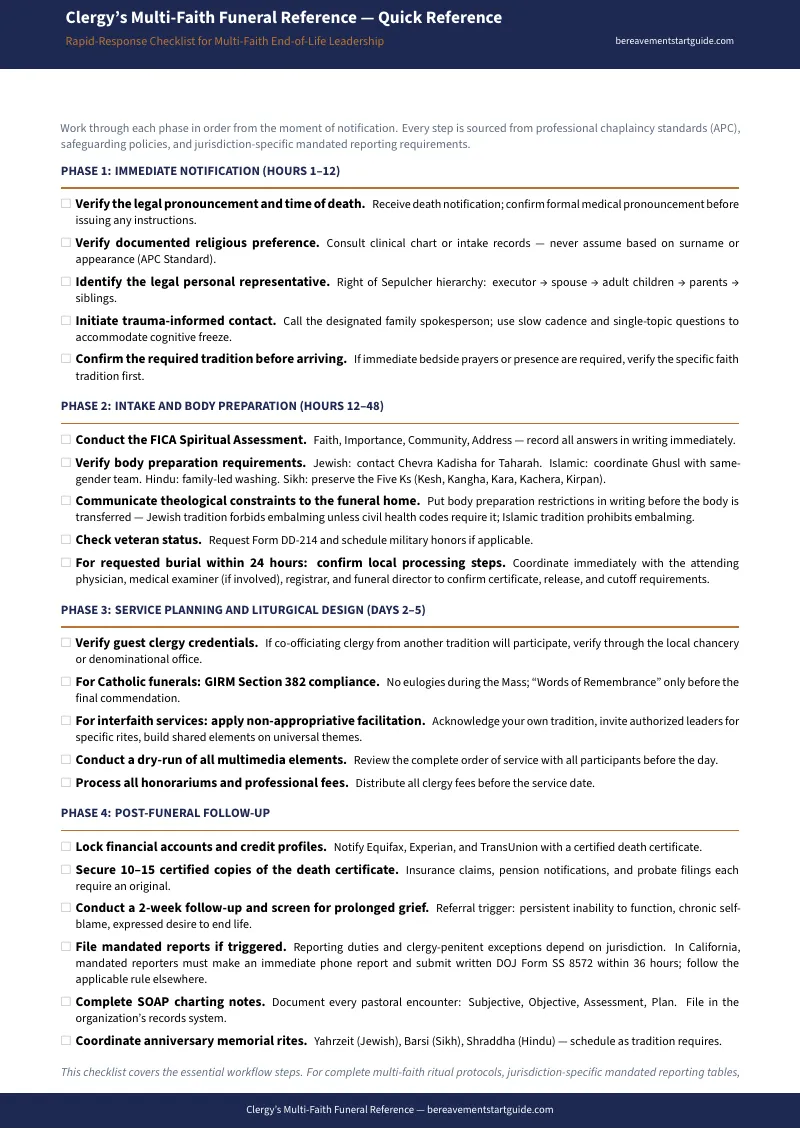
The free Quick Reference checklist gives you the first-hours sequence. The full reference gives you the protocols, scripts, legal frameworks, and clinical documentation templates that make each step defensible and effective.
Get the Complete Clergy's Multi-Faith Funeral Reference →
One download. Immediate access. Every protocol, script, and template you need to lead with confidence when the family, the law, and the faith traditions are all pulling in different directions.