Someone You Love Died in a Car Accident. Now Every Institution in the Country Wants a Decision from You Before You Can Breathe.
A police officer at your door. A hospital chaplain on the phone. A tow yard already charging daily fees on the vehicle that holds the only objective evidence of what happened. An insurance adjuster calling to get a recorded statement while your hands are still shaking. There was no diagnosis, no slow decline, no time to say goodbye — and now the medical examiner, the insurance company, the probate court, and the funeral home are all demanding something from you at the same time.
Meanwhile your brain has stopped working properly. You are reading the same paragraph three times. You pick up the phone and forget who you were calling. You walk into the kitchen and stand there because the reason you came in has evaporated. Your hands are shaking and you cannot make them stop.
That is not a personal failing. It is a documented neurological response to sudden traumatic loss — your executive function has shut down at precisely the moment when every decision carries legal and financial consequences that can follow your family for years.
The Collision Aftermath Triage System — an External Brain for the Worst Week of Your Life
After a Car Accident Death is the practical triage toolkit built specifically for the aftermath of a fatal collision. Not a grief memoir. Not a pamphlet. Not a law firm's intake questionnaire. A sequenced operating system that tells you exactly what to do, in what order, with fill-in-the-blank templates, copy-paste scripts for every phone call, and spoliation letters you can send within minutes — designed to be read in five-minute intervals by a brain in shock.
The toolkit covers what no single free resource does: evidence preservation before the tow yard crushes your vehicle, the Event Data Recorder data that proves what happened, the insurance coverage taxonomy that determines who pays for what, the wrongful death standing rules that vary by state, the social media posts that opposing counsel will use against you, and the traumatic grief that makes all of it harder — in one printable document that works at 2 a.m. when you are googling in the dark.
What's Inside the Toolkit
- Evidence Preservation and Spoliation Letter Templates — because the crashed vehicle is the most critical witness in your potential wrongful death case, and insurance adjusters routinely pressure families into signing a salvage release before an independent expert can download the Event Data Recorder. Fill-in-the-blank spoliation notices you can send to the tow yard, the insurance carrier, and any commercial fleet within minutes — legally freezing the vehicle and its electronic data before anyone can destroy it.
- The Medical Examiner Chapter and the "Pending" Death Certificate — because every traffic fatality falls under mandatory forensic jurisdiction, toxicology testing is standard, and the official death certificate may carry a "Pending" cause of death for weeks or months. What that means for your insurance claims, your probate filings, and your bank accounts — and how a Proof of Death Letter bridges the financial gap while you wait.
- Tow Yard Rights and Personal Property Recovery — because storage fees start accruing the moment the vehicle arrives and some unauthorized "bandit tow" operators hold vehicles hostage for exorbitant payouts. Your statutory rights to retrieve personal belongings at no charge, how to identify unauthorized operators, and when biological contamination requires professional biohazard remediation before anyone touches the interior.
- Auto Insurance Decoder — PIP, MedPay, BI, UM/UIM — because most auto policies require "prompt notice" — a term that is intentionally vague and gives insurers grounds to deny your claim if there is unexplained delay. This chapter maps Personal Injury Protection death benefits, Medical Payments coverage, Bodily Injury liability, and Uninsured/Underinsured Motorist claims across the major state frameworks, with the specific filing windows and documentation requirements for each.
- Wrongful Death Standing and Statutes of Limitations — because who can file a wrongful death lawsuit varies dramatically by state, and filing deadlines range from one year in Kentucky, Louisiana, and Tennessee to six years in Maine. The hierarchy of authorized plaintiffs, the difference between survival actions and wrongful death actions, and a clear table showing the states where the window is shortest.
- Digital Footprints and Social Media Discovery Protection — because insurance defense adjusters and opposing counsel actively monitor the social media accounts of the deceased and their family. A post, a photo, or a comment can be used to argue comparative fault, challenge your emotional distress claim, or minimize the settlement value. Step-by-step lockdown instructions and copy-paste scripts for journalists, online commentators, and well-meaning friends who want to post tributes.
- The Settlement Trap — because an adjuster who calls within a week to offer a fast lump sum is counting on your inability to calculate the full economic value of what you have lost. How to evaluate an early offer against the real lifetime costs — lost income, medical liens, funeral expenses, and non-economic damages — and why the earliest offers are almost always the lowest.
- Funeral Decisions Under Acute Trauma — because nobody should choose a casket under a 48-hour deadline while still in shock. Your FTC Funeral Rule consumer rights, how PIP death benefits and state victim compensation funds offset costs, and how to compare funeral home pricing without the pressure.
- Traumatic Grief, PTSD, and Prolonged Grief Disorder — because grief after a car accident death is structurally different from grief after an illness. The suddenness prevents anticipatory bereavement, the violence of the crash embeds intrusive sensory memories, and the legal process forces you to relive the event repeatedly. The clinical distinction between normal grief, PTSD, and PGD (DSM-5-TR criteria), with somatic grounding techniques built for crash-specific flashbacks.
- Supporting Grieving Children — because children are highly literal thinkers and euphemisms like "we lost Daddy" or "Mommy went to sleep" create severe anxieties. Age-specific scripts using concrete language, the behavioral signals that distinguish normal grief from clinical intervention thresholds, and concrete actions to reduce risk.
- Sibling and Survivor Loss — because when a sibling dies in a crash, the support network focuses on the spouse and the children. Surviving siblings are expected to manage logistics while suppressing their own grief — and research shows their distress peaks in the second year, after everyone else's support has faded.
- Ten Printable Worksheets and Planning Tools — an Incident Information Log, Benefits and Claims Tracker, Role Delegation Worksheet, Spoliation Letter Templates, Evidence Preservation Checklist, Digital Boundary Protocol Card, Funeral Cost Tracking Sheet, Children's Grief Support Plan, Settlement Readiness Checklist, and Personal Property Inventory. Every administrative artifact you would otherwise have to invent while cognitively impaired — each one a separate printable PDF you can hand to a family member or bring to a meeting.
Who This Guide Is For
- Surviving spouses and partners who lost someone in a collision without warning and are managing shock, an estate, insurance adjusters, and children's questions simultaneously
- Unmarried partners whose legal standing is ambiguous — who may have no default right to direct funeral arrangements, access medical records, or participate in estate administration
- Adult children whose parent died on the highway, at an intersection, or as a passenger — who are fielding calls from every institution while processing their own disbelief
- The family member who witnessed the crash or arrived at the scene and is carrying intrusive sensory memories that traditional grief support does not address
- Siblings whose grief is being minimized because the support network is focused on the spouse or the children
- Anyone managing the administrative aftermath — executor, next of kin, or the person everyone assumes "has it handled" because they are not visibly falling apart
Why Free Checklists and Google Searches Fall Short
Government victim-service pages give you accurate legal information in bureaucratic language that your brain cannot process right now. Hospital and coroner handouts stop at the institutional door. Law-firm blogs are written to funnel you into a retainer — and they cover only the legal angle, not the insurance maze, not the funeral decisions, not the traumatic grief. Grief memoirs are beautiful and important — later. Right now, at 2 a.m., you need someone to tell you whether the tow yard can legally crush the vehicle, how to freeze the Event Data Recorder data before it is overwritten, and what "prompt notice" actually means for your insurance claim deadline.
No free resource consolidates the evidence preservation procedures, the spoliation letter templates, the insurance coverage taxonomy, the wrongful death standing rules, the social media discovery risks, the funeral consumer protections, and the traumatic grief support into one sequenced document. That consolidation is the product. It exists so you do not have to search six different government websites, three law-firm blogs, and a grief forum at 2 a.m. while your hands are shaking.
Guarantee
Full refund, no time limit. If the toolkit does not help your family, email hello@bereavementstartguide.com and we will refund you — no forms, no justification required. The guide is completely independent and does not accept affiliate fees or referral commissions from funeral homes, estate attorneys, tow companies, or insurance companies.
Get the Toolkit
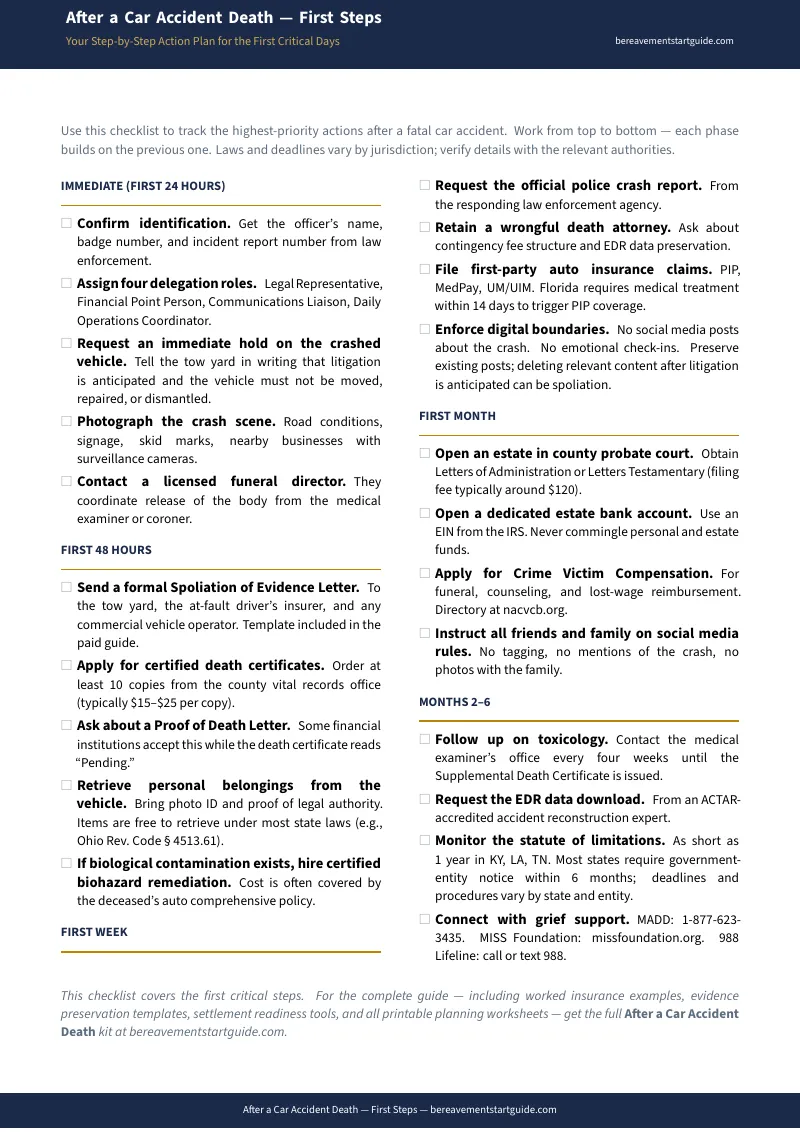
You can download the free one-page emergency checklist right now — it covers the immediate first steps for the first 48 hours. When you are ready for the complete system — all fourteen chapters, every template, every spoliation letter, every script — the full toolkit is available for as an instant download.