Someone Murdered Your Person. Now Every System in the Country Wants Something From You Before You Can Even Breathe.
A detective is asking for your statement. The medical examiner has taken jurisdiction over the body and won't tell you when you can plan the funeral. Your home might be an active crime scene — sealed off behind police tape while you sleep on a relative's couch. A reporter just knocked on the door. Someone from the insurance company left a voicemail about a "contestability review." And a biohazard cleanup company you've never heard of is quoting you $8,000 to make your living room habitable again.
Meanwhile, your brain has stopped functioning. You are reading the same text message three times without processing the words. You walked into the kitchen and forgot why. You can hear your own heartbeat inside your skull but you cannot feel your hands. The cortisol flooding your system has shut down the part of your brain that makes decisions — at precisely the moment when every decision carries legal, financial, and investigative consequences that can follow your family for years.
That is not a personal failing. That is a clinically documented state called peritraumatic stress response. And it is happening to you at the single worst possible moment for it.
The Homicide Aftermath Triage System — A Step-by-Step External Brain for the Most Chaotic Week of Your Life
After a Homicide is the operational triage toolkit built specifically for surviving families in the aftermath of a violent death. Not a grief memoir. Not a thin government pamphlet. Not a law firm's sales pitch disguised as information. This is a 13-chapter sequenced operating system that tells you exactly what to do, in what order, with pre-written scripts for every difficult phone call and every institutional encounter — designed to be used in five-minute intervals by a brain in crisis at 2 a.m.
The toolkit covers what no single free resource does: the police investigation, the autopsy and death certificate process, the biohazard remediation trap, the Crime Victim Compensation application, the life insurance minefield, the media privacy protocol, the children's traumatic grief response, and the wrongful death question — all in one printable document that works when nobody is answering the phone and you are googling in the dark because you cannot sleep.
What's Inside the Toolkit
- First 72-Hour Triage Protocol with Family Role Assignment — because attempting to manage legal, forensic, financial, and media matters collectively leads to missed deadlines, conflicting communications, and family members burning out or breaking down. The role assignment system divides responsibilities across five defined positions — Communication Liaison, Law Enforcement Contact, Financial Coordinator, Security and Family Caretaker, and Media Liaison — so critical tasks are covered without one person collapsing under the weight.
- The Investigation Chapter — because you have never worked with homicide detectives before and every interaction matters. What you are required to tell the police, what you have the right to decline, how to protect physical evidence without compromising the case, what "person of interest" actually means when they say it to you, and how to track case updates in one central log so the family is not calling the detective five times a day from five different numbers.
- Autopsy Navigation and Death Certificate Guide — because the medical examiner has legal jurisdiction over your person's remains and there is nothing you can do to accelerate that timeline. This chapter explains why the autopsy is happening, what "pending" cause of death means for your insurance claim, how long toxicology results typically take, when the body will be released to a funeral home, and how to avoid the death certificate errors that freeze financial accounts for months.
- Crime Scene Cleanup and Biohazard Remediation — because nobody tells families that the police do not clean the crime scene. When the yellow tape comes down, the blood, the biological matter, and the structural contamination are your legal and financial responsibility. This chapter covers how to identify certified biohazard companies, what OSHA-compliant remediation actually involves, how to submit the cost to your homeowners or renters insurance, and how Crime Victim Compensation covers cleanup when insurance doesn't — with cost ranges from $2,500 to $12,000 depending on severity so you know what to expect before the first quote arrives.
- Crime Victim Compensation (CVC) Application Walkthrough — because every U.S. state has a program that reimburses funeral costs, medical bills, lost wages, counseling, and crime scene cleanup for families of homicide victims — and most families never apply, or apply too late, or get denied because they didn't know CVC operates as the "payer of last resort" and requires you to exhaust insurance first. This chapter walks you through the full application process, documents needed, common denial reasons, and filing deadlines that vary by state.
- Life Insurance Claims Under Active Homicide Investigation — because homicide is not an automatic exclusion on a standard life insurance policy, but the insurer will use every procedural tool available to delay your payout indefinitely while the criminal case is open. The slayer rule, the two-year contestability window, the "felonious act" exclusion, and the premium trap — this chapter explains each one and tells you exactly what to demand in writing from your insurer and when to involve an attorney.
- Media Privacy and Online Safety Protocol — because a violent death attracts reporters, true-crime podcasters, and social media speculation within hours. You have the absolute legal right to decline all media contact, bar cameras from the funeral, and set strict boundaries — but nobody hands you that information at the police station. This chapter includes a template written media statement, a social media lockdown checklist, and a protocol for managing the online harassment that often follows public homicide cases.
- Supporting Children Through Traumatic Grief — because children who lose a parent or sibling to homicide do not grieve the way adults expect. A child's imagination fills every gap you leave with details far more terrifying than the truth. This chapter provides age-appropriate language for explaining what happened, the behavioral warning signs that distinguish normal grief from childhood traumatic grief, and clear guidance on when to seek professional trauma therapy — including why euphemisms like "went to sleep" cause more harm than the word "homicide."
- Wrongful Death and Civil Liability — because when a homicide occurs on someone else's property or under circumstances where a third party's negligence contributed to the death, a separate civil claim may exist alongside the criminal prosecution. This chapter explains the distinction, the statute of limitations pressure, and how to protect your legal options without interfering with the criminal case.
- Ten Printable Worksheets and Tracking Tools — an evidence preservation checklist, an incident information log, a family role assignment sheet, a benefits and claims tracker (CVC, insurance, employer benefits), six communication scripts for the hardest phone calls, a media privacy protocol card, a funeral cost comparison worksheet, a victim impact statement worksheet, and a monthly recovery calendar. Every administrative artifact you would otherwise have to invent while cognitively impaired — each one a separate printable PDF you can hand to the family member responsible for that task.
Who This Guide Is For
- Surviving spouses and partners who are managing shock, an active investigation, children's questions, and institutional demands all at once
- Parents whose child was murdered — carrying the shattering of every protective instinct alongside impossible administrative and legal decisions
- Adult children whose parent was killed — fielding calls from detectives, insurance adjusters, funeral directors, and extended family while processing disbelief
- Siblings whose grief is being minimized because the support network is focused on the spouse or the parents — the forgotten mourners who are often absorbing heavy operational duties in silence
- Anyone managing the administrative aftermath — executor, next of kin, or the person everyone assumes "has it handled" while they are quietly falling apart
Why Free Resources Leave You Stranded
Government victim-service portals are written to satisfy legal compliance standards, not to support a traumatized human being at 2 a.m. The language is cold, intimidating, and scattered across dozens of websites — one for the coroner, one for CVC, one for victim advocacy — each assuming you already know how the system works.
Law-firm blogs provide useful information about wrongful death liability, but every page is engineered to funnel you into a litigation contract. The emotional, logistical, and family-support dimensions of your crisis are invisible to them.
Grief memoirs offer deep emotional validation, but they contain no checklists, no scripts, no deadlines, and no step-by-step administrative guidance. They are written for reflection, not for the moment when you need to call the insurance company before the contestability clock runs out.
The After a Homicide toolkit exists in the space none of these resources occupy: high operational utility combined with genuine empathy. It translates the dense bureaucratic requirements into clear, human, step-by-step instructions — without trying to sell you a lawsuit, a funeral upgrade, or a spiritual framework.
Satisfaction Guarantee
If the toolkit doesn't help — for any reason — email hello@bereavementstartguide.com and we will refund you in full, no time limit. You are dealing with enough right now. The last thing you need is purchase anxiety on top of everything else.
You Don't Have to Figure This Out Alone
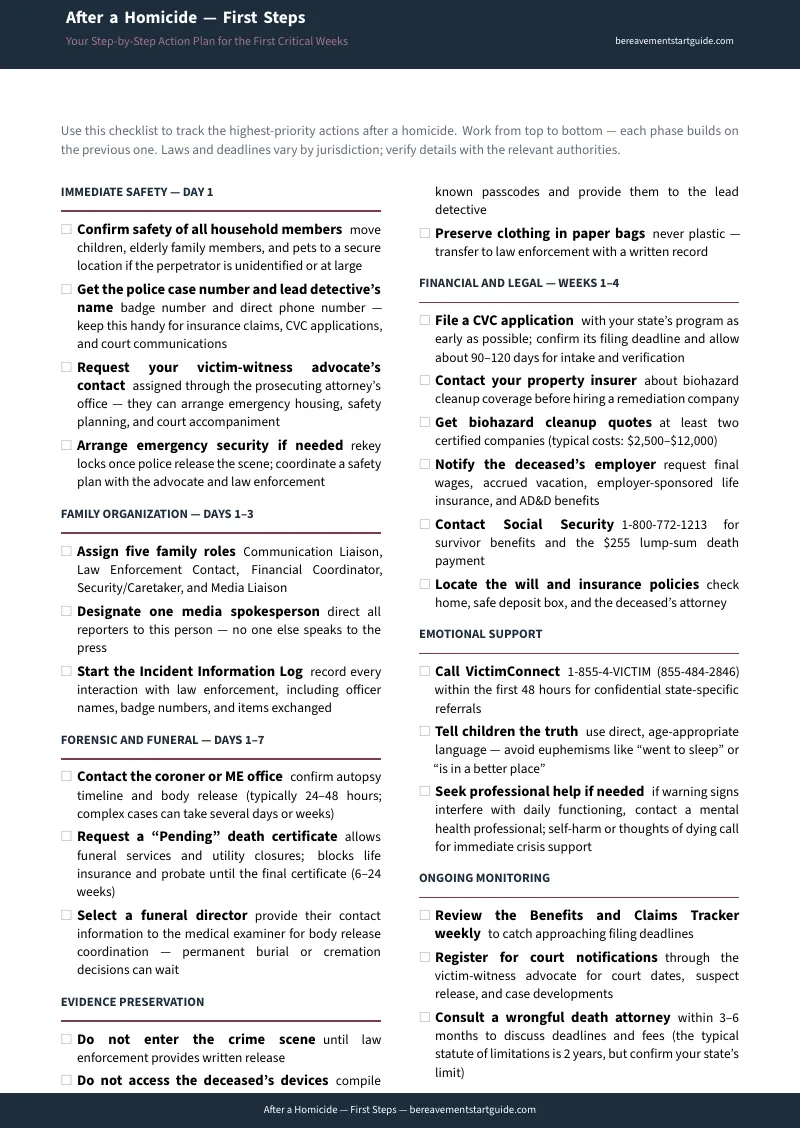
The free checklist gives you the sequence — what to do and when. If that is all you need right now, take it. But if you need the scripts, the worksheets, the insurance strategy, the media template, and the chapter-by-chapter guidance that walks you through every institutional encounter — get the full After a Homicide toolkit and give your family a system that works when your brain cannot.
You are away from having an external brain for the worst week of your life.