Your family is in crisis. You need a system, not a search engine.
When someone you love dies from a drug overdose, you don't get a grace period. Within hours, police may treat your home as a crime scene. Within days, insurance carriers start building their denial case. Within weeks, filing deadlines for victim compensation begin closing. And through all of it, you're grieving a loss that most people around you don't know how to acknowledge.
The After a Drug Overdose Death toolkit is a Crisis Triage System — a structured, step-by-step crisis binder built for the moment when your cognitive capacity is near zero and the stakes of every decision are at their highest.
This is not a grief memoir. There are no platitudes, no spiritual exercises, and no judgment about how your loved one died. This is an operational manual: checklists, scripts, timelines, and templates that replace the 40 hours of panicked Googling with a single document you can follow from the first police interaction through the final insurance appeal.
What's inside the Crisis Triage System
- First 72 Hours Triage Protocol — exactly what to say to police, what not to touch at the scene, how to designate a Family Coordinator using the role assignment matrix, and how many pending death certificates to order before the funeral director's window closes
- Medicolegal System Navigator — how autopsies, forensic toxicology, and pending death certificates work, including the communication script for calling the medical examiner's office ("I am calling as the legal representative for [Name], Case Number [Number]…")
- Insurance Denial Defense Kit — how to challenge life insurance and AD&D denials using the proximate cause standard and contra proferentem doctrine, with a step-by-step breakdown of the ERISA administrative appeals process and what evidence must be in the record before the 60-to-180-day window permanently closes
- Criminal Justice and Good Samaritan Law Guide — which protections apply and which do not, including Drug-Induced Homicide statutes in the 30 states that actively enforce them, so witnesses and family members understand their legal exposure
- Crime Victim Compensation Roadmap — how to file state CVC/VOCA claims for funeral costs, biohazard remediation, evidence replacement, and other out-of-pocket expenses, with filing deadlines and cooperation requirements
- Hazardous Substance Safety Protocols — fentanyl and synthetic opioid decontamination procedures for re-entering a residence where the death occurred, including what not to do (no fans, no vacuuming) to avoid aerosolizing potent compounds
- Evidence Preservation Vault Checklist — exactly what to photograph, what records to request from hospitals and law enforcement, and how to build the document vault that protects your financial and civil rights
- Children's Conversation Scripts — age-appropriate language for explaining an overdose death to children at every developmental stage, including the R.I.C.E. framework and guidance on addressing magical thinking in younger children
- Grief Psychology and Relationship-Specific Guidance — managing disenfranchised grief, survivor guilt, the "relief-then-shame" cycle, and the distinct trauma patterns for spouses, parents, siblings, and witnesses
- Obituary and Memorial Planning Templates — how to draft an honest obituary that balances disclosure with privacy, manage digital legacy and social media accounts, and use the FTC Funeral Rule to protect against funeral home overcharges
Who this is for
You just lost a spouse or partner. You're managing a police investigation, a financial crisis, and sole parenting — all in the same week. The triage protocol tells you what to do first, second, and third, and the role assignment matrix helps you delegate what you physically cannot handle alone.
You just lost a child. Every instinct screams to protect their memory, but altering the scene creates legal risk. The guide walks you through evidence preservation, victim compensation, and insurance appeals — the administrative work that won't wait — so you can focus on the family members who need you now.
You were there when it happened. Good Samaritan laws protect you from simple possession charges — but not from Drug-Induced Homicide statutes. The criminal justice chapter explains exactly what you are and are not protected from, and when you need an attorney before giving a statement.
You're the family coordinator. Someone put you in charge of "handling things." The toolkit gives you the complete administrative roadmap: who to call, in what order, with what documents, and by what deadline.
Why scattered free resources fail families in crisis
Government victim services websites bury critical information in legalistic language designed for case workers, not grieving families. Law firm blogs exist to convert you into a litigation client, not to help you file your own appeal. Nonprofit resource libraries scatter essential protocols across dozens of blog posts and PDFs. Grief memoirs offer emotional validation — months from now, when you can read again — but nothing you can act on tonight.
The Crisis Triage System organizes all of it — legal protections, financial recovery options, forensic timelines, communication scripts, and grief-specific guidance — into a single, sequential document designed for a brain operating at near-zero cognitive capacity. Every section opens with a 2-minute checklist so you can act first and read deeper when you're ready.
Satisfaction guarantee
Full refund, no time limit. If this toolkit doesn't give you the clarity and structure you need, email hello@bereavementstartguide.com and you'll get your money back. No forms, no waiting period.
Start with the free checklist or get the full toolkit
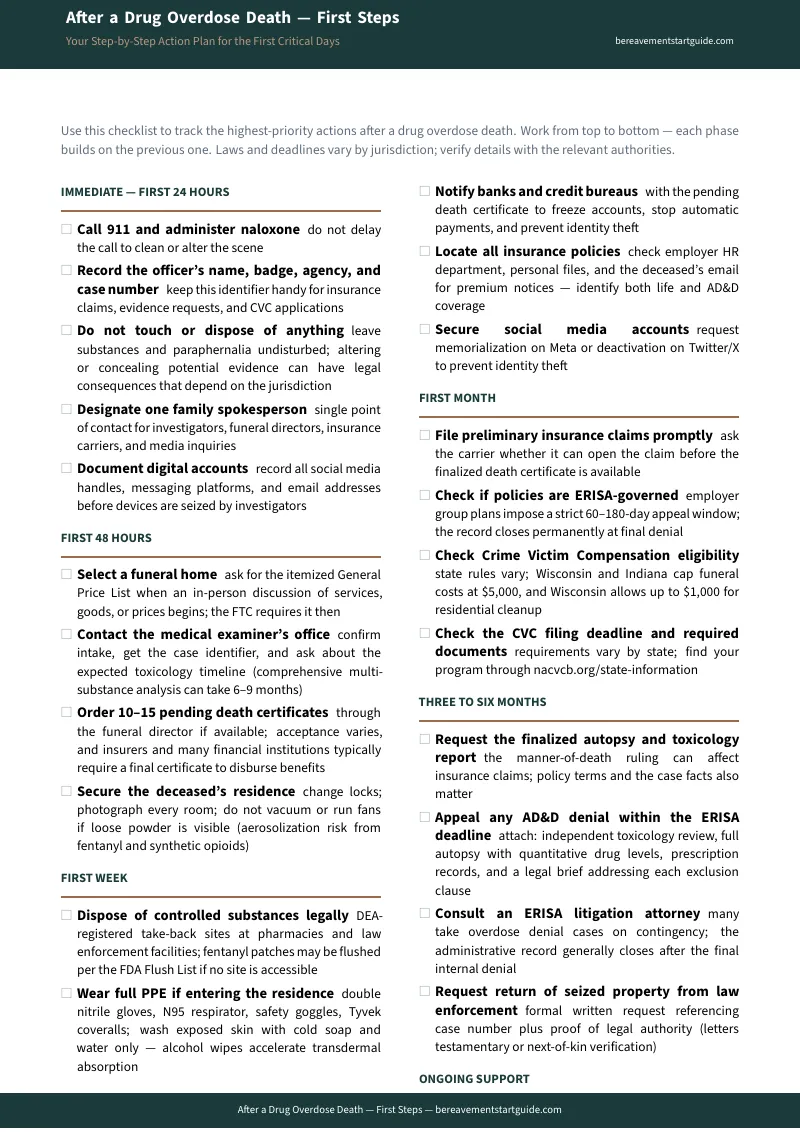
The free one-page checklist covers what to do in the first 48 hours. The full After a Drug Overdose Death toolkit covers how — with scripts, templates, appeal procedures, and worksheets that walk you through every decision point from scene response through long-term recovery.
Download the free checklist to start tonight. When you're ready for the complete system, the full toolkit is here — .