
You just lost someone to suicide. The investigation has already started — and so have the deadlines.
Within hours of a suicide death, law enforcement seizes phones, laptops, and personal notes as evidence. The forensic investigation locks you out of the scene. The medical examiner takes custody of the body. And the biohazard remediation clock starts — because municipal first responders do not clean or restore the scene of a death, and the contamination is yours to deal with.
Then come the questions you never imagined having to answer: Does the life insurance still pay? Who is financially responsible for the scene cleanup? What do you tell the children? What do you say to the people texting you right now? How do you stop the media from showing up at your door?
You are not just grieving. You are managing an active investigation, an administrative crisis, and a family on the edge of fracture — all while your brain is operating in survival mode.
The Suicide Aftermath Crisis Navigator
The After a Suicide toolkit is a structured crisis navigation system built specifically for the complexity that makes a suicide death different from any other kind of loss. While grief memoirs offer comfort and law firm websites push you toward a retainer, this toolkit puts every time-sensitive administrative, legal, and emotional task in one place — in the order they actually need to happen.
It bridges the gap that no existing resource covers: the space between the clinical postvention frameworks of nonprofit organizations and the sterile jargon of estate planning guides. The result is a self-directed triage system that helps you protect your family's assets, privacy, and wellbeing while you process the most disorienting grief you have ever experienced.
What's Inside the Toolkit
- The Forensic Investigation, Decoded — what happens when law enforcement secures the scene, why your loved one's phone was seized, how to file a Motion for Return of Property to get devices back, and the full medical examiner autopsy and toxicology timeline
- Biohazard Remediation Insurance Guide — why you must never clean the scene yourself, how over 93% of standard homeowners policies cover professional remediation under dwelling coverage, how Crime Victims Compensation Programs fill insurance gaps, and why surviving family members are not personally liable for cleanup costs
- Life Insurance Claim Protection — the two-year suicide exclusion window, the separate contestability period, why employer group life policies typically pay the full benefit regardless of cause of death, and two legal doctrines for challenging wrongful denials (the mental incapacity defense and the preponderance of accidental evidence standard)
- Estate Administration After Suicide — probate procedures, will validity, testamentary capacity challenges, and navigating the "pending" death certificate that freezes bank accounts, benefit claims, and estate filings
- Safe Disclosure and Privacy Protection — pre-written notification scripts for family, friends, employers, and schools, aligned with the American Foundation for Suicide Prevention's safe messaging guidelines; strategies for handling media intrusion, neighborhood rumors, and social media speculation
- Supporting Children Through a Suicide Death — age-appropriate language for telling children the truth honestly without traumatizing them, recognizing grief reactions at different developmental stages, and when to seek professional help through programs like The Dougy Center
- Grief After Suicide — Why It Feels Different — survivor guilt, hindsight bias, the "grief olympics" that fracture families, the debunked 90% divorce myth, and the somatic symptoms that masquerade as illness
- 12-Month Administrative Timeline — vehicle title transfers, digital account closures, tax filings, Social Security survivor claims, and benefit applications organized month by month so nothing slips through the cracks
- Printable Worksheets and Planning Tools — incident information log, benefits and claims tracker, forensic query bank, communication scripts, support request messages, family role assignment worksheet, document collection log, and a 12-month administrative timeline — all printable standalone PDFs you can hand to a trusted friend so they can help without having to ask you what needs doing
Who This Toolkit Is For
- A spouse, parent, or partner who just lost someone to suicide and needs a clear sequence of what to do first, what can wait, and what absolutely cannot be missed
- The family member managing the investigation, the funeral home, and the insurance claims while everyone else is in shock — and who needs the administrative load organized into something manageable
- Someone whose life insurance claim has been denied because of a suicide ruling, and who needs to understand the exclusion window, the contestability period, and how to build an appeal before the deadline passes
- A friend or supporter who wants to take concrete administrative tasks off the family's plate instead of asking "let me know if you need anything"
Why Free Tools Fall Short
The information you need after a suicide exists — scattered across AFSP resource pages designed for long-term emotional recovery, law firm lead-generation websites designed to sell you a retainer, county medical examiner FAQ pages written in clinical jargon, and grief support forums that offer validation but no administrative roadmap.
Each of these sources covers one narrow slice. None of them connects the forensic investigation to the biohazard remediation claim to the life insurance dispute to the disclosure decision to the emotional crisis fracturing your household right now. And none of them is designed for a person whose executive functioning has been shattered by traumatic shock.
The toolkit organizes all of it — the legal navigation, the insurance protection, the communication scripts, the children's support strategies, and the long-term administrative timeline — into a single, chronologically ordered system you can use at 2 a.m. when you cannot think straight.
Satisfaction Guarantee
Full refund, no time limit. If the toolkit does not help your family, email hello@bereavementstartguide.com and we will refund your purchase — no questions, no deadline, no forms to fill out.
This is an independent resource. We are not affiliated with any law firm, insurance carrier, or government agency.
Get Started Now
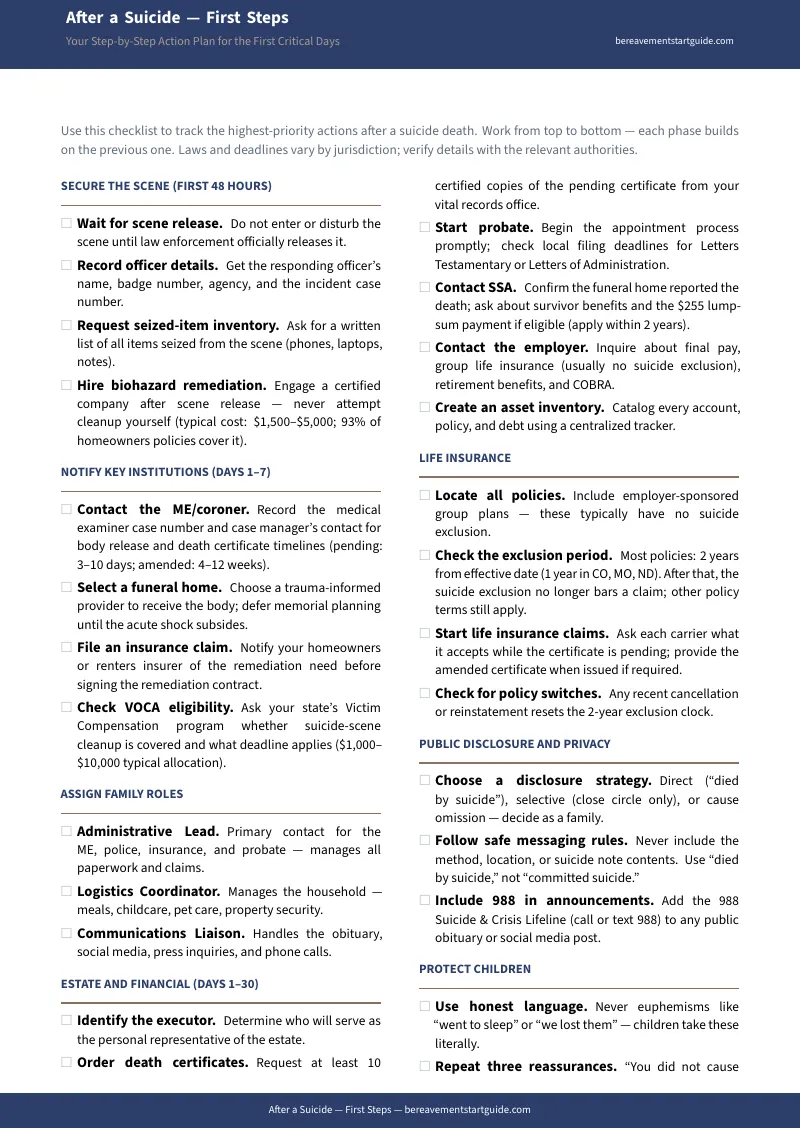
Download the free After a Suicide — First Steps checklist to see if this approach works for you. When you are ready for the full system — the legal navigation, the insurance claim strategies, the communication scripts, and the month-by-month recovery roadmap — the complete toolkit is waiting.
The investigation is already underway. The decisions are already piling up. The toolkit gives you a way to manage them.