The Bank Froze Everything. The Extended Family Wants the House. Three Legal Systems Say Three Different Things About Who Inherits. And "Next of Kin" on the Account Form Means Absolutely Nothing.
Someone in your family has died. The bank learned about it — maybe from a family member, maybe from a hospital — and froze every naira in every account within hours. You assumed that being listed as "Next of Kin" on the account opening form would give you access. It does not. The Court of Appeal ruled in Union Bank Plc v. Ajabule (2011) that a bank's next-of-kin designation is an emergency contact field, not an inheritance mechanism. You need a Grant of Probate or Letters of Administration — a court order — before any bank in Nigeria will release a single naira. And if that account sits frozen and unclaimed for 10 years, the funds transfer permanently to the Central Bank of Nigeria under Section 45(1) of BOFIA 2020.
Meanwhile, the extended family has arrived. Under Igbo customary law, the eldest son inherits the estate and the family headship. Under Yoruba custom, assets split by Idi-Igi or Ori-O-Jori. Under Islamic law, fixed Quranic fractions determine every share — a daughter inherits half of what a son inherits. Under statutory law, the surviving spouse gets one-third and the children split two-thirds equally. Which system governs your family depends on the type of marriage, the state of residence, and religious practice. Get it wrong and you face years of litigation.
Then there is PenCom. Since December 2020, Pension Fund Administrators cannot release any death benefit without direct PenCom approval through the automated RMAS system. The documentation checklist is so demanding — certified court orders, NPC death certificates, NIN identification, bank confirmation forms, employer letters with specific payslip dates from 2004, 2007, and 2010 — that first-time applications are routinely rejected.
To hire a private lawyer to handle all of this, families typically pay ₦2,800,000 or more across consultation, search, drafting, and disbursement fees. Most families cannot afford that. And the free information available online — government registry pages, law firm blog posts, Nairaland threads — is fragmented, outdated, and missing the practical step-by-step instructions that actually get you through the process.
The Guide to Estate Settlement and Inheritance in Nigeria is a Three-System Estate Navigation Blueprint — a complete manual that maps all three legal frameworks, every court procedure, every bank requirement, every PenCom form, and every deadline into one sequential roadmap. It is built for the family member who needs to act now, not the lawyer billing by the hour.
What's Inside the Three-System Estate Navigation Blueprint
A 16-chapter guide and the Nigeria Estate Settlement Checklist — covering death registration, the three-system inheritance framework, court applications, bank unfreezing, pension claims, real estate transfers, tax obligations, widow and child protections, diaspora administration, and the 15 most common mistakes that add years to the process:
The First 48 Hours — Death Registration and Document Security
When death occurs in a hospital, the attending physician issues a Medical Certificate of Cause of Death. When death occurs at home, you register with the National Population Commission (NPC). NPC registration is officially free, but private PPP vendors charge ₦2,000 to ₦5,000 for automated processing. Late registrations require a court-sworn affidavit. Only the NPC-issued certificate is legally valid for probate — the hospital certificate alone is not enough. The guide covers the full NPC registration process, the distinction between the two certificates, and the immediate asset-securing steps that prevent extended family members from accessing property before the court process begins.
Three Legal Systems — Your Decision Flowchart
Nigeria operates three parallel inheritance systems. A Marriage Act marriage triggers statutory succession. A customary marriage triggers ethnic-specific rules — Igbo primogeniture where the Okpala (eldest son) inherits, Yoruba Idi-Igi or Ori-O-Jori distribution, Bini absolute primogeniture where the Igiogbe must pass to the eldest son even if a Will says otherwise. An Islamic marriage triggers Sharia succession with mandatory Quranic fractions. The guide includes a decision flowchart that maps your specific situation — marriage type, state, religion, ethnic group — to the correct legal framework, explains the landmark Ukeje v. Ukeje (2014) ruling on female inheritance, and covers the practical reality of enforcing constitutional rights against traditional resistance.
Letters of Administration — The Complete Intestacy Process
When there is no Will, the surviving family petitions the Probate Registry of the High Court in the state where the deceased last resided. The guide walks through every stage: filing the petition, assembling documentation (death certificate, proof of relationship, asset inventory, sureties), the registry interview where officers verify identities and assess surety liability, the mandatory newspaper publication with its 21-day caveat window, and final issuance. For Lagos specifically, the guide covers the LAPRS online filing system and the manual steps the digital portal does not handle — the physical Bank Certificate runs to every financial institution, the property valuation with the Commissioner of Lands, and the in-person interview.
Grant of Probate — When a Will Exists
If the deceased left a valid Will, the named executor applies for a Grant of Probate. The process is faster but still requires court validation, executor verification, and payment of assessed estate duties. The guide covers Will validity under the Wills Act, lodgement deadlines, and the specific scenarios where a Will can be contested — including the Bini customary exception where the Igiogbe passes to the eldest son regardless of testamentary instructions.
Unfreezing Bank Accounts — What Banks Require
Banks freeze accounts immediately upon notification of death. Joint accounts only escape the freeze if the mandate explicitly includes a survivorship clause — without it, the deceased's share is frozen as a tenancy in common. To release funds, you need either a Grant of Probate or Letters of Administration, plus the bank's own verification form and certified identification. The guide covers bank-by-bank documentation, the possibility of a temporary court order for urgent estate expenses, and the 10-year abandonment clock.
PenCom Pension Claims — First-Submission Accuracy
The documentation is exhaustive: certified Will or Letters of Administration, NPC death certificate, NIN identification, bank confirmation forms with stamps, next-of-kin indemnity forms with court-stamped passport photographs, employer letters with specific payslip dates (June 2004, January 2007, July 2010 for accrued rights reconciliation), and notary attestation for retirees. PFAs physically visit issuing probate registries to verify documents. For deaths at foreign hospitals, sworn court affidavits are required. For deaths in rural villages, PFAs conduct on-the-ground verification with local village heads. The guide maps every document and every form so your first submission to PenCom's RMAS system is complete.
Real Estate Transfer — Land Use Act Compliance
Transferring property from a deceased estate requires navigating the Land Use Act, state consent requirements, and Governor's consent for rights of occupancy transfers. Minor children cannot hold direct legal title. The guide covers the Deed of Assent, survey plan requirements, state consent fees, and the registration process at the state lands registry — plus the protective measures for minor beneficiaries.
Taxes and Estate Duties
Lagos assesses a 10% valuation fee on gross estate value. Other states have their own assessment structures. The guide covers the state-by-state assessment framework, the Probate Pay Sheet process, the distinction between estate duty and income tax obligations, and legitimate cost management strategies during valuation.
Widow and Child Protections
Despite constitutional rulings, customary disinheritance practices persist. The guide covers the specific constitutional provisions, the landmark cases (Ukeje v. Ukeje, Mojekwu v. Mojekwu), the ACJA provisions against widow disinheritance, and the practical steps to assert rights when extended family invokes customary law.
Diaspora Administration
Overseas relatives can appoint a local attorney-in-fact through a Power of Attorney — notarized and apostilled in the country of residence, then filed with the probate registry. The guide covers the specific POA clauses needed for estate administration, the risks of appointing family versus professional administrators, and the PenCom verification requirements for deaths that occurred abroad.
Common Mistakes That Add Years
The 15 most frequent errors: assuming Next of Kin means inheritance rights, filing in the wrong state's probate registry, incomplete newspaper publication, missing the caveat window, submitting to PenCom without the correct payslip dates, failing to obtain Governor's consent for land transfers, distributing assets before the Grant is issued. Each mistake includes the consequence and the corrective action.
Who This Is For
- The surviving spouse or eldest child who needs to unfreeze bank accounts, claim pension benefits, and transfer property — and just discovered that "Next of Kin" on the account form means nothing
- The family member facing customary law pressure — Igbo primogeniture claims, Yoruba distribution disputes, Bini Igiogbe assertions — who needs to know their constitutional rights before the family meeting
- The executor named in a Will who has never been inside a probate registry and needs to understand fiduciary obligations before personal liability attaches
- The diaspora relative coordinating from the UK, US, or Canada who needs a Power of Attorney and a reliable process for remote administration
- HR managers and welfare officers processing death-in-service benefits and PenCom claims for an employee's family
Why Not Free Information?
The LAPRS portal tells you to submit forms online — but does not explain the physical Bank Certificate runs, the property valuation with the Commissioner of Lands, or the in-person interview that no online form replaces. LawPadi publishes helpful educational articles but lacks structured, printable execution blueprints. DIYlaw.ng sells affordable legal templates for commercial agreements but has zero coverage of estate probate, Letters of Administration, or PenCom compliance. Law firm blog posts explain concepts but stop short of actionable step-by-step procedures — because the next step is a consultation at ₦300,000. Nairaland threads offer raw experience but are anecdotal, outdated, and legally risky.
This guide is the only resource that combines all three legal systems, the complete court application process, bank-specific unfreezing procedures, PenCom's full documentation requirements, real estate transfer steps, and widow/child protections into one sequential, printable manual — for a fraction of what a single lawyer consultation costs.
What You Get
For , you receive 10 printable PDFs — the complete estate settlement system:
- The Guide to Estate Settlement and Inheritance in Nigeria — 16 chapters covering death registration through final asset distribution, with the three-system decision flowchart, step-by-step court procedures, bank unfreezing requirements, PenCom pension claim forms, real estate transfer process, and widow/child constitutional protections
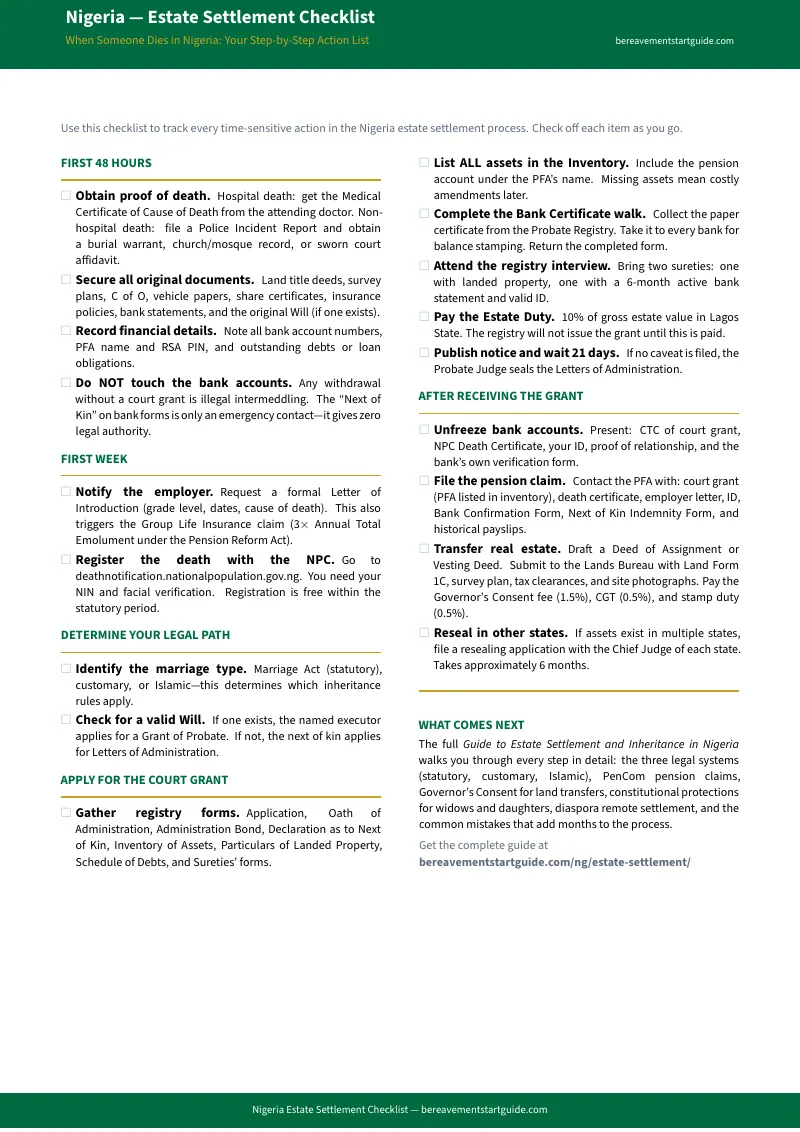
- The Nigeria Estate Settlement Checklist — a one-page chronological reference with every critical action, document, and deadline from the first 48 hours through final distribution
- Document Master Checklist — every document you need for NPC registration, Letters of Administration, bank unfreezing, PenCom claims, and real estate transfer — tick off each one as you obtain it
- Three-System Decision Flowchart — a single-page reference that maps your marriage type, religion, and ethnic group to the correct legal framework
- Letters of Administration Process — the five-step court application guide with required forms, LAPRS filing instructions, and timeline
- Bank Account Unfreezing Worksheet — track every frozen account through the release process, with required documents and joint account rules
- PenCom Pension Claim Checklist — every document and form needed for first-submission approval through RMAS
- Real Estate Transfer Steps — Land Use Act compliance, Governor's Consent process, fees, and document requirements
- Fees and Charges Reference — every cost in the estate settlement process, including estate duties, transfer fees, and the taxes Nigeria does not charge
- Agency Directory — probate registries, NPC, PenCom, AGPT offices, and state-level contacts
Instant download. Printable PDF. Start the process today.
Or download the free Estate Settlement Checklist — the one-page overview of every step and deadline — and see the quality for yourself before deciding.
The estate settlement process in Nigeria is complex, but it is not unknowable. Every court application, every bank requirement, every PenCom form has a defined procedure. The families who struggle are the ones navigating without a map. This is the map.