Your Parent Is in the Hospital. The Doctor Asks Who Has Authority to Make Medical Decisions. Nobody Does. And You Just Learned That Alabama Requires Your Witnesses to Be 19, Not 18 — Which Means the Document You Downloaded Last Week Might Be Invalid.
This is how most families encounter advance care planning in Alabama. Not during a calm Sunday afternoon. During a crisis — when someone is hospitalized, diagnosed, or declining — and you realize nobody wrote down what they want. Or worse, someone did fill out a form from the internet, and the hospital legal team is questioning whether the witnesses were qualified, whether the feeding-tube instructions are clear enough to act on, and whether the person who signed the form was old enough under Alabama law to make it binding.
Alabama is not like other states. The Alabama Natural Death Act imposes execution requirements that trip up families who rely on generic national templates. The age of majority is 19, not 18. The witness disqualification list is long and specific — your named proxy cannot witness, your family cannot witness, anyone who inherits from your estate cannot witness, anyone financially responsible for your care cannot witness. And the feeding-tube default rule means that if you leave a single initial line blank on the form, hospitals are legally required to maintain or insert artificial nutrition — regardless of what your proxy believes you would want.
The Alabama Advance Directive & Living Will Kit is an Execution-Proof Planning System — not a blank form, but a structured walkthrough of every decision, every signature requirement, and every statutory trap between opening the Alabama statutory form and having a legally binding, hospital-ready document that actually works when your family needs it.
What's Inside the Execution-Proof Planning System
A comprehensive 14-chapter guide, a Quick-Start Advance Directive Checklist, and 7 standalone printable tools — covering every step from understanding Alabama's framework through distributing and storing your completed documents, built specifically for the Alabama Natural Death Act and the state-specific rules that make advance care planning here different from any other state:
The Living Will Section: Making Your Treatment Choices Stick
The Alabama statutory form requires you to initial "Yes" or "No" for life-sustaining treatment and artificial nutrition under two separate clinical scenarios — terminal illness and permanent unconsciousness. That is four critical decisions. The guide explains what each option means in practice, what happens if you leave a line blank (feeding-tube default kicks in), and how to use the "Other Directions" section for situations the standard form does not cover — including dementia-stage instructions that fall outside the terminal illness and permanent unconsciousness definitions.
Healthcare Proxy Appointment: Getting the Authority Right
Choosing who makes your medical decisions is not as simple as naming a trusted person. The guide walks you through the two authority levels Alabama offers — Directive-Only (proxy follows only your written instructions) versus General and Custom (proxy uses their own judgment based on your known values). It explains the legal duties your proxy takes on under HIPAA, the limitations Alabama imposes on proxy authority (no psychosurgery, no sterilization, no involuntary mental health treatment), and how to brief your proxy so they are prepared for the intense clinical conversations that happen in ICU hallways.
The Witness Screening Checklist
Most execution failures happen at the signing table. Alabama's witness disqualification list is one of the most restrictive in the country — six categories of people who cannot legally sign. The kit includes a concrete screening checklist that translates the statutory language into plain questions: Is this person 19 or older? Are they named as my proxy? Are they related to me? Do they inherit from my estate? The checklist identifies eligible witnesses before you assemble everyone for signing, so you do not discover a disqualification after the document is complete.
The Notary Decision: Medical Directive vs. Remains Disposition
Alabama does not require a notary for the standard healthcare directive — two qualified witnesses are sufficient. But if you want your burial or cremation wishes to be legally binding, you need a separate notarized affidavit under Alabama Code § 34-13-11 appointing an "authorizing agent" for remains disposition. Standard hospital forms and free state PDFs do not include this. The guide explains when a notary is required, when it is not, and how the remains disposition affidavit works alongside your medical directive.
The Pregnancy Clause and Other Alabama-Specific Rules
Under the Alabama Natural Death Act, any advance directive refusing life-sustaining treatment has no effect during a known pregnancy. Your proxy has no authority to enforce withholding treatment in this scenario. The guide covers this absolute restriction, the out-of-state directive portability rules under § 22-8A-12, and the statutory decision-making hierarchy that governs who makes medical decisions when no advance directive exists.
Storage, Distribution, and Emergency Mobilization
A completed advance directive that sits in a desk drawer is a completed advance directive that fails. The guide covers how to register the document with your physician's office, how to add it to hospital electronic health records, how to prepare wallet cards for emergency responders, and how to record it with the local county probate judge. It addresses the practical logistics that determine whether your document is accessible at 2 a.m. in an emergency room — not just legally valid in a filing cabinet.
7 Standalone Printable Tools
In addition to the full guide and checklist, your kit includes standalone PDFs you can print individually and bring to the signing table, hand to your proxy, or post on the fridge:
- Witness Screening Checklist — screen both witnesses against all six disqualification categories before signing day
- Healthcare Proxy Briefing Packet — hand this directly to your named proxy so they understand their legal role, HIPAA rights, and statutory limits
- Treatment Decision Worksheet — record your choices for life-sustaining treatment, feeding tubes, proxy authority, and custom directives before filling out the official form
- Family Conversation Starters — compassionate scripts for initiating the advance care planning conversation with parents, spouses, or adult children
- Storage & Distribution Checklist — track where every copy of your signed directive goes (proxies, physicians, hospitals, probate court)
- Key Alabama Contacts — quick-reference card with phone numbers for ADPH, Legal Services Alabama, UAB Medicine, and other critical resources
- 7 Mistakes That Invalidate Your Directive — review this before signing to avoid the most common execution failures under Alabama law
Who This Kit Is For
- The adult child managing a parent's declining health — who needs clear legal authority to communicate with doctors, access medical records, and make treatment decisions without waiting for a court-appointed guardian
- The spouse in a second marriage or blended family — who needs explicit, airtight documentation to prevent legal disputes between a current partner and children from a previous marriage over end-of-life treatment decisions
- The retiree arranging their affairs — who wants their children spared the emotional burden of guessing their medical wishes or fighting over whether to continue life support during a family crisis
- The caregiver of someone with early-stage dementia — who knows there is a narrowing window to execute planning documents while the person still has the legal capacity to sign, and needs to get it done correctly the first time
- The military family before a deployment — who needs to secure reliable family protection quickly, with documents that will hold up across Alabama's healthcare system while the service member is away
- The recently diagnosed patient — facing a serious or terminal diagnosis and needing a straightforward, reliable path to documenting their medical autonomy before the clinical situation progresses
Why Free Alabama Forms Leave Families Exposed
The Alabama Department of Public Health and local hospital networks distribute the statutory advance directive form at no cost. The legal skeleton is there. Here is what is missing:
- No execution guidance. The form gives you blank lines for witness signatures but does not explain the six disqualification categories that can invalidate the entire document. Families discover their witnesses were ineligible after the declarant has lost capacity — when it is too late to re-execute.
- No feeding-tube context. Free forms present the artificial nutrition question as a checkbox without explaining Alabama's default rule. Families leave a line blank, assuming the proxy will handle it. The hospital legal department disagrees.
- No remains disposition. Standard hospital PDFs do not include the notarized § 34-13-11 affidavit for burial and cremation choices. Families learn this gap exists when a dispute over remains holds up the funeral.
- No proxy preparation. Free forms designate a decision-maker but do not explain their legal duties, their HIPAA access rights, or their statutory limitations. Proxies walk into ICU conversations unprepared for the decisions they are asked to make.
- No family conversation framework. The blank form arrives without any guidance for the hardest part of the process — how to talk to your parents, your spouse, or your children about end-of-life treatment preferences without the conversation turning into silence, tears, or a fight.
Generic online platforms like FreeWill, Rocket Lawyer, and LegalZoom automate document generation but do not provide state-specific execution guidance. They build the form. They do not help you survive the signing table, prepare your proxy for their role, or ensure the document actually reaches the hospital system before the emergency happens.
Your Purchase Is Protected
If the kit does not help you complete a legally sound Alabama advance directive, email hello@bereavementstartguide.com for a full refund. No time limit, no questions, no hassle.
Start Planning Today
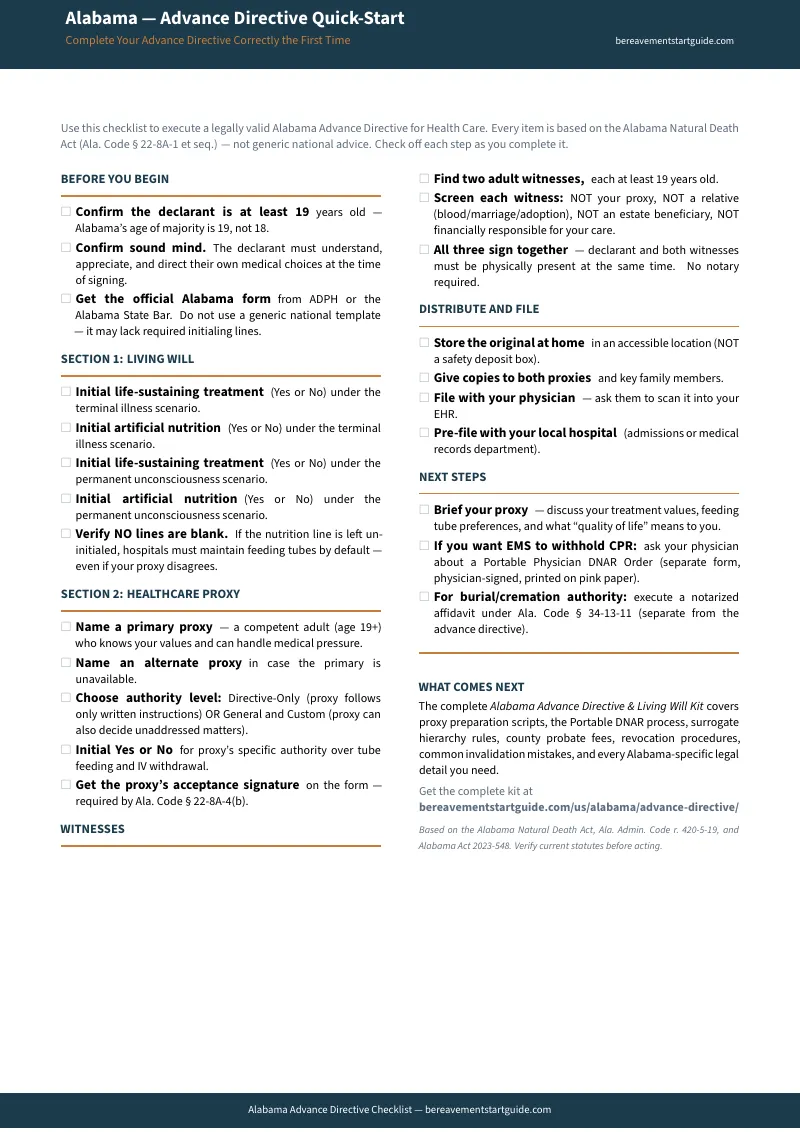
Download the free Alabama Advance Directive Quick-Start Checklist to see what goes into proper execution under Alabama law. When you are ready for the complete system — the full 14-chapter guide, 7 standalone printable tools (witness screening, proxy briefing, decision worksheet, conversation starters, storage tracker, contacts card, and mistakes reference), plus the checklist — the full kit is . A fraction of the cost of one hour with an Alabama elder-law attorney.
Frequently Asked Questions
What if the rules change after I buy?
We update the guide when the rules change. Email us any time, even years later, and we'll send you the current edition free.