
Alabama Does Not Make This Easy
No transfer-on-death deeds for real estate. No small estate affidavit that banks accept directly. A handwritten will that gets no special treatment — it needs two witnesses just like a typed one. County probate courts that each run their own filing fees, forms, and processing schedules. And an elective share statute that can override your will if you are in a blended family and forgot to get a waiver signed.
These are not obscure edge cases. They are the default rules that apply to every family in the state. And most people discover them only after something goes wrong — after a deed is recorded with language that makes it legally void, after a bank freezes an account because the beneficiary designation was never updated, or after a surviving spouse learns they are entitled to a share of the estate that the will tried to give entirely to children from a prior marriage.
The Alabama Estate Coordination System
Free will templates give you a document. Attorney blogs give you information. This kit gives you a system — one that coordinates your will, your powers of attorney, your beneficiary designations, your property titles, and your digital accounts into a plan that actually works under Alabama law.
The difference matters because your will controls only a fraction of your estate. Life insurance, retirement accounts, POD bank accounts, and jointly held property all pass outside your will — directly to the person named on the account. If those designations contradict your will, the designations win. Every time. The kit walks you through the coordination step by step, so nothing falls through the gap between your documents and your accounts.
What You Get
The Complete Guide (13 Chapters)
- Alabama estate fundamentals — probate vs. non-probate assets, the full intestacy distribution table, county-by-county filing fees, and the three statutory protections (homestead allowance, personal property exemption, family allowance) with current 2026 indexed amounts
- Will execution requirements — two-witness formalities, the self-proving affidavit that eliminates witness testimony at probate, why holographic wills are risky in Alabama, and how to make changes without invalidating the original
- Powers of attorney — financial POA (durable vs. springing), healthcare proxy under the Alabama Natural Death Act, and the advance directive — three documents that your family cannot obtain once you are incapacitated
- Real estate transfer strategies — why TOD deeds are void in Alabama, the serious risks of adding a child to your deed (creditor exposure, gift tax reporting, destroyed tax basis), life estate limitations, and the one joint tenancy structure that actually avoids probate
- Financial account coordination — POD and TOD designations, the beneficiary override rule, and the specific steps for aligning retirement accounts, life insurance, and annuities with your estate plan
- Digital assets under RUFADAA — Alabama's three-tier access hierarchy, how to authorize email content access in your will, and the digital asset inventory worksheet
- Blended family protections — the elective share formula, how to protect children from a prior marriage without triggering a spousal claim, and why "trust that your partner will do the right thing" is a legal strategy that fails
- Executor duties and costs — surety bond requirements, the 2.5% + 2.5% compensation formula, and how to waive both in your will (plus when the probate judge can override your waiver)
- Medicaid planning — the five-year lookback period, which transfers trigger penalties, and how to protect your home from Medicaid estate recovery
- When to hire an attorney — an honest assessment of what the kit handles completely and what genuinely requires professional help, with typical Alabama fee ranges so you know what to expect
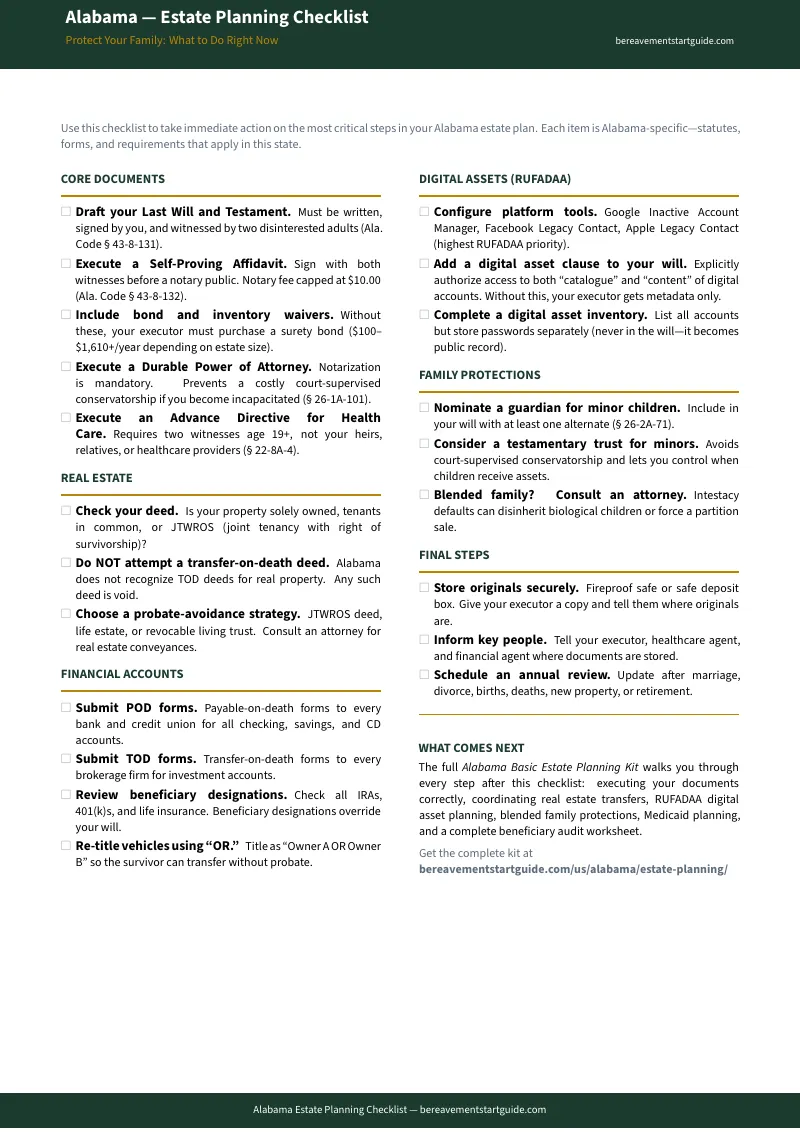
The Estate Planning Checklist
A 20-item, 6-section printable checklist that tracks every document, every account, every beneficiary designation, and every legal formality across your entire plan. Use it as your project manager — check off each step as you complete it, and you will know exactly where you stand at any point.
8 Standalone Worksheets and Reference Cards
- Beneficiary Audit Worksheet — 5-part fillable form for documenting every asset, verifying beneficiary designations, and identifying probate exposure
- Estate Planning Action Plan — 5-phase checklist that maps your entire plan from information gathering through document storage and family communication
- Intestacy and Statutory Protections Reference — Alabama's intestacy distribution table, statutory protections with current 2026 amounts, and summary distribution threshold
- County Probate and Recording Fees — Filing fees, surety bond premiums, deed recording costs, and executor compensation rules across Alabama counties
- Real Estate Transfer Strategies — Side-by-side comparison of JTWROS, life estate, and revocable trust options with advantages, risks, and deed tax information
- Digital Asset Inventory — RUFADAA-compliant fill-in form for email, social media, cloud storage, financial platforms, and cryptocurrency
- Blended Family Scenarios — The elective share formula, common risk scenarios with default outcomes and recommended solutions
- Alabama Statutes Quick Reference — Every statute cited in the kit with key provisions, in one printable page
Who This Is For
- First-time homeowners who just realized their house will go through probate unless they take specific steps that Alabama law actually recognizes
- New parents who need guardian nominations and have no estate plan at all
- Married couples who assume everything passes to the surviving spouse — and have not checked whether their retirement account beneficiary designations agree with their will
- Blended families dealing with the elective share statute and the risk of accidental disinheritance
- Adult children helping aging parents get powers of attorney in place before a health crisis removes the option
- Anyone who has been putting this off because the attorney quoted thousands and the free templates did not explain any of the Alabama-specific rules that actually matter
Why Not Free Templates?
A free will template gives you a blank document. It does not tell you that Alabama does not recognize Lady Bird deeds — and that title companies routinely refuse to insure properties transferred with them. It does not warn you that your bank will freeze your accounts the moment they learn of your death, and that Alabama has no statutory provision for heirs to access funds with a simple affidavit. It does not explain that adding your child to your house deed is an irrevocable transfer that exposes the property to their creditors, their divorce proceedings, and their bankruptcy.
The gap between "having a will" and "having an estate plan that works under Alabama law" is where families lose money, lose time, and lose access to their own assets. This kit closes that gap.
A Fraction of What You Would Pay an Attorney
A comprehensive estate planning package from an Alabama attorney runs $1,500 to $3,500. LegalZoom charges $99 to $349 upfront plus $199 per year to keep editing. This kit costs — a one-time purchase with no subscription, no recurring fees, and no upsells.
For straightforward estates, the kit handles everything. For complex situations, it organizes your entire financial picture before your first attorney meeting — saving you billable hours and ensuring you walk in knowing exactly what to ask.
Satisfaction guarantee: If the kit does not give you a clear, actionable path to completing your Alabama estate plan, email hello@bereavementstartguide.com for a full refund. No questions, no hassle.
Start Your Estate Plan This Weekend
Download the free Alabama Estate Planning Checklist to see exactly what your plan needs. When you are ready to work through the full system — every chapter, every worksheet, every coordination step — the complete kit is waiting.
Frequently Asked Questions
What if the rules change after I buy?
We update the guide when the rules change. Email us any time, even years later, and we'll send you the current edition free.