Someone You Love Just Died in Alabama. The Bank Froze Their Accounts This Morning. The Funeral Director Is Asking How Many Death Certificates You Need. You Have No Idea What Happens Next.
You are standing in the middle of chaos that nobody prepared you for. Maybe you were named executor in a will you barely remember reading, and now the funeral home is asking you to sign forms you have never seen. Maybe there was no will at all, and because you are the eldest child or the surviving spouse, everyone in the family is looking at you for answers you do not have. Maybe the bank just told you that the checking account is frozen and you cannot access a single dollar to pay the electric bill, the mortgage, or the funeral deposit — and the person who would have known what to do is the one who just died.
You are grieving and sleep-deprived, but the paperwork does not wait. The funeral director needs a number for death certificates by tomorrow. The Social Security Administration will claw back any benefits deposited for the month of death if you do not act. Siblings are already asking about the house. A credit card company sent a letter demanding payment on a balance you did not know existed. And somewhere in the back of your mind, a terrifying question keeps circling: if I pay the wrong bill, or sign the wrong form, or miss a deadline I don't even know about — am I personally liable?
The short answer: you are not personally responsible for the deceased's debts. But the long answer — the one that involves Alabama's six-month creditor window, a mandatory 60-day inventory filing, a Medicaid notification deadline that operates on its own separate 30-day clock, a small estates threshold that just changed in 2025, and a vehicle title transfer process that splits into two completely different procedures depending on whether you open probate — that answer is what separates families who settle an estate in months from families who spend years and thousands of dollars untangling mistakes they did not know they were making.
The When Someone Dies in Alabama — Estate Settlement Guide is a Calm Sequencing System for every legal, financial, and administrative step between the funeral home and final distribution. Not a law textbook. Not a generic checklist you found on a national website that does not know Alabama from Alaska. A structured, Alabama-specific manual that separates what must be done in the first 48 hours from what can legally wait six months — so you stop guessing, stop panicking, and start working through this in the right order.
What's Inside the Calm Sequencing System
A 13-chapter guide, the First 48 Hours Checklist, and 3 appendices — covering every stage from the moment of death through final asset distribution, built specifically for Alabama statutes, county probate courts, and the state-specific rules that make settling an estate here different from any other state:
The First 48 Hours: Death Certificates and Immediate Actions
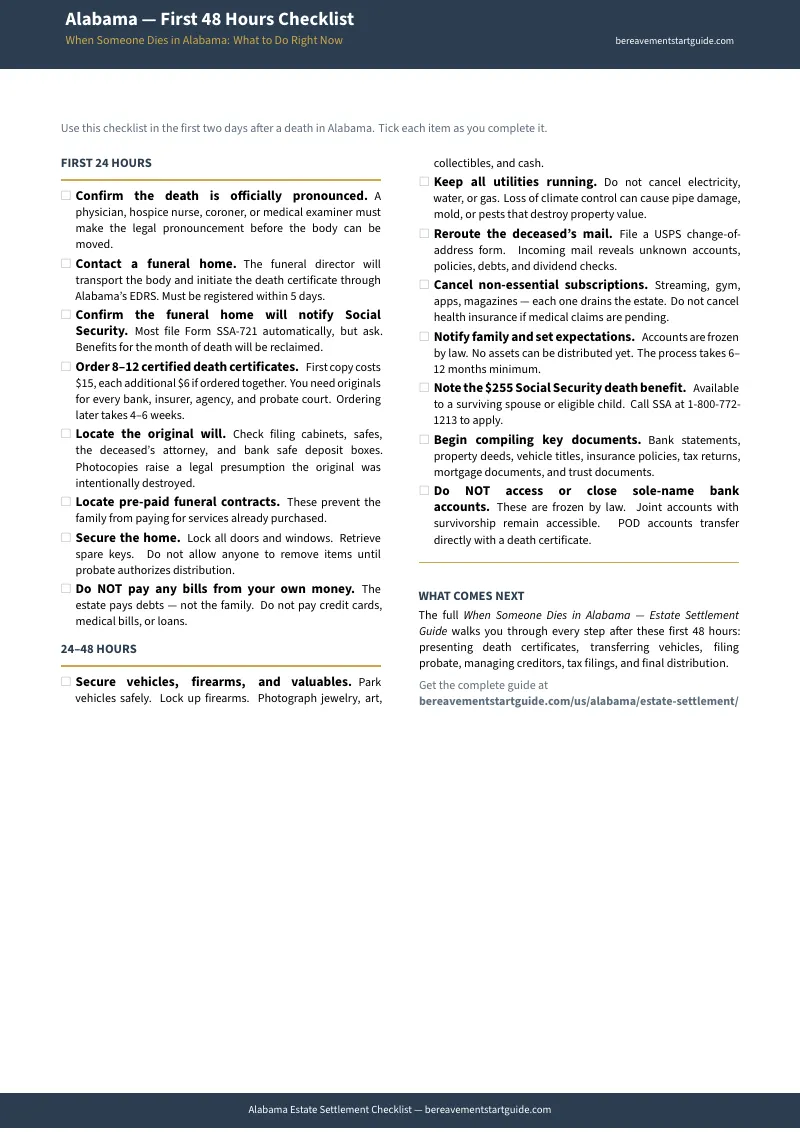
The funeral director is going to ask you how many certified death certificates to order, and most families guess wrong. You need originals — not photocopies — for every bank, every insurance company, the probate court, the Department of Revenue for vehicle transfers, every county where the deceased owned property, and the IRS. The guide gives you the exact calculation based on the deceased's assets. The first certified copy costs $15 from the Alabama Center for Health Statistics, each additional copy ordered at the same time costs $6, and coming back weeks later for more can take four to six weeks. Order the right number now, or pay for it in delays later. This chapter also covers what to do today, what to do tomorrow, and what to absolutely not do — including the single most important rule in this entire guide: do not pay any of the deceased's bills with your own money.
The First Week: Securing the Estate and Setting Family Expectations
Before probate gives you legal authority over anything, you have a common-law duty to prevent assets from being lost, stolen, or damaged. This chapter covers locking the home, securing vehicles and valuables, rerouting mail (your best forensic tool for discovering unknown accounts and debts), canceling subscriptions that drain the estate, and the family meeting where you set the single most important expectation: no one takes anything from the house until a judge says so. It also addresses the relatives who have already started "helping themselves" — which is the most common source of probate litigation in Alabama.
Banking and Financial Accounts: Unlocking Frozen Money
When a bank receives notice that an account holder has died, individual accounts are frozen immediately. Being the deceased's spouse or child does not override the freeze. But not every account is locked. Payable-on-Death accounts transfer directly to named beneficiaries with just a death certificate. Joint accounts with right of survivorship stay open. And Alabama has a $5,000 small deposit exemption that lets banks release modest balances to the surviving spouse after a 60-day waiting period without requiring probate at all. The guide maps every account type, what unlocks it, and what paperwork you need — so you stop getting turned away at the bank counter.
Vehicle Title Transfers: Two Completely Different Processes
Alabama maintains two entirely separate paths for transferring a vehicle after a death, and using the wrong one will get your paperwork rejected. If the estate is going through probate, you need Letters Testamentary from the court before the Department of Revenue will process the transfer. If the estate is not being probated, you use the Next of Kin Affidavit — Form MVT 5-6 — which requires you to swear under penalty of perjury that the estate has not been and will not be probated. The guide covers both paths, the "AND" versus "OR" joint title nuance that trips up almost every family (hint: "John AND Jane" means the deceased's half goes to the estate, while "John OR Jane" means automatic survivorship), and what to do when the name on the death certificate does not match the name on the title.
Real Property: Why Alabama Is Different
If you searched for "transfer on death deed Alabama" or "Lady Bird deed Alabama," you already discovered the bad news: Alabama does not recognize TOD deeds, beneficiary deeds, or Lady Bird deeds for real estate. If the deceased owned a house solely in their name, that property must go through probate. There is no shortcut. The only way real estate bypasses probate is if it was already held as joint tenancy with right of survivorship or placed in a living trust before the death. This chapter explains exactly what that means for your family's situation and what happens next.
The Big Decision: Probate vs. Summary Distribution
Not every estate needs full probate. Alabama's Revised Small Estates Act — updated effective October 2025 — lets families use a simplified summary distribution process if the estate contains no real property and the total personal property value falls below the combined statutory allowances, which currently aggregate to approximately $47,000. The guide includes a decision tree that walks you through the exact criteria: Do you own real estate? What is the total value of personal property? Have all debts been addressed? Have you waited the mandatory 30 days? If your family qualifies, summary distribution saves months of court proceedings and potentially thousands in attorney fees. If you do not qualify, the guide tells you exactly why and what the full probate process requires instead.
Full Probate Administration: Every Milestone and Deadline
If the estate requires full probate, this chapter walks you through every step: filing the petition, posting the fiduciary bond, receiving Letters Testamentary or Letters of Administration, opening an estate bank account with its own EIN, filing the mandatory inventory within 60 days, publishing the Notice to Creditors in a local newspaper for three consecutive weeks, and managing the six-month creditor claim window before you can safely distribute a single asset to any beneficiary. It includes county-specific filing fees for Jefferson, Mobile, Shelby, Madison, Houston, and Lee counties — because the costs vary significantly across the state.
Government Notifications: SSA, VA, IRS, and Alabama Medicaid
Each agency operates on its own timeline with its own forms and its own consequences for delay. Social Security benefits must stop — payments deposited for the month of death will be clawed back. The VA requires separate notification to halt pension or disability payments. The IRS needs the deceased's final Form 1040 filed. And Alabama Medicaid operates under Act 2019-489, which requires the executor to send a formal Notice of Probate to the Medicaid Estate Notice Office, triggering a strict 30-day response window that runs independently of the six-month creditor period. If Medicaid does not respond within 30 days, their claim is permanently waived. The guide covers every agency, every form, every deadline, and the specific consequences of missing each one.
Spousal Protections: Thousands Before Creditors Touch Anything
Alabama law protects surviving spouses with three statutory allowances that sit at the top of the creditor hierarchy — they must be paid before almost any debt. The $15,000 Homestead Allowance, the approximately $7,500 Exempt Property allowance (household goods, vehicles, personal effects), and the Family Allowance for reasonable support during administration. These apply regardless of what the will says. Together, they drive the approximately $47,000 small estates threshold. The guide explains how to claim each one, how they interact with the elective share, and how they can effectively consume an entire small estate — leaving nothing for unsecured creditors and everything for the surviving family.
Creditor Management: Who Gets Paid and in What Order
The estate pays the debts, not the family. But when the estate does not have enough money to pay everyone, Alabama law dictates a strict priority order: funeral expenses first, then administrative costs, then medical bills from the last illness, then taxes, then everything else. The guide maps this hierarchy, explains what happens when an executor pays lower-priority debts before higher-priority ones (personal liability), and gives you the framework for managing creditor demands without making mistakes that a probate judge will hold against you.
When You Need a Lawyer — and When You Do Not
This guide does not pretend that every estate can be settled without professional help. If the estate involves contested wills, complex real estate, business interests, or significant debt, you need a licensed Alabama probate attorney. This chapter is honest about exactly when that threshold is crossed. It is also honest about the cost: Alabama estate attorneys typically charge $3,840 to $5,760 for standard probate representation. For the many families whose estate falls below the $47,000 small estates threshold, or whose assets pass entirely through non-probate channels like POD accounts and joint survivorship, this guide handles the entire process.
The Complete Timeline: Every Statutory Deadline in One Calendar
From Day 1 through Month 12 and beyond, every Alabama statutory deadline in one sequential reference. The 5-day death certificate registration window. The 30-day wait for summary distribution. The 30-day Medicaid notification response clock. The 60-day inventory filing requirement. The six-month creditor claim period. Every deadline that matters, in the order it appears, with clear language about what happens if you miss it.
Who This Guide Is For
- The surviving spouse whose partner just died and whose bank accounts were frozen this morning — who needs to know which accounts stay accessible, which ones require court paperwork, and how to claim the statutory protections — including the $15,000 Homestead Allowance — that Alabama law guarantees before any creditor gets paid
- The adult child named as executor who has never been through probate, lives out of state, and is terrified of making a mistake that triggers personal liability — who needs the complete sequence of fiduciary duties, court deadlines, and filing requirements in one document
- The family with no will who just learned that Alabama's intestate succession laws will decide everything — who needs to understand exactly who inherits what, whether the house must go through probate, and whether the small estates shortcut applies to their situation
- The person who just got rejected at the bank trying to access their deceased parent's checking account — who needs to know whether a POD designation, a joint account, or the $5,000 small deposit exemption can bypass probate entirely, or whether Letters Testamentary are the only path forward
- The family dealing with Medicaid who received a letter from the Alabama Medicaid Agency demanding reimbursement for nursing home costs — who needs to understand Act 2019-489, the 30-day response window, the assets that are protected from recovery, and the undue hardship waiver
- The executor facing creditor letters from companies they have never heard of — who needs to know that the estate pays the debts (not the family), that there is a strict statutory priority for payment, and that the six-month creditor window exists specifically to protect them from paying debts they should not pay
Why Free Resources Will Not Get You Through This
The information exists. It is scattered across Alabama county probate court websites, the Alabama State Bar's pamphlet library, funeral home bereavement pages, and a dozen federal agency portals that do not talk to each other. Here is what you actually encounter when you try to settle an estate using free sources alone:
- County probate courts give you forms and tell you to hire a lawyer. Mobile County publishes an Administrator Handbook. Jefferson County posts fee schedules. But every court website explicitly states it "cannot provide legal advice" and directs you to retain counsel. If you are dealing with a $30,000 estate and the attorney quotes $4,000, the math does not work — but the court offers no alternative path.
- Alabama Legal Aid targets pre-death planning, not post-death crisis management. The Volunteer Lawyers Program and Legal Services Alabama provide free pamphlets on creating wills and basic probate overviews. They do not provide sequential, step-by-step guidance for the person standing in the funeral home parking lot who needs to know what to do in the next 48 hours.
- Funeral homes give you surface-level advice designed to sell services. Bereavement pages from Alabama funeral homes tell you to order death certificates and close joint bank accounts. They do not explain the MVT 5-6 form, the small estates threshold, the Medicaid notification requirement, or the creditor priority hierarchy. Their advice ends where the hard questions begin.
- Local estate attorneys highlight complexity to justify retainer fees. Attorney blog posts about Alabama probate are accurate and detailed — and they are explicitly designed to convince you that the process is so dangerous you need to spend thousands on representation. For contested estates, that is true. For the majority of straightforward estates, the answer costs a fraction of what an attorney charges.
- National platforms miss Alabama-specific details and charge recurring fees. SimplyTrust, EstateExec, and similar platforms offer estate administration tools for $149 per year. They cover probate in general terms. They do not cover the MVT 5-6 non-probate vehicle transfer form, the $5,000 small deposit bank exemption, the $47,000 revised small estates threshold, or the Act 2019-489 Medicaid notification process. Alabama is not a footnote — it is a state with its own rules, and generic tools miss them.
Free resources give you fragments from a dozen different sources that do not reference each other. The Calm Sequencing System puts every Alabama-specific statute, form, deadline, and procedure into one document, in the order you actually need them.
— Less Than Thirty Minutes With an Alabama Estate Attorney
A single consultation with an Alabama probate attorney costs $150 to $300 per hour. Standard probate representation runs $3,840 to $5,760. National estate software platforms charge $149 per year in recurring subscription fees. This guide costs less than thirty minutes of professional legal time and gives you the complete Alabama-specific roadmap — every statute, every deadline, every form, every county fee table, and the decision tree that tells you whether you even need an attorney at all.
Your download includes the complete 13-chapter guide with three appendices (county court reference, key forms, and glossary), the standalone Alabama First 48 Hours Checklist, and eight printable reference sheets: the Probate vs. Summary Distribution Decision Tree, Vehicle Title Transfer walkthrough (both paths), County Probate Court Reference (fees and contacts), Spousal Protection Worksheet (fillable allowance calculator), Statutory Deadline Calendar (every deadline with space for your dates), Creditor Priority Reference, Account-Closing Checklist, and Government Notification Tracker. Ten PDFs total — instant download, no account required.
Money-back guarantee, no time limit. If the guide does not give you clarity on what to do next and confidence that you are doing it in the right order, email us for a full refund. No questions asked.
Not ready for the full guide? Download the free Alabama First 48 Hours Checklist — 16 items covering everything that must happen in the first two days after a death in Alabama: death certificates, securing the home, notifying Social Security, what not to pay, and what to gather. It is enough to get through tonight and tomorrow.
You did not ask for this job. But you can do it. The guide shows you how, one step at a time.
Frequently Asked Questions
What if the rules change after I buy?
We update the guide when the rules change. Email us any time, even years later, and we'll send you the current edition free.