Your CPA Charges $150 an Hour to Sort Through a Shoebox. The Alabama Department of Revenue Assumes You Already Know Which Forms Apply. The IRS Covers Federal Requirements and Nothing Else. And Nobody Mentioned the December 31 Property Tax Deadline That Carries a 10% Penalty.
Someone died in Alabama, and now you are the person responsible for their taxes. You have a stack of 1099s addressed to someone who is no longer alive. You do not know whether that income belongs on the deceased's final individual return or on the estate's fiduciary return. You are not sure whether the estate owes federal estate tax, and the phrase "death tax" is generating conflicting answers from every source you consult. You called the county assessor about the property tax bill and learned that Alabama taxes are paid a year in arrears --- on a fiscal year that does not match the calendar year --- and that you were supposed to report the ownership change by a deadline you may have already missed.
Meanwhile, the IRS covers its own forms and assumes you will figure out Alabama's. The Alabama Department of Revenue publishes form instructions written for tax professionals, not for grieving family members handling this for the first time. CPA firm blogs give you enough information to realize you need help, then invite you to schedule a $200-per-hour consultation. And no single source connects the federal requirements, the state requirements, the county requirements, and the probate court requirements into a sequence you can actually follow.
The Alabama Final Tax & Estate Tax Guide is a Deadline Map and Document Organizer for every tax obligation that follows a death in Alabama --- from the immediate EIN application through the final estate closure. Not a tax preparation manual. Not a substitute for a CPA. A structured, Alabama-specific roadmap that tells you which forms apply, which deadlines you cannot miss, which documents to gather from the deceased's home, and how to sort them so your CPA spends their time preparing returns instead of billing you $150 an hour to inventory a shoebox.
What's Inside the Deadline Map and Document Organizer
A 17-chapter guide plus a quick-start checklist --- covering every tax obligation, every form, every deadline, and every document-gathering step that Alabama executors, surviving spouses, trustees, and beneficiaries face after a death:
Chapter 1: How to Use This Guide
Ground rules and structure. This guide is a deadline map and document organizer --- it tells you which forms apply, which deadlines you cannot miss, and which documents to gather. Every chapter ends with a specific document list. By the time you finish, you have a complete, sorted file ready for your CPA.
Chapter 2: Alabama's Tax Landscape --- The Relief You Need to Hear
The single most important fact for most Alabama families: Alabama does not have a state estate tax (eliminated for deaths after December 31, 2004) and imposes a 0% inheritance tax. Beneficiaries owe the Alabama Department of Revenue nothing for receiving inherited assets. This chapter confirms what you can stop worrying about --- and immediately redirects your attention to the obligations that remain.
Chapter 3: Federal Estate Tax --- The $15 Million Decision Tree
The One Big Beautiful Bill Act set the 2026 federal exemption at $15 million per individual. If the gross estate is under that threshold, no Form 706 is needed for tax purposes. But surviving spouses face a critical decision: filing Form 706 anyway to capture the deceased spouse's unused $15 million exemption through portability --- creating a $30 million future shield. The decision flowchart and the asset inventory you need to prove you are under the threshold.
Chapter 4: The Estate Tax Clearance Affidavit
Banks and brokerages freeze accounts when someone dies. Alabama requires a sworn affidavit under Code Section 40-15-13 to release those funds. The seven required elements, the notarization process, the recording at Probate Court, and the certified copy you present to financial institutions.
Chapter 5: Filing the Final Individual Tax Return (Form 40)
The deceased's tax year ends on the date of death. Which Alabama form to use, the April 15 deadline, the six-month extension (to file, not to pay), joint return rules for surviving spouses, the joint and several liability warning, and the payment voucher.
Chapter 6: Claiming a Tax Refund for the Deceased (Form 1310A)
If the final return produces a refund, the executor cannot simply deposit the check. The decision tree: Box A (surviving spouse), Box B (court-appointed executor with Letters Testamentary), Box C (heir without probate). Which supporting documents each box requires.
Chapter 7: Estate Income Tax --- Alabama Form 41
The estate becomes a separate taxable entity at death. Alabama requires Form 41 if the estate's net income exceeds $1,500. How to separate pre-death income (goes on Form 40) from post-death income (goes on Form 41). The critical Alabama trap: Form 41 does not allow a deduction for state income taxes paid, unlike the federal Form 1041. K-1 schedules for beneficiaries. The Alabama rule that traps excess losses inside a terminated estate.
Chapter 8: Step-Up in Basis
Inherited assets receive a basis adjustment to fair market value at date of death. The 50% rule for jointly owned property in Alabama (a common law state): only the deceased spouse's half gets the step-up, the surviving spouse's half keeps its original basis. Why date-of-death appraisals are non-negotiable. Alabama taxes capital gains as ordinary income at up to 5%.
Chapter 9: Alabama Property Tax After a Death
The arrears system: October 1 to September 30 fiscal year, taxes paid one year behind. The December 31 deadline to notify the County Revenue Commissioner of ownership changes --- failure triggers an automatic 10% penalty. The HB73 7% assessment cap and the family-transfer exception. Homestead exemptions (H-1 through H-4). The property tax auction timeline for unpaid taxes.
Chapter 10: Inherited Retirement Accounts
The hidden tax trap: inherited traditional IRAs and 401(k)s are taxed as ordinary income in Alabama at up to 5%. The SECURE Act's 10-year rule for non-spouse beneficiaries. Spousal rollover. How to locate Form 8606 and non-deductible contribution records to prevent double taxation. The 1099-R documentation strategy.
Chapter 11: The Small Estates Act
Estates with personal property under $47,000 can bypass formal probate through summary distribution. No real property. Thirty-day waiting period. Mandatory Medicaid Agency notice. The worksheet for separating probate assets from non-probate assets (life insurance and joint accounts do not count toward the cap).
Chapter 12: Medicaid Estate Recovery
Act 2019-489 requires executors to notify the Alabama Medicaid Agency within 30 days of opening probate. The state may recover nursing facility costs for decedents over 55. Statutory exemptions: surviving spouse, child under 21, blind or disabled child. This notice requirement applies to every estate.
Chapters 13-17: Business Wind-Down, Unclaimed Property, Executor Compensation, CPA Handoff, and Master Deadline Calendar
Business Privilege Tax dissolution to prevent annual accruals on dormant entities. Unclaimed property searches through the Alabama State Treasurer. The 2.5% executor compensation cap and the time-tracking ledger for justifying fees to probate court. The organizational protocol that turns a $450 document-sorting session into a focused return preparation meeting. And the master deadline calendar organizing every filing from the immediate EIN application through final estate closure.
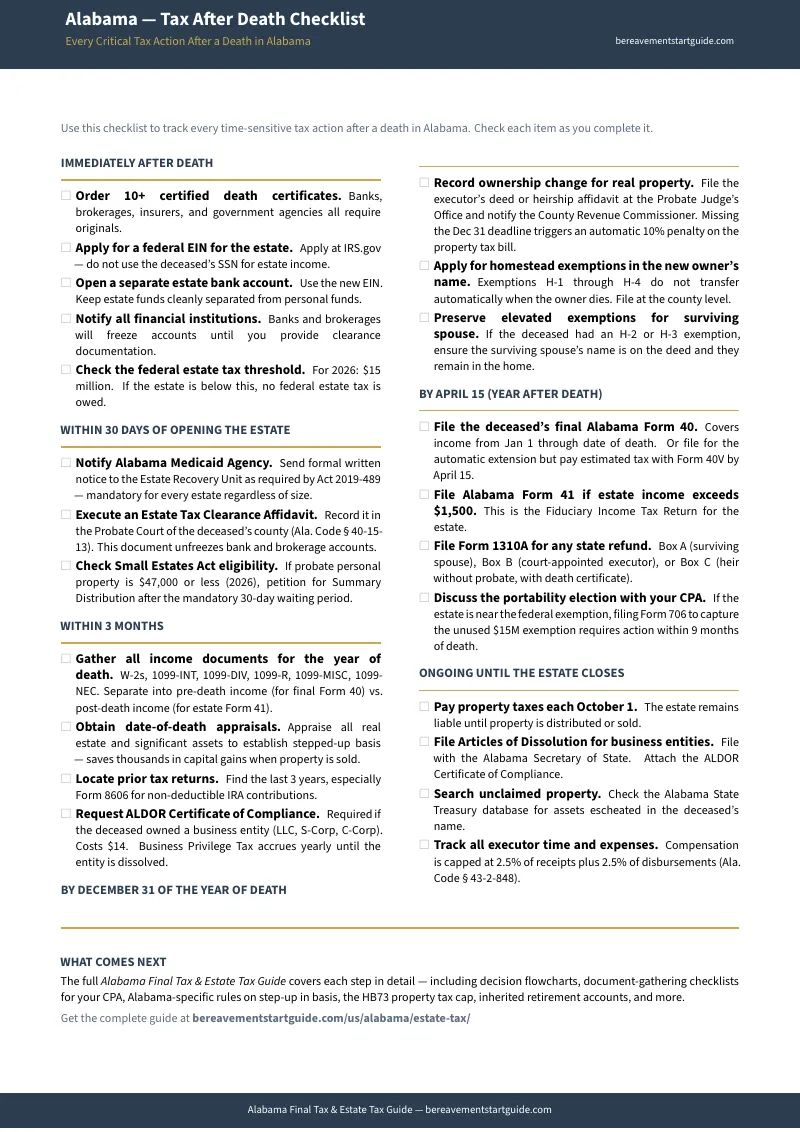
Plus: The Alabama Tax After Death Checklist
A standalone quick-start reference organized by timeframe --- immediately after death, within 30 days, within 3 months, by December 31, by April 15, and ongoing until the estate closes. Every deadline, every form number, every action item. Enough to start immediately, even before reading the full guide.
Plus: 7 Printable Standalone Tools
Every worksheet, reference card, and decision tree you need --- extracted from the guide so you can print them separately and use them at the kitchen table, at the CPA's office, or at the notary:
- Master Deadline Calendar --- Every filing deadline with checkboxes, organized chronologically from the immediate EIN application through final estate closure. Pin it to the wall.
- CPA Document Checklist --- The complete document list organized by category. Bring this to your CPA meeting with everything checked off --- so they spend their time preparing returns, not inventorying what you brought.
- Form Decision Tree --- Visual flowchart for determining which Alabama and federal forms apply: Form 40 vs. Form 41, Form 1310A refund claims, and Form 706 portability elections.
- Step-Up in Basis Worksheet --- Fillable tracker for the basis adjustment on inherited assets, including the 50% common-law rule for jointly owned Alabama property.
- Property Tax Reference Card --- The arrears system, the December 31 notification deadline and 10% penalty, the HB73 assessment cap, and homestead exemption transfers on one printable page.
- Small Estates Worksheet --- Two-column asset classification to determine whether the estate qualifies for summary distribution under the $47,000 threshold.
- Clearance Affidavit Guide --- Step-by-step reference for the estate tax clearance affidavit: the seven required elements, notarization, Probate Court recording, and presentation to financial institutions.
Who This Guide Is For
- The executor who just realized the deceased still owes a tax return --- you have W-2s and 1099s addressed to someone who is no longer alive, you do not know whether to file Form 40 or Form 41, and April 15 is approaching. The guide gives you the filing requirements, the deadlines, and the document list --- organized so your CPA can prepare the returns without billing you for three hours of sorting.
- The surviving spouse navigating the basis trap --- you own the house jointly and know it needs a step-up in basis, but you are not sure whether the entire property steps up or only half. The guide explains that Alabama is a common law state, that only the deceased spouse's 50% receives the basis adjustment, and that you need both a date-of-death appraisal and your original purchase records.
- The adult child sorting through a parent's filing cabinet --- you have a stack of 1099 forms, old tax returns, property tax bills, and retirement account statements. You do not know what is relevant. The guide tells you exactly which documents matter, which ones to discard, and how to sort them into the two piles your CPA needs: pre-death and post-death.
- The trustee managing a trust that survived the grantor --- the trust now generates its own taxable income and requires its own Form 41. The guide covers the $1,500 filing threshold, the Schedule C adjustment, the K-1 requirements, and the Alabama rule that traps excess losses inside the entity.
- The family selling inherited property --- you want to sell the house and need to know your tax exposure. The step-up in basis determines whether you owe $0 or $50,000 in capital gains. But the property taxes are in arrears, the December 31 assessor notification has a 10% penalty, and the homestead exemption may have disappeared the day the owner died.
Why Free Resources Leave You Sorting Receipts at $150 an Hour
The information exists. It is spread across a dozen government websites, a hundred CPA blog posts, and a thousand forum threads. Assembling it into a single actionable sequence --- while you are grieving and a dozen deadlines are running simultaneously --- does not.
- IRS.gov covers federal tax forms. It does not cover Alabama Form 41 thresholds, the estate tax clearance affidavit, the December 31 property tax notification deadline, or any Alabama-specific rule. It covers its own forms and nothing else.
- The Alabama Department of Revenue publishes form instructions for tax professionals, not for executors handling this for the first time. No chronological workflow, no explanation of how state requirements interact with federal filings, no document-gathering protocol.
- CPA firm blogs are designed to generate $200-per-hour consultations. The article tells you enough to realize you need help. No standalone checklist, no chronological roadmap, no document list you can use independently.
- TurboTax and H&R Block assume you already have every document organized and classified. The software calculates math once the data is entered. It offers zero help in locating documents, separating pre-death from post-death income, or determining which forms apply.
- Nolo and LegalZoom provide national overviews. They will not tell you about the Alabama Form 41 Schedule C adjustment, the estate tax clearance affidavit, the $47,000 Small Estates Act threshold, or the December 31 property tax penalty.
Free resources answer one agency's questions. The Deadline Map and Document Organizer answers them all --- in sequence, with deadlines, with the exact forms and documentation, and with the Alabama-specific rules that no single agency or software platform provides.
--- Less Than One Hour of CPA Time
An Alabama CPA charges $120 to $350 per hour for estate and fiduciary work. The typical first meeting --- where the CPA inventories what you brought and tells you what is missing --- costs $300 to $450 before any returns are prepared. The guide costs a fraction of that first meeting and ensures you never need it.
Your download includes 9 PDFs: the complete 17-chapter guide, the Alabama Tax After Death Checklist, and 7 standalone printable tools --- the deadline calendar, CPA document checklist, form decision tree, step-up worksheet, property tax reference card, small estates worksheet, and clearance affidavit guide. Print the standalone tools, use the checklist immediately, and work through the full guide chapter by chapter as each deadline approaches.
Money-back guarantee, no time limit. If the guide does not give you a clear map of every tax obligation, every form, every deadline, and every document you need to gather --- email us for a full refund. No questions asked.
Not ready for the full guide? Download the free Alabama Tax After Death Checklist --- a summary of the most time-sensitive deadlines, form numbers, and action items that most executors do not discover until they are sitting in a CPA's office being billed for the information.
You did not plan to be the person handling the taxes for someone who died. But the April 15 deadline does not care, the December 31 property tax notification has a 10% penalty attached, and every hour your CPA spends sorting paperwork is an hour billed to the estate. This guide turns a fragmented, multi-agency maze into a single organized sequence --- so you walk into your accountant's office prepared, not panicked.
Frequently Asked Questions
What if the rules change after I buy?
We update the guide when the rules change. Email us any time, even years later, and we'll send you the current edition free.