The Funeral Home Said Embalming Is "Required." The Crematory Said Only a Family Member Can Authorize. Your Siblings Cannot Agree on Anything. And the 48-Hour Clock Is Already Running.
Someone just died, and you are the person making the phone calls. You called a funeral home and they quoted you $8,400 for a "standard service package." You asked what that includes, and the answer was a list of items you have never heard of — basic services fee, transfer of remains, preparation, use of facilities — bundled together with no indication of what is optional and what is not. You asked if embalming is required. The answer was vague: "It's standard practice." You asked about cremation, and they said a family member needs to sign an authorization form, but your brother wants a burial and your sister wants cremation and neither one is willing to budge.
Meanwhile, the body is on a clock. Alabama law requires disposition — burial, cremation, or refrigeration — within 48 hours of death. After that, you start paying daily holding fees. The funeral home is not going to mediate the argument between your siblings. Under Alabama Code § 34-13-12, the funeral director can legally follow the instructions of whichever family member showed up first — and they are shielded from liability if they do. If you want to override those instructions, you have to file a written objection before any irreversible action occurs. Nobody told you that. Nobody tells families any of this.
The Alabama Funeral Laws & Consumer Rights Guide is a Consumer Defense Manual for every decision, deadline, and potential overcharge in an Alabama funeral arrangement — from the moment of death through final disposition and regulatory complaints. Not a sympathy resource. Not a blog post written by a funeral home to funnel you into their service packages. A plain-English, Alabama-specific legal reference that tells you exactly what the funeral industry is required to disclose, what they are prohibited from charging, who has the legal authority to make decisions when the family disagrees, and what to do when something goes wrong.
What's Inside the Consumer Defense Manual
An 18-chapter guide, a consumer rights checklist, and the Alabama-specific statutes you need — covering every legal, financial, and procedural question families face during funeral arrangements in the state of Alabama:
Chapter 1: Who Has the Legal Authority to Make Decisions
Before the funeral home meeting, before you sign anything, before you argue with your siblings — you need to know who the law says is in charge. Alabama Code § 34-13-11 establishes a strict statutory hierarchy: designated agent (via notarized affidavit) takes first priority, then surviving spouse, then adult children, then parents, then siblings, then extended kin. The guide covers the full hierarchy, the critical difference between burial authorization (any single person in a priority class can act) and cremation authorization (which requires sworn consent from every member of the same priority class), the forfeiture rules (charged with murder, pending divorce, failure to act within 2-3 days), and what happens when the funeral home follows your brother's instructions because he got there first.
Chapter 2: Death Certificates — How to Get Them, What They Cost, How to Fix Errors
The death certificate is the administrative key to everything: insurance claims, bank accounts, property transfers, court filings. Alabama requires medical certification within 48 hours and registration within 5 days. You will need 8-12 certified copies. First copy costs $15, each additional is $6 when ordered together. Ordering 10 copies in one request costs $69. Ordering them separately costs $150. The guide covers the electronic death registration system, the paper process for home funerals, who is legally permitted to obtain copies (restricted for 25 years), and how to correct errors after filing.
Chapter 3: The 48-Hour Rule — Disposition, Refrigeration, and Body Custody
Alabama mandates that final disposition must occur within 48 hours of death — or the body must be embalmed or placed in continuous refrigeration. This is the rule that creates daily compounding costs when families delay decisions. The guide covers the three legal exceptions, refrigeration standards (35-45°F, no stacking, minimum three-body capacity), the separate 24-hour viewing limit for unembalmed remains, and what this means for your budget if the family needs more than two days to reach agreement.
Chapter 4: Embalming — When It Is Required and When It Is Not
Alabama state law does not require embalming for in-state burial or cremation. Refrigeration is a legal alternative. But funeral homes routinely present embalming as "standard" or "required" — and charge $400 to $800 for a procedure you may not need. The one major exception: Alabama Code § 22-19-2 requires embalming or cremation before transporting a body out of state. The guide covers the exact statutory language, the religious and cultural objections that families raise, and the specific questions to ask the funeral home so you do not pay for a service you did not authorize.
Chapter 5: Cremation Laws and Authorization Requirements
Alabama mandates a strict 24-hour waiting period from the time of death before any cremation can begin — no exceptions, no waivers. The authorization process requires the legally designated next of kin to sign a Cremation Authorization Form disclosing the deceased's identity, the presence of mechanical implants (pacemakers, surgical hardware), and the intended disposition of the cremains. The guide covers who can sign, the sibling consent requirement, what happens when a family member objects in writing, the combustible container requirement (a simple cardboard or pressed-wood container is all that is legally required — any claim that a casket is needed for cremation violates federal law), and the chain-of-custody documentation the crematory must maintain.
Chapter 6: Burial Laws — Permits, Cemeteries, and Home Burial
Alabama has modernized its burial transit rules: the state no longer requires a standalone burial transit permit for in-state movement. A completed death certificate with medical permission serves as legal authorization. The guide covers in-state burial requirements, the out-of-state embalming mandate, cemetery regulations, and the legal requirements for home burial on private property — including minimum distances from water supplies and power lines, depth requirements, and how to file the site with the county probate court to protect the burial ground for future generations.
Chapter 7: Green and Natural Burial
Green burial is legal in Alabama. The state does not require embalming for local disposition and does not require burial vaults or concrete grave liners. But private cemeteries do — their bylaws often mandate vaults as a landscaping maintenance requirement. The guide covers how to locate hybrid cemeteries with vault-free sections, the options for biodegradable containers and shrouds, and what church cemeteries and conservation burial grounds offer in Alabama.
Chapter 8: Body Donation and Anatomical Gifts
If the deceased expressed a wish to donate their body to science, the process involves the Alabama Anatomical Gift Act. The guide covers which institutions accept whole-body donations, the consent requirements, time-sensitive logistics, conditions that disqualify a donation, and the transport exemption that applies to bodies being moved for the purpose of scientific donation.
Chapter 9: Scattering Ashes — What Is and Is Not Allowed
Cremated remains are sterile and pose no public health risk. Alabama has no state law restricting where you may scatter ashes. But federal law, park regulations, and private property rules still apply. The guide covers private land scattering (requires landowner consent), public parks and federal lands (may require a permit from the park superintendent), and maritime scattering along the Gulf Coast — which is governed by the EPA, requires dispersal at least three nautical miles offshore, and requires a written report filed within 30 days.
Chapter 10: What Funerals Cost in Alabama
The chapter that saves families the most money. Budget direct cremation: $895-$1,200. Standard direct cremation through a traditional funeral home: $1,500-$3,500. Cremation with memorial service: $2,500-$4,500. Full-service cremation with embalming and viewing: $4,000-$6,500. Traditional full-service burial: $7,500-$12,000+. The guide breaks down every cost component — basic services fee, transfer of remains, refrigeration vs. embalming, casket vs. combustible container, cemetery fees, grave opening/closing charges, vault requirements — so you can compare quotes line by line and identify charges that should not be there.
Chapter 11: The FTC Funeral Rule — Your Federal Consumer Rights
The Federal Trade Commission Funeral Rule is the single most powerful consumer protection in the funeral industry, and most families have never heard of it. It requires funeral homes to provide an itemized General Price List to anyone who inquires in person. It requires accurate phone quotes without demanding your name. It requires a Casket Price List before showing you any merchandise. It prohibits bundled packages that force you to buy services you do not want. It prohibits handling fees on third-party caskets and urns. It prohibits embalming without explicit authorization. The guide covers every provision and gives you a compliance checklist to use during the funeral home meeting.
Chapter 12: Preneed Funeral Contracts — Rights, Cancellation, and Risks
If the deceased had a prepaid funeral contract, the family often assumes everything is covered. It usually is not. The guide covers the absolute 30-day cancellation window with 100% refund, the financial penalties for canceling after 30 days (trust-funded vs. insurance-funded contracts), the harsh reality that Alabama law does not require other funeral homes to honor a preneed contract's prices, and the irrevocable option that permanently waives cancellation rights — a tactic used during Medicaid asset protection that most families do not fully understand when they sign.
Chapter 13: Filing Complaints Against Funeral Homes
When a funeral home overcharges you, refuses to provide the General Price List, embalms without authorization, or violates any consumer protection law — the Alabama Board of Funeral Services is the regulatory authority. The guide covers the complaint filing process (online portal or physical form), the 20-day response deadline for the funeral home, the Board's investigative and disciplinary powers, and what supporting documents to include with your complaint.
Chapter 14: Casket Rights and Third-Party Purchasing
You have the federal right to purchase a casket from any vendor — online retailers, independent shops, warehouse clubs — and the funeral home must accept it without penalty, handling fee, or markup. The guide covers the specific FTC provisions, how to compare casket pricing across vendors, the difference between rental caskets (for viewing before cremation) and purchase caskets, and the combustible container alternative for cremation that costs $50-$200 instead of thousands.
Chapter 15: Veterans Burial Benefits in Alabama
Eligible veterans can receive a free burial plot at Alabama's national and state veterans cemeteries, a VA burial allowance, a government headstone or marker, a burial flag, and a Presidential Memorial Certificate. The guide covers eligibility requirements, the DD-214 documentation, specific Alabama veterans cemeteries (Montevallo, Fort Mitchell, Spanish Fort), and how to claim each benefit.
Chapters 16-18: Religious Considerations, Board Structure, and Endowment Care Cemeteries
The final chapters cover how Alabama law accommodates religious practices that conflict with standard regulations, the role and authority of the Alabama Board of Funeral Services, and the endowment care requirements that protect families who purchase plots in perpetual-care cemeteries.
Who This Guide Is For
- The family member who just got a funeral home quote that feels wrong — who needs to understand exactly which charges are legally required, which are optional, and which may violate federal consumer protection law. The guide gives you a line-by-line framework for evaluating any General Price List.
- The person trying to arrange a cremation when siblings disagree — who needs to know the exact statutory hierarchy, the cremation consent requirement, and what happens legally when one family member files a written objection. The guide maps every scenario.
- The out-of-state family member navigating Alabama's embalming mandate — who has been told embalming is required before the body can be transported across state lines, and needs to know whether that is true (it is), what it costs ($400-$800), and whether there are alternatives (only cremation before transport).
- The person planning a direct cremation who wants to avoid overpaying — who needs the cost ranges, the questions to ask on the phone, and the federal rules that prevent funeral homes from adding mandatory viewing fees, casket requirements, or handling charges to a basic cremation.
- The family that wants a green burial, home burial, or ash scattering — who needs to know that all three are legal in Alabama, but the practical details — cemetery bylaws, zoning ordinances, EPA maritime rules — determine whether their specific plan will work.
- The executor who discovers a preneed contract and needs to know what it actually covers — who needs the cancellation rules, the portability limitations, and the financial consequences of terminating a contract funded by trust versus insurance.
Why Free Resources Will Not Protect You
Funeral consumer information exists. It is spread across the FTC website in dense regulatory language, the Alabama Board of Funeral Services in bureaucratic form, funeral home blogs written to generate leads, and national platforms that cover Alabama as a footnote. Here is what you actually encounter when you try to protect yourself using free sources:
- The FTC Funeral Rule pages tell you what your rights are. They do not tell you how to use them. The federal regulation is clear: funeral homes must provide itemized pricing, must allow third-party caskets, must not embalm without authorization. But the FTC does not tell you what questions to ask during the meeting, how to read a General Price List, what a "non-declinable services fee" actually covers, or what to do when the funeral director says embalming is "standard practice" for the type of service you selected.
- Funeral home blogs are accurate, detailed, and written by the people selling you services. Every funeral home in Birmingham, Huntsville, and Mobile publishes educational content. Some of it is excellent. All of it exists to drive you into that funeral home's service pipeline. The information subtly steers you toward packages, memberships, and preneed contracts — never toward independent price shopping, third-party casket purchases, or the direct cremation providers who charge half the price.
- National platforms cover Alabama generically. Ever Loved, Cake, and Parting provide useful overviews. None of them cover Alabama's specific 48-hour disposition rule, the Code § 34-13-11 disposition hierarchy with its forfeiture provisions, the mandatory embalming requirement for interstate transport under § 22-19-2, the cremation sibling-consent rule, or the Board's 20-day complaint response deadline. When you are in a dispute with a funeral home, you need statute numbers, not general guidance.
- An attorney solves the problem but costs more than the funeral. A family attorney can resolve a disposition dispute, challenge a fraudulent preneed contract, or file a regulatory complaint. The consultation runs $150-$300 per hour. For straightforward consumer rights questions — "Do I have to pay for embalming?" "Can my brother override my decision?" "Is this charge legal?" — a legal retainer is the most expensive possible way to get a yes-or-no answer.
Free resources give you fragments written by different people for different purposes, with no sequencing, no Alabama-specific statute references, and no advocacy for the consumer. The Consumer Defense Manual puts every Alabama funeral law, every FTC protection, every cost benchmark, and every complaint procedure into one document — organized by the decisions you actually face, in the order you face them.
— Less Than One Hour of Funeral Home Overcharges
The average Alabama family spends $7,500 to $12,000 on a traditional burial. Families who choose direct cremation from a low-overhead provider pay $895 to $1,200 — a difference of $6,000 to $10,000 driven almost entirely by charges that are optional, not required. An embalming you did not authorize: $400-$800. A casket for a cremation that legally requires only a cardboard container: $2,000-$5,000. A burial vault the state does not mandate: $800-$2,500. This guide costs less than any single one of those line items and tells you which ones you can refuse.
Your download includes 10 PDFs: the complete 18-chapter guide, the Alabama Funeral Consumer Rights Checklist, and 8 standalone printable tools — a Disposition Rights Hierarchy reference card, an FTC Compliance Checklist for the funeral home meeting, a Funeral Cost Comparison Worksheet for evaluating quotes, a Cremation Authorization Guide with step-by-step instructions, a Preneed Contract Rights Reference, a Complaint Filing Guide, a Home Burial Requirements checklist, and a Veterans Benefits Reference. Print the ones you need. Use them independently or alongside the full guide.
Money-back guarantee, no time limit. If the guide does not give you clarity on your rights, your options, and the specific Alabama laws that protect you — email us for a full refund. No questions asked.
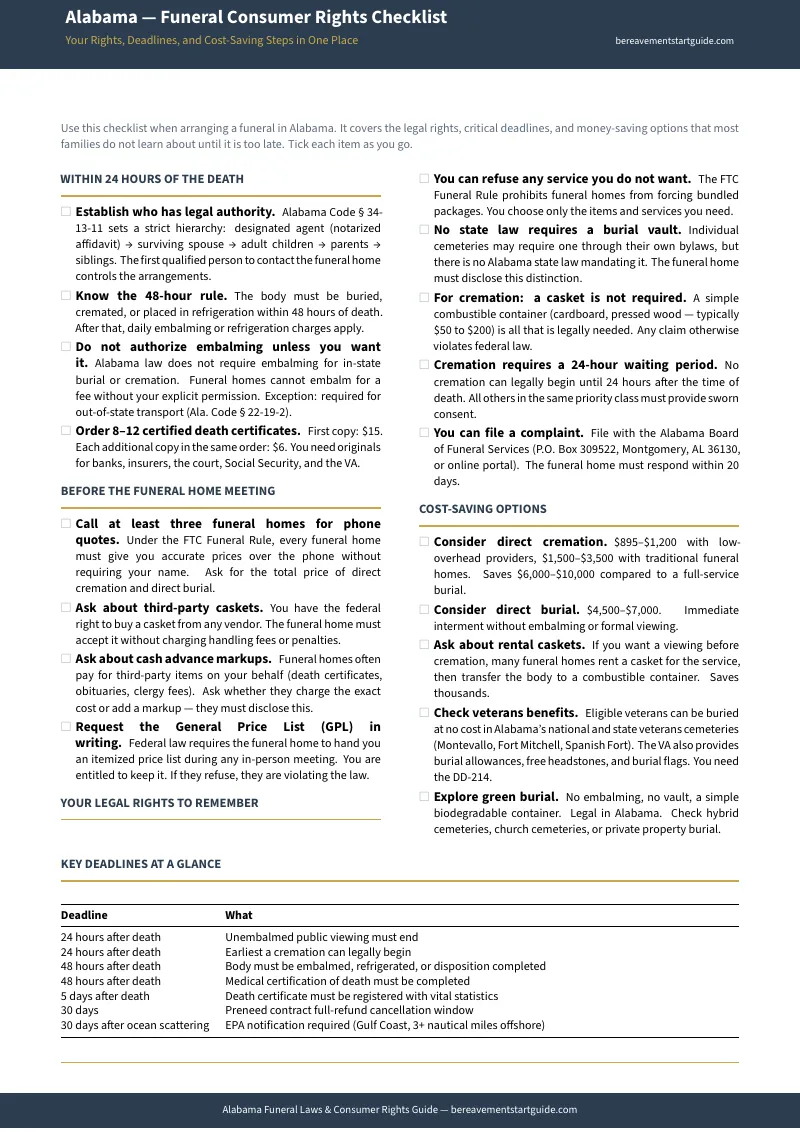
Not ready for the full guide? Download the free Alabama Funeral Consumer Rights Checklist — a summary of the key rights, deadlines, and cost-saving steps that most families do not learn about until it is too late. Enough to walk into a funeral home meeting with your eyes open.
You did not choose this situation. But you can choose to walk into it informed. The guide gives you the laws, the numbers, and the leverage — so the funeral home meeting is a negotiation, not a surrender.
Frequently Asked Questions
What if the rules change after I buy?
We update the guide when the rules change. Email us any time, even years later, and we'll send you the current edition free.