The Bank Said You Need "Letters Testamentary." The County Clerk Said She Cannot Tell You How to Get Them. You Are Holding a Will That Apparently Means Nothing Until a Judge Says It Does.
You thought the hard part was the funeral. Then you walked into the bank with the death certificate, the original will, and your driver's license, and the teller said the account is frozen until you produce Letters Testamentary. You had never heard that phrase before Monday. You went to the county probate court to ask how to get them, and the clerk handed you a form and told you — politely, firmly — that the court cannot give you legal advice. She cannot tell you how to fill it out, which boxes to check, what to attach, or what happens after you file it. That is the law in Alabama: every probate court in the state is prohibited from telling you how to use the forms they hand you.
So now you are home with a blank petition, a frozen bank account, a will that everyone keeps telling you "needs to be probated," and a growing sense that you are going to get this wrong. Maybe you will file the petition incorrectly and waste weeks waiting for a rejection you could have prevented. Maybe you will miss the 60-day inventory deadline you did not know existed. Maybe you will distribute assets before the six-month creditor window closes and discover, months later, that you are personally liable for debts the estate should have paid. Maybe a sibling will contest the will and you will learn — too late — that you should have requested a formal probate hearing instead of the informal one that seemed faster. Or maybe the estate is small enough that you did not need to file any of this. Maybe the $47,000 summary distribution threshold would have saved you months of court proceedings, and you are about to spend thousands of dollars on a process you could have avoided entirely.
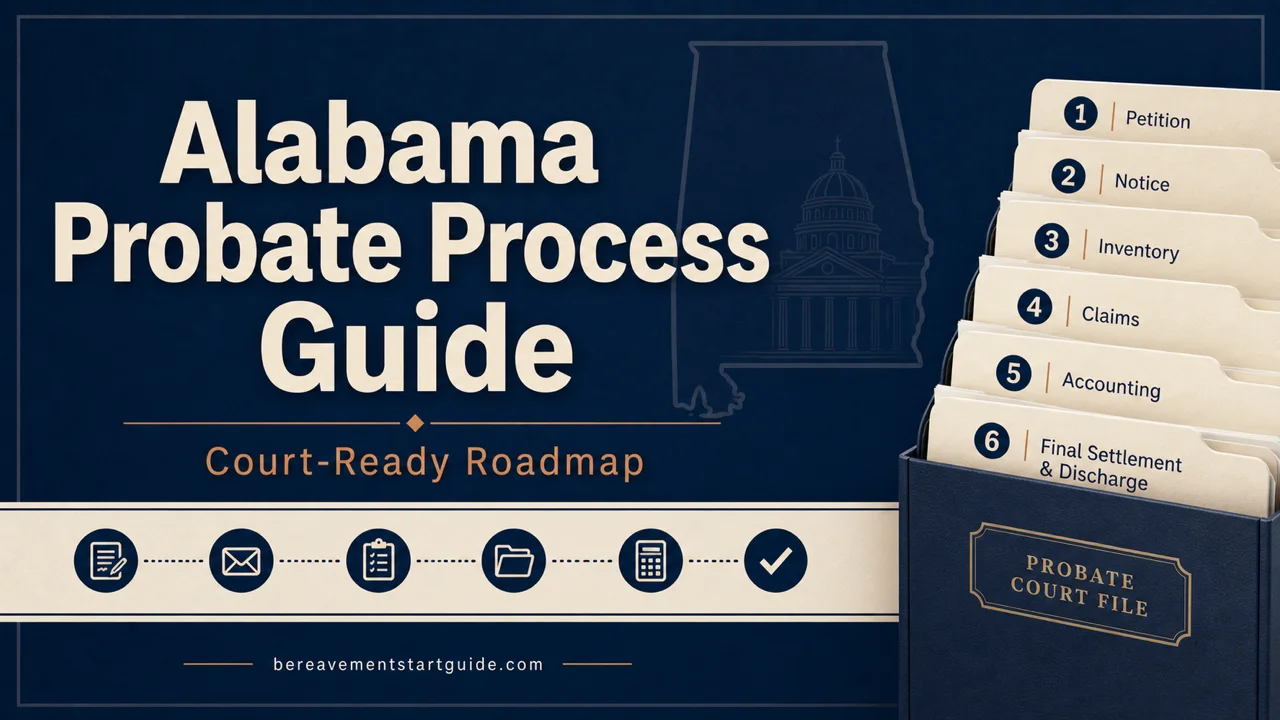
The Alabama Probate Process Guide is a Court-Ready Roadmap for every filing, hearing, deadline, and decision in an Alabama probate case — from the initial petition through final distribution and estate closing. Not a generic overview written for all 50 states. Not a blog post designed to convince you that probate is too dangerous to attempt without a $5,000 retainer. A plain-English, Alabama-specific manual that tells you exactly what the county clerk cannot: which forms to file, when to file them, what to attach, what happens next, and which mistakes will cost you money or expose you to personal liability.
What's Inside the Court-Ready Roadmap
A step-by-step guide, a filing-readiness checklist, and standalone reference sheets — covering every phase of probate in Alabama from opening the case through final discharge, built on Alabama Code Title 43 and the specific county-level rules that make this process different from any other state:
Before You File: Does the Estate Actually Need Probate?
This is the question that determines whether you spend six months in court or six weeks completing a simplified process. Alabama's Small Estates Act — revised effective October 2025 under Act 2025-431 — allows estates to bypass formal probate entirely through summary distribution if the estate contains no real property and the total personal property value falls below the combined statutory allowances: $18,800 Homestead Allowance plus $18,800 Exempt Property plus $9,400 Family Allowance, totaling $47,000 for 2025 and 2026. But there are hard disqualifiers. Any real estate solely in the deceased's name disqualifies the estate regardless of value. Outstanding debts that have not been arranged disqualify it. The guide includes a decision tree that walks you through the exact criteria — so you do not file a full probate petition for an estate that qualifies for the shortcut, and you do not attempt summary distribution on an estate that does not qualify.
Testate vs. Intestate: Two Different Processes, Two Different Sets of Rules
If the deceased left a will, the process is called testate probate. You petition the court to validate the will, and the judge grants you Letters Testamentary — the document that gives you legal authority to act on behalf of the estate. If there was no will, the process is intestate administration. The court appoints an administrator, grants Letters of Administration, and Alabama's intestate succession statute — Code Section 43-8-41 — dictates exactly who inherits what. The statutory formulas are rigid and frequently contradict what the family expected. A surviving spouse with children from both spouses receives the first $50,000 plus half the remainder. A surviving spouse with stepchildren receives only half. A surviving spouse with no children but surviving parents receives the first $100,000 plus half, and the parents take the rest. The guide covers both paths end to end, because the forms are different, the bond requirements are different, and the distribution rules are different.
Filing the Petition: What the Court Needs and What Triggers a Rejection
The petition to open probate is not a single form — it is a package. You need the original will (if there is one), a certified death certificate, the proposed executor or administrator's personal information, a list of known heirs and beneficiaries, and the estimated value of the estate. If only a copy of the will exists, you need witness testimony or an affidavit establishing the original's absence. If the will is "self-proved" — meaning it includes a notarized self-proving affidavit, which Alabama has allowed since 1982 — the process is faster because the court does not need to examine the witnesses. If it is not self-proved, you may need the attesting witnesses to appear or submit affidavits. The guide walks through both scenarios and the specific requirements that vary by county.
The Bond: Who Needs One, What It Costs, and How to Get It Waived
Alabama requires personal representatives to post a surety bond — a financial guarantee protecting the estate from mismanagement. The bond amount is typically set at the estate's total value plus estimated annual income. For a $100,000 estate, that is a $100,000 bond, with annual premiums running $500 to $1,500. But many wills contain a "waiver of bond" clause that eliminates this requirement entirely. If the will waives the bond, you need to know how to invoke that provision in your petition. If the will does not waive it — or if there is no will — you need to understand bond alternatives and what happens if you cannot secure one. Intestate estates almost always require a bond, adding a significant upfront cost that catches families off guard.
Letters Testamentary and Letters of Administration: What They Are, What They Unlock
These are not forms you download. They are judicial decrees — official documents issued by the probate judge after the court approves your petition, validates the will (or confirms your appointment as administrator), and is satisfied that the bond requirement has been met or waived. They are the key that unlocks every frozen bank account, every insurance claim, every real estate transaction, and every vehicle title transfer. Without them, no institution will release a dollar or transfer a title. The guide explains the prerequisites, the timeline between filing and issuance, what delays them, and what to do if the court requires a hearing before granting them.
The 60-Day Inventory: What You Must Report and What You Can Skip
Within 60 days of receiving your Letters, Alabama Code Section 43-2-835 requires you to file a detailed inventory with the court listing every asset the deceased owned at death, valued at fair market value, along with any encumbrances. Miss the 60-day deadline, and the judge has grounds to remove you as personal representative. But here is the exception most executors do not know about: if the will contains an express inventory waiver, the court will generally honor it — unless it suspects waste or mismanagement. Even with a waiver, an informal inventory is critical for tax purposes and beneficiary accounting. The guide explains how to identify the waiver clause, how to file the inventory if required, and how to organize asset valuations systematically.
Notice to Creditors: The Most Dangerous Phase for Executors
Within 30 days of your appointment, you must publish a Notice to Creditors in a local county newspaper once a week for three consecutive weeks. You must also send direct written notice to every known or reasonably ascertainable creditor. And you must separately notify the Alabama Medicaid Agency — electronically or by mail to P.O. Box 5624 — with the deceased's full legal name, date of birth, and date of death. This triggers a distinct 30-day clock for Medicaid that runs independently of the general six-month creditor period. If Medicaid does not respond within 30 days, their claim is permanently waived. But if you skip this notification entirely, the Medicaid claim stays alive indefinitely. The guide maps every notification requirement, every deadline, and the specific consequences of getting any of them wrong.
The Six-Month Creditor Window: Why Patience Protects You
After the first Notice to Creditors is published, a mandatory six-month holding period begins. During this window, known and unknown creditors can file claims against the estate. You cannot safely distribute any assets to beneficiaries until this window closes. Distributing early is the single most financially dangerous mistake an executor can make — if a creditor files a valid claim after you have already distributed the money, you are personally liable for the shortfall. The guide explains the creditor priority hierarchy: funeral expenses first, then administrative costs, then last-illness medical bills, then taxes, then general claims. It also explains what happens when the estate does not have enough to pay everyone — and how to protect yourself in that scenario.
Real Estate in Probate: Court Approval Before You List the House
If the deceased owned real property solely in their name, you cannot simply call a real estate agent and list it. If the will does not include an explicit "power of sale" clause, you must petition the court under Alabama Code Section 43-2-443 for specific authorization to sell. This process may require professional appraisals, written consent from adult heirs, and potentially a public auction. The guide covers when court approval is required, when the will grants independent sale authority, and the specific procedural steps for each scenario — including what happens when heirs disagree about selling.
Closing the Estate: Final Accounting and Discharge
Probate does not end when you distribute the assets. You must file a final accounting with the court showing every dollar that came in, every dollar that went out, and every asset distributed to every beneficiary. If the accounting is approved, the court issues a discharge order that formally releases you from your fiduciary duties. If you skip this step, your personal liability as executor never technically ends. The guide covers the accounting format, what the judge looks for, and how to petition for formal discharge.
Who This Guide Is For
- The executor who just received the will and has no idea what to do with it — who needs to understand that a will is legally inactive until validated by an Alabama probate judge, and that the process between "holding the will" and "having legal authority" involves specific filings, potential hearings, a bond, and a judicial decree
- The surviving spouse whose bank accounts were frozen this morning — who needs Letters Testamentary or Letters of Administration to unlock those accounts and cannot afford to wait months because the petition was filed incorrectly or the bond was not arranged
- The family with no will navigating intestate succession — who needs to understand exactly who the court will appoint as administrator, what bond is required, and how Alabama's statutory inheritance formulas will divide the estate among the spouse, children, and parents
- The adult child managing probate from out of state — who is filing in an Alabama county court remotely and needs every form, every deadline, and every county-specific requirement in one document instead of calling the clerk's office repeatedly and getting the same answer: "We cannot give legal advice"
- The executor facing a potential will contest — who needs to understand the difference between informal and formal probate, when to request a hearing, what constitutes valid grounds for contest, and how to protect the estate during the challenge
- The family trying to determine whether probate is even necessary — who needs the decision tree that maps the $47,000 summary distribution threshold, the real estate disqualifier, and the specific criteria that separate a six-month court process from a six-week simplified alternative
Why Free Resources Will Not Get You Through This
Alabama probate information exists. It is scattered across 67 county probate court websites, a state e-forms portal that covers adoptions and guardianships better than it covers estate administration, attorney blog posts designed to generate retainer clients, and national platforms that treat Alabama like a footnote. Here is what you actually encounter when you try to navigate probate using free sources:
- County probate courts hand you forms and tell you they cannot help you fill them out. This is not rudeness — it is Alabama law. Probate clerks are statutorily prohibited from providing legal advice. Jefferson County publishes fee schedules. Mobile County posts an administrator handbook. But every court explicitly directs you to retain counsel. If the estate is $30,000 and the attorney quotes $4,000, that is 13% of the estate consumed by legal fees — and the court offers no alternative guidance.
- The state e-forms portal is incomplete for probate. The Alabama Administrative Office of Courts provides electronic forms for adoptions, grandparent visitation, and limited civil matters. Comprehensive, statewide probate forms for opening and closing estates do not exist in a unified database. You are left piecing together forms from county-specific repositories with county-specific rules and county-specific formatting requirements.
- Legal Aid serves low-income residents, not the middle-class executor. Legal Services Alabama and the Justice4AL initiative provide vital services — for people who meet poverty-level income qualifications. The family handling a $50,000 estate does not qualify. They fall into the gap between free legal help and affordable legal help, which is precisely where this guide lives.
- Attorney blog posts are accurate, detailed, and designed to sell you representation. Every probate attorney in Birmingham, Huntsville, and Mobile publishes content explaining how complex and dangerous the process is. For contested estates, that is true. For the straightforward estate where the will is clear, the heirs agree, and the assets are modest — the post never quite tells you that you can do this without a $5,000 retainer. It always ends with "call our office for a free consultation."
- National platforms like LegalZoom charge hundreds and miss Alabama-specific rules. LegalZoom offers access to probate attorneys for $300 to over $1,000. Their articles cover probate in general terms. They do not cover Alabama's revised $47,000 small estates threshold, the Medicaid notification requirement under Act 2019-489, the 30-day Medicaid response clock, the county-specific filing fee variations, or the self-proved will procedures. Alabama Title 43 has its own rules, and generic platforms do not know them.
Free resources give you fragments from a dozen sources that do not reference each other, do not sequence the steps, and cannot tell you which rules apply to your county. The Court-Ready Roadmap puts every Alabama probate statute, form, deadline, and county requirement into one document, in the order you actually need them.
— Less Than Thirty Minutes With an Alabama Probate Attorney
A consultation with an Alabama probate attorney runs $150 to $300 per hour. Full probate representation costs $3,840 to $5,760 for a standard estate. National estate platforms charge $149 or more per year in recurring subscriptions. This guide costs less than thirty minutes of professional legal time and gives you the complete Alabama-specific probate roadmap — every filing requirement, every deadline, every county fee variation, and the decision tree that tells you whether you need formal probate at all.
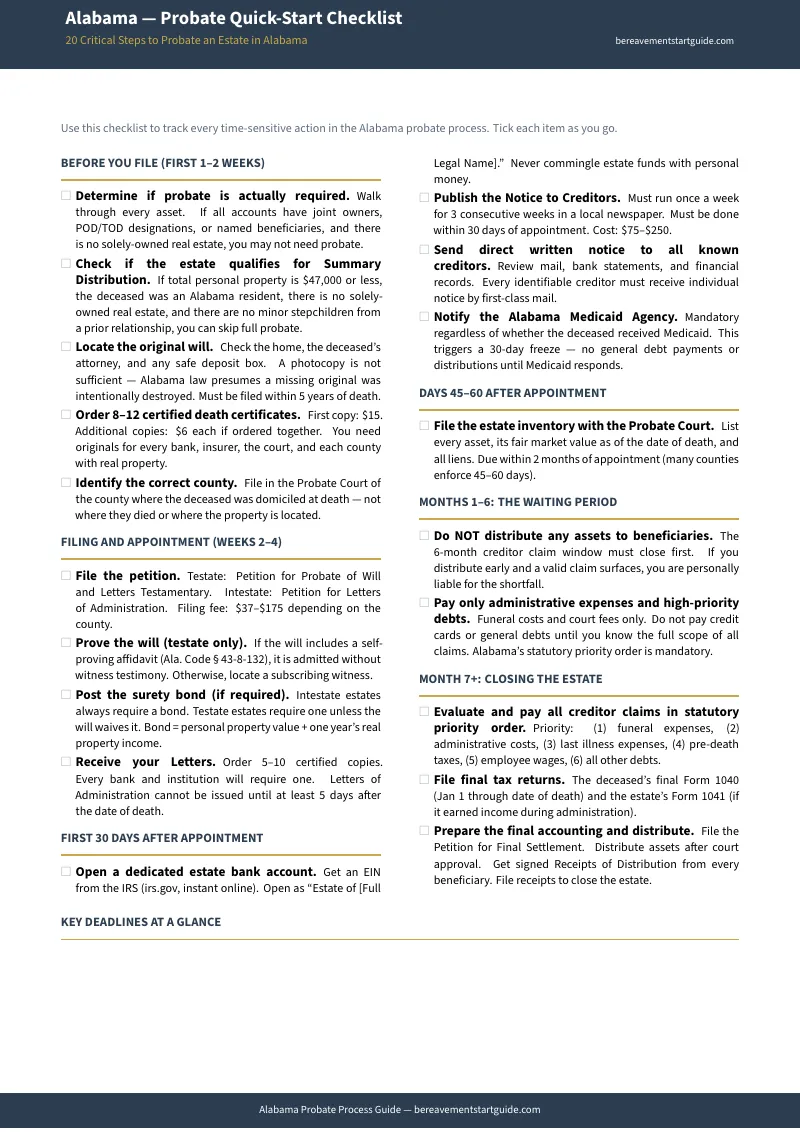
Your download includes the complete step-by-step guide covering testate and intestate probate, the standalone Alabama Probate Filing-Readiness Checklist, and printable reference sheets: the Probate vs. Summary Distribution Decision Tree, Executor Duties Timeline (every statutory deadline from Day 1 through Month 12), Notice to Creditors Template and Compliance Guide, Creditor Priority Reference, Inventory Preparation Worksheet, and County Filing Fee Reference. Instant download, no account required.
Money-back guarantee, no time limit. If the guide does not give you clarity on what to file, when to file it, and what happens next — email us for a full refund. No questions asked.
Not ready for the full guide? Download the free Alabama Probate Quick-Start Checklist — an overview of the probate process and the key deadlines, decisions, and documents you need to have ready before you walk into the county courthouse. Enough to understand what you are facing and whether you need the full guide.
Probate is not something you were trained for. But it is something you can get through with the right instructions. The guide gives you those instructions, one filing at a time.
Frequently Asked Questions
What if the rules change after I buy?
We update the guide when the rules change. Email us any time, even years later, and we'll send you the current edition free.